Symposium · Philosophy in Fiction · Pl. 9Jonathan Swift · 1667–1745
Reason Without Passion
A country with no word for lying
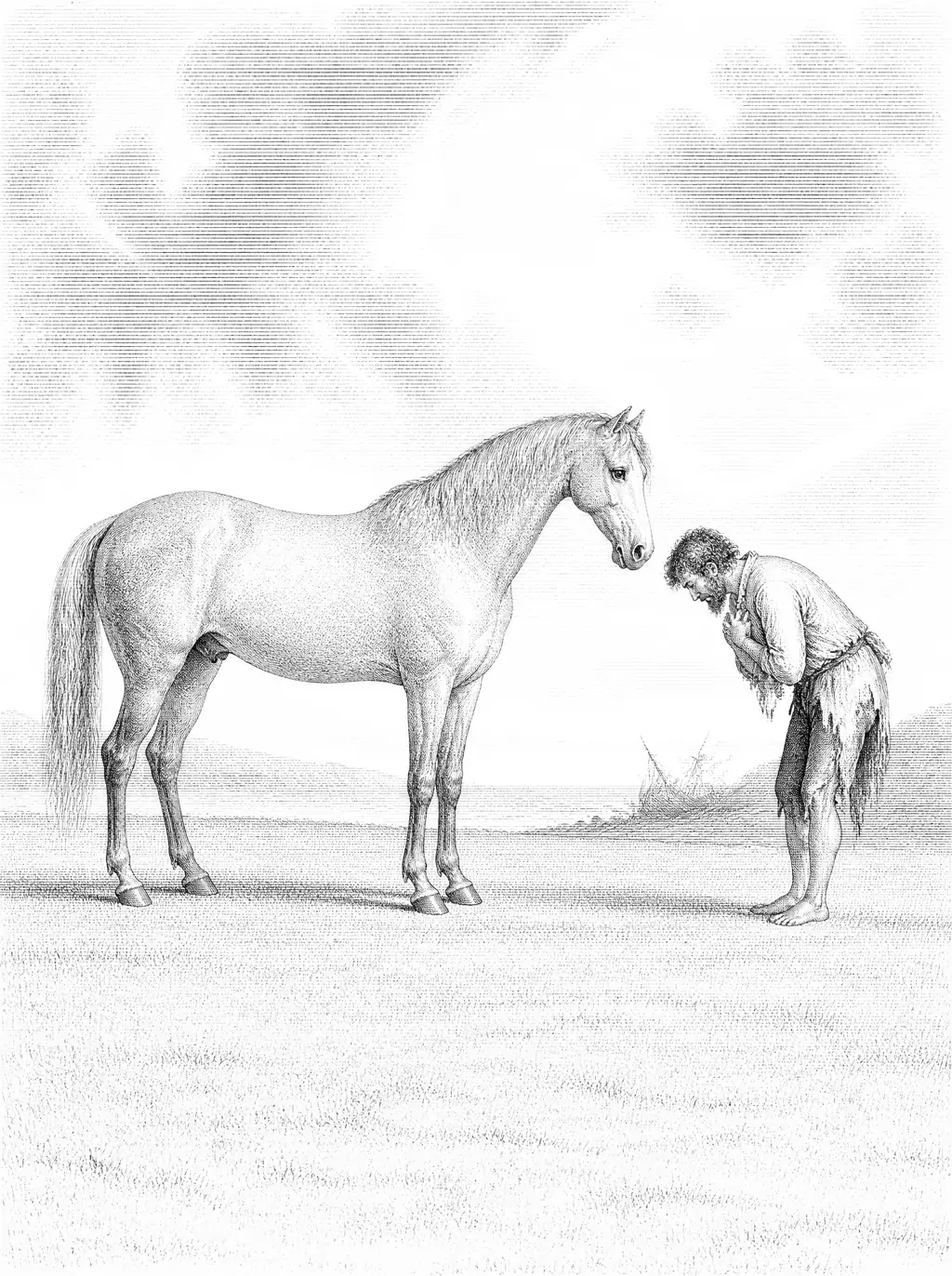
On his fourth voyage Gulliver is put ashore among the Houyhnhnms, a nation of horses who live wholly by reason, and the Yahoos, filthy human animals who live wholly by appetite. The horses are calm, truthful, and temperate. They have no lawyers, no money, no wars over doctrine, and no word for lying; the nearest they can manage is the thing which is not. Gulliver, who has spent three voyages measuring other people, decides at last that he has found the standard. The trouble begins when he tries to carry it home.
The world it came from
The character is Gulliver, a ship's surgeon and the narrator of Jonathan Swift's Travels into Several Remote Nations of the World, published anonymously in 1726. Swift was Dean of St Patrick's in Dublin, a political writer who had watched party fury, financial bubbles, and religious quarrel at close range. Part Four arrives after Lilliput, Brobdingnag, and the flying island, each of which has already shrunk human self-regard by another degree. Behind the horses stands the age's confidence that reason alone can settle conduct, a confidence Swift disliked in both its Christian and its freethinking forms, and which he here builds a whole society out of.
The idea
The Houyhnhnms embody a proposal: that reason, if it were unmixed with passion and interest, would not merely guide conduct but decide it, the way arithmetic decides a sum. Among them a question does not have two plausible sides. Reason strikes with immediate conviction, so opinion and dispute never arise, and neither do the vices that grow in the gap between what a person believes and what they want. The result is a society without cruelty, deceit, or ambition. It is also a society without love as we know it, without grief, without art, and without any reason to prefer one's own child.
How the reasoning runs
Swift builds the case in two directions at once. Positively: if reason is a faculty for finding truth, and if truth is single, then two rational creatures with the same evidence must reach the same conclusion. Disagreement therefore proves that something other than reason is operating, namely passion or interest. Remove those and disputes vanish; with disputes go law, faction, and war. That is the horses. Negatively: the Yahoos show the same creature with the reason subtracted, and they are unbearable. Gulliver draws the obvious inference, that humans are Yahoos with just enough reason to be worse. The book then quietly declines to endorse it.
Seen in life
A hiring committee argues for an hour and splits three to two. Everyone believes they are weighing the evidence; everyone can name the reason the other side is wrong. Afterwards you notice that each vote lines up with who would gain from it. Swift's horses would find the meeting incomprehensible, because for them the evidence would already have settled the matter. The uncomfortable half of the joke is that they would also find the committee's warmth incomprehensible: the loyalty to a candidate someone had mentored, the reluctance to wound a colleague. Both the corruption and the kindness come from the same place, and neither survives the operation.
Why it matters
The fantasy of pure rationality keeps returning: in Enlightenment schemes of government, in utilitarian calculation, in economic models of the agent, and now in arguments about artificial minds that would decide without appetite. Swift got there first and made the picture concrete enough to test. His horses are not a straw target; they genuinely are better than us on every count he lets them be measured on. The book's contribution is to show what the improvement costs, and to leave the reader unable to say whether the price is too high or whether refusing to pay it is simply another Yahoo appetite.
“their grand maxim is, to cultivate reason, and to be wholly governed by it”
From the source
In Part Four, Chapter Eight, Gulliver reports on Houyhnhnm education and morals. Endowed by nature with a disposition to every virtue, and having no conception of evil in a rational creature, “their grand maxim is, to cultivate reason, and to be wholly governed by it.” Reason among them, he adds, is no point problematical as with us, where men can argue with plausibility on both sides of a question, but strikes with immediate conviction, as it must where it is not mingled, obscured, or discoloured by passion and interest. He then admits he had extreme difficulty making his master understand the word opinion, or how a point could be disputable at all.
The pushback
Read straight, the episode is incoherent as praise. The Houyhnhnms practise eugenics, plan to exterminate the Yahoos, feel no more for their own foals than for a neighbour's, and expel the one creature who loves them. A society that calm is not virtuous; it is simply unable to want anything badly enough to do wrong. Worse, Gulliver's conversion ruins him. He ends the book unable to endure the smell of his wife, talking to his horses in the stable, and readers have argued for three hundred years about whether Swift is mocking humanity, mocking Gulliver, or has lost control of his own satire.
The reply
The best answer is that the incoherence is the argument. Swift gives you two options, the Yahoo and the Houyhnhnm, and makes both unliveable, so that a reader looking for a third has to construct it themselves. Gulliver is the warning attached: he is a man who took a satire literally and adopted a standard no human can meet, and his madness is what that costs. On this reading the target is not reason but the demand for purity, in politics as much as in ethics. Swift does not tell you where the mean lies. He removes the two places it certainly does not.
Where it went next
Part Four turned Swift's reputation toxic for a century; Thackeray called the book blasphemous and told readers to shut it. Twentieth-century criticism split into hard and soft schools, one taking the horses as Swift's ideal and one taking them as a further satire, and the quarrel has never closed. George Orwell wrote an essay attacking the Houyhnhnms as a totalitarian utopia while admitting he had read the book six times. The episode now anchors discussions of value alignment in artificial intelligence, where a perfectly rational agent with no passions turns out to raise exactly Swift's question about the Yahoos.
Where this leads
The Stoic slogan of living according to nature is what the Houyhnhnms actually achieve, which makes them the best available test of it: this is what a whole society of sages would look like from the inside, and Swift wants you to notice the chill. The Stoic claim that the wise man is unshaken meets the same test and comes off no better. Hobbes runs the other half of the experiment. His state of nature is the Yahoo field, and his solution, a sovereign imposed from above, is the arrangement the horses do not need because nothing in them ever pulls the wrong way.