Symposium · Philosophy in Fiction · Pl. 7Fyodor Dostoevsky · 1821–1881
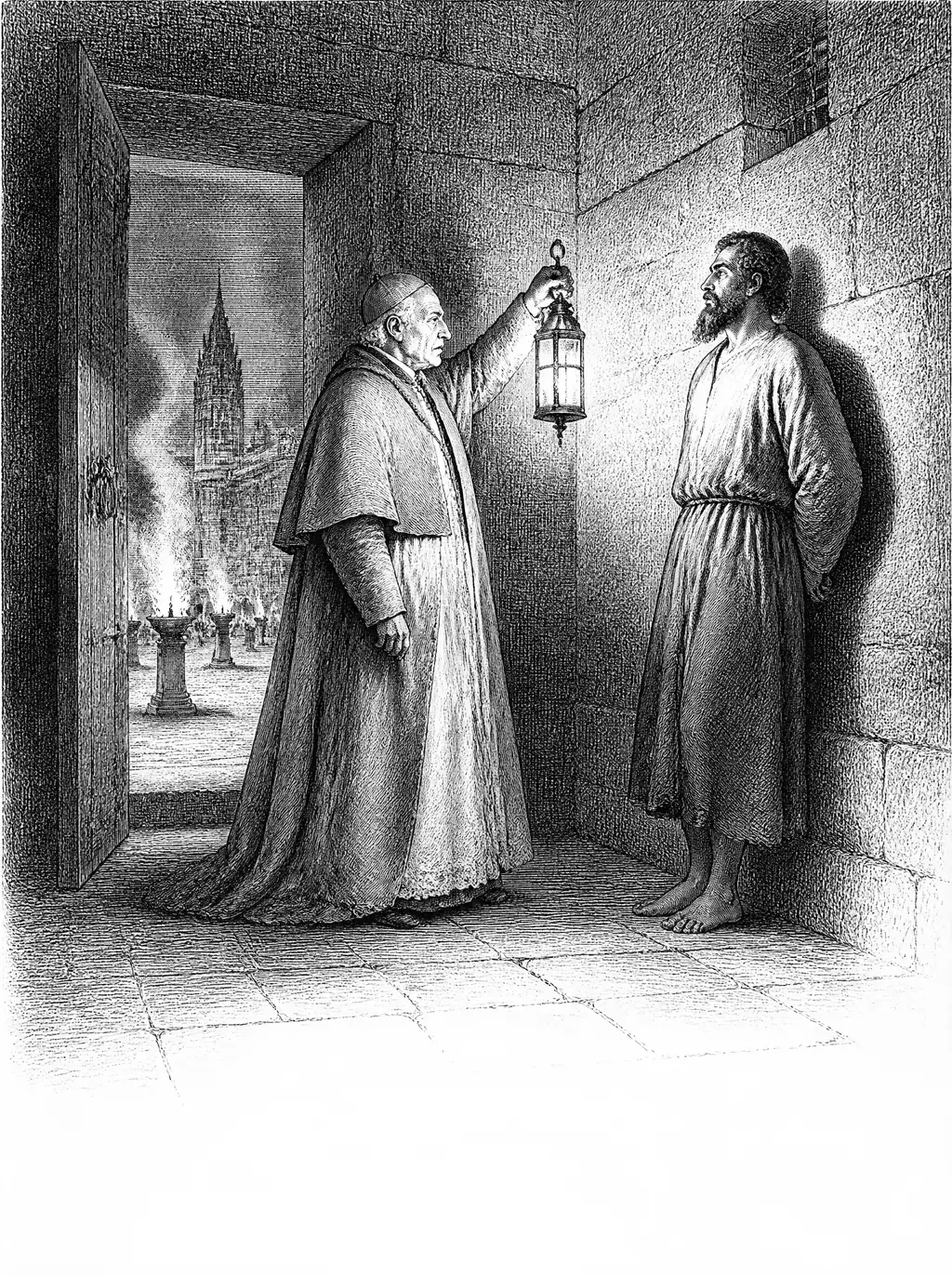
The Grand Inquisitor
The prisoner who says nothing
Ivan Karamazov tells his younger brother a story he has been composing in his head. Christ returns to Seville at the height of the Inquisition, is recognised in the street, and is arrested that evening by a cardinal of ninety. The old man visits the cell alone and talks all night. His charge is not heresy. It is that Christ overestimated people by offering them freedom, and that the Church has been quietly repairing the error ever since by taking that freedom back and handing out bread instead. The prisoner listens and never answers. At the end he kisses the old man on his bloodless lips.
The world it came from
The Brothers Karamazov appeared in 1880, the year before Dostoevsky died. The chapter belongs to Ivan, the middle brother, an educated unbeliever who has just told Alyosha, a novice monk, that he accepts God but returns his ticket to a world built on the suffering of children. The Grand Inquisitor is the poem Ivan offers as his second move. Russia in the 1870s was arguing about socialism, about whether bread or liberty came first, and about a Church tied to the state. Dostoevsky, who had faced a firing squad and served four years in a Siberian prison camp, wrote the strongest case against his own faith and put it in the mouth of a character he meant to refute.
The idea
The Inquisitor's claim is that human freedom is a burden most people cannot carry, and that loving them means lifting it off. In the wilderness, he says, the tempter offered Christ three things and Christ refused all three: bread, miracle, and earthly authority. Those three were the answer. People will not choose well when left free; they will starve, or follow the first confident voice, or tear each other apart deciding. So the Church took the tempter's offer instead, feeds them, awes them, rules them, and carries the guilt of the deception itself. The many are happy. The few who know are damned, and accept it.
How the reasoning runs
The argument is a piece of political reasoning dressed as theology. Premise one: freedom of conscience is the heaviest thing a person can be handed, because it makes every choice yours to answer for. Premise two: most people, hungry and frightened, will trade it for security without hesitation, and history keeps showing this. Premise three: a ruler who knows both facts and still insists on freedom is choosing his principle over their happiness. Conclusion: mercy requires the deception. Notice that the Inquisitor never claims his story about the world is false. He claims it is true and that Christ, who knew it too, loved humanity too abstractly to act on it.
Seen in life
The chapter reads like a description of every system that asks you to hand over a decision in exchange for calm. A subscription service that curates so you never face a blank shelf. A workplace that removes the choice about where you sit, when you work, what you optimise. A government that meets an emergency with a rule rather than an argument, and finds afterwards that the rule is popular. In each case someone has decided that the burden of choosing was doing you no good. The Inquisitor's uncomfortable point is that this is not always cynicism. Sometimes the people who take the choice away have looked hard and concluded you would be happier.
Why it matters
This is the most quoted attack on freedom ever written by a defender of it, and it has outlived the theology it was framed in. Twentieth-century readers found the totalitarian state described before it existed, complete with the argument its own leaders would use. Political philosophers cite it wherever paternalism is at issue: the question of whether a government may act for your good against your judgment is the Inquisitor's question in secular dress. It also set a standard for intellectual honesty. Dostoevsky gave his opponent the best speech in the book and let it stand unanswered.
“No science will give them bread so long as they remain free. In the end they will lay their freedom at our feet”
From the source
The Inquisitor tells his prisoner that hunger will finish what argument began, and that no science can feed a free people. “No science will give them bread so long as they remain free. In the end they will lay their freedom at our feet, and say to us, ‘Make us your slaves, but feed us.’” They will do it gladly, he says, because they will finally understand that freedom and bread enough for everyone cannot be had together. Christ answers none of this. He rises, kisses the old man, and the Inquisitor shudders, opens the door, and tells him to go and never come again. The kiss, Ivan says, glows in the old man's heart, but he does not change his idea.
The pushback
Doesn't the chapter cheat by giving one side a speech and the other side a kiss? Ivan's Inquisitor gets pages of tight reasoning; Christ gets a gesture, which is not a reply to an argument but a refusal to have one. Readers from D. H. Lawrence onward have concluded that Dostoevsky lost control of his own case and half agreed with the old man. A second objection cuts at the premise. The claim that most people cannot bear freedom is an empirical one, and the Inquisitor supports it with rhetoric rather than evidence, from a position that would benefit if it were true.
The reply
Dostoevsky's defenders answer that the kiss is the point, not an evasion. An argument that a person is unfit for freedom cannot be defeated by a better argument, since anyone who follows the argument has already shown the capacity in question; it can only be defeated by treating the arguer as free, which is what the kiss does. The novel then answers in its own currency, through Alyosha and the elder Zosima, where active love is shown rather than proved. On the empirical objection the reply is partial. Dostoevsky does not establish that people can bear freedom. He stakes the book on it.
Where it went next
Freud called The Brothers Karamazov the greatest novel ever written and this its summit. Camus put the Inquisitor at the centre of The Rebel. Orwell's O'Brien, explaining the Party to Winston Smith, is the old man with the mercy removed, and Huxley's World Controller in Brave New World is the same figure with the mercy left in. Berdyaev, Rozanov, and later Vasily Grossman all wrote about the chapter directly. It is quoted in arguments about surveillance, about public health orders, about content moderation, and about anything else where safety is offered on the condition that somebody else decides.
Where this leads
Everything is lawful is Ivan's other proposition from the same novel, the one Smerdyakov takes literally and acts on, and reading it beside this chapter shows how far Dostoevsky was willing to follow an idea he rejected. The state of nature is Hobbes making the Inquisitor's bargain in the open and without apology, arguing that people will hand their liberty to a sovereign because the alternative is worse. The general will shows Rousseau reaching the strangest version of the trade, where a citizen who resists the collective decision is, in his phrase, forced to be free.