Symposium · Existentialism · Pl. 5Fyodor Dostoevsky · 1821–1881
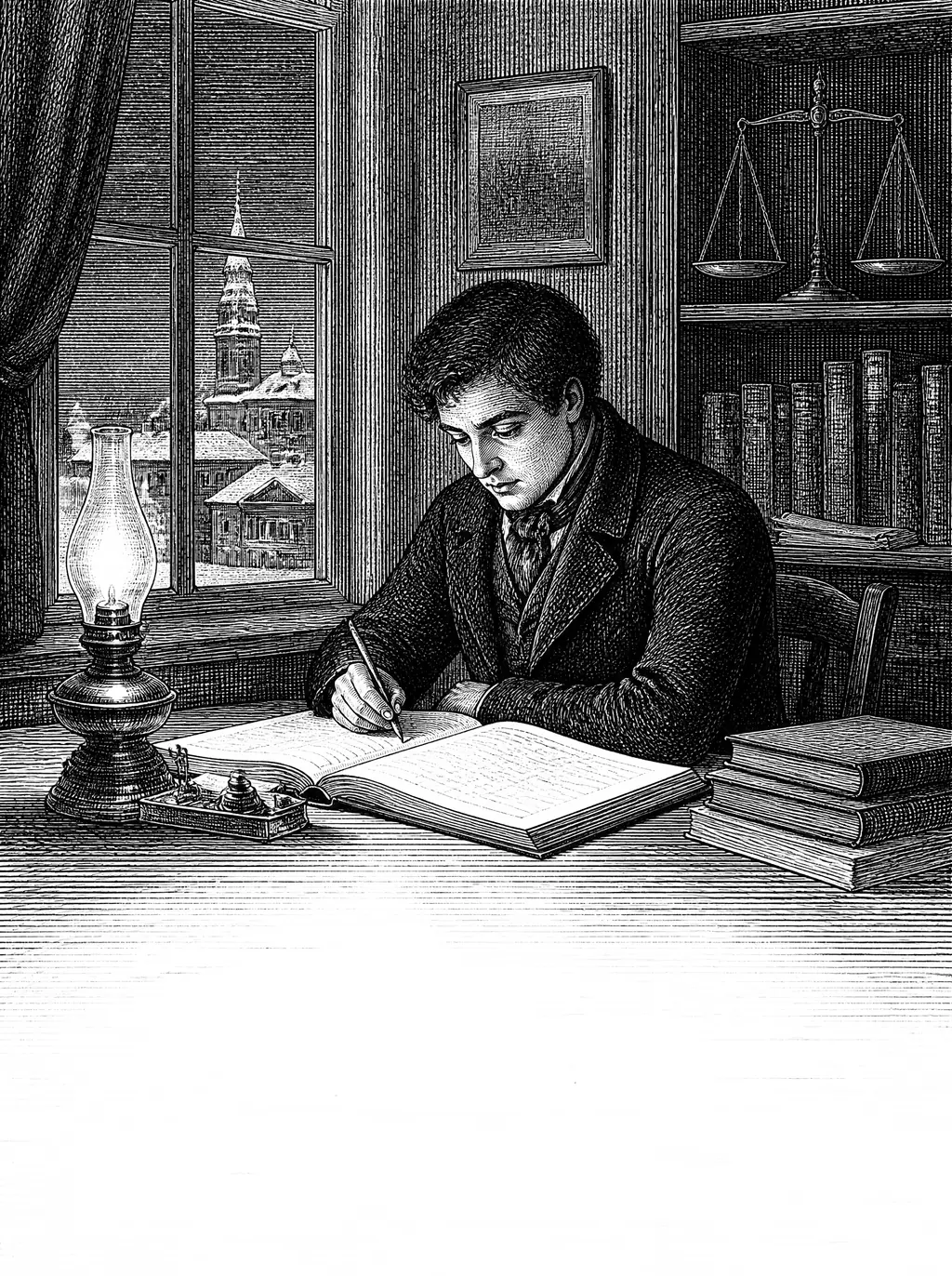
Everything Is Lawful
A theory for scoundrels
Ivan Karamazov, the brooding intellectual brother in Dostoevsky's novel, works out a chain of reasoning that unsettles everyone who hears it repeated secondhand: without belief in an immortal soul, morality loses whatever was actually binding it. Another character sneers that it sounds like an attractive theory for scoundrels. The novel spends the rest of its length testing whether he is wrong. Dostoevsky did not invent the argument to knock it down. He believed it was the most dangerous idea of his age, and he gave it to the most intelligent character he ever wrote.
The world it came from
The Brothers Karamazov was serialized in 1879 and 1880, and Dostoevsky died three months after finishing it. He had been sentenced to death in 1849 for reading banned literature, reprieved in front of the firing squad, and sent to a Siberian prison camp for four years; his faith was rebuilt there, among murderers, and it never lost the memory of doubt. Russia in the 1860s and 1870s had produced a generation of radicals who called themselves nihilists, and in 1866 one of them shot at the Tsar. Dostoevsky watched them and saw men who had accepted the premise of Ivan's theory. His own son Alyosha died in 1878, at three, while the novel was being planned. The saintly brother carries the boy's name.
The idea
If there is no immortality of the soul, Ivan's argument runs, then there is no virtue in any binding sense, and everything is lawful. Morality, on this view, was never self-standing. It depended on cosmic stakes, judgment, consequence, meaning beyond the grave, and once those stakes are removed, no purely human argument can force an obligation on anyone who simply refuses it. Ivan is not a scoundrel. He is tormented by the argument, and the novel's tragedy is that a man who believes nothing acts on it while the man who framed it stands by, and then cannot bear what he sees.
How the reasoning runs
Take the premise that moral obligation must bind even someone who does not want to be bound; otherwise it is only preference wearing a uniform. Ask what could bind a free and intelligent person against his own interest. Human argument cannot, since the person can always ask why he should care. Consequence cannot, since a clever man avoids it. Only a judgment that follows him past death, with everything at stake, has the reach. Now remove immortality, as the modern world was busy doing. The binding force goes with it, and what remains is a set of habits and sentiments that a strong enough will can simply decline. Therefore, if the soul is not immortal, virtue has no ground, and everything is lawful. Ivan's article said this. Smerdyakov listened.
Seen in life
You are in a position to take something and nobody would ever know: a figure in a report, a decision that quietly favors you, a kindness withheld from someone who cannot complain. You do not take it. Now ask yourself honestly why. If the answer is that you would feel bad, Ivan would say that a feeling is a habit, and habits can be trained away. If the answer is that it is wrong, he would ask what makes it so, once you have given up the judge who used to say so. Most people never get past this point, and Dostoevsky knew it. His novel is about the one servant in the house who did get past it, and what he did next.
Why it matters
This is the harder, darker cousin of Nietzsche's death of God, worked out as fiction rather than declaration: if morality's foundation really does depend on something beyond this world, then losing belief in that foundation is not a private, cost-free change of opinion. It is a live question about what, if anything, actually stops a person from doing whatever they can get away with. The novel's answer is not another argument. It is a murder, a breakdown, and a monk's instruction to love people in particular rather than humanity in general, which Dostoevsky thought was the only ground that would hold.
“If there's no immortality of the soul, then there's no virtue, and everything is lawful.”
From the source
Rakitin summarizes Ivan's article with visible contempt, calling it his stupid theory: “If there's no immortality of the soul, then there's no virtue, and everything is lawful.” The line becomes a refrain the novel keeps testing against its characters' actual choices. Dmitri repeats it in prison, half in terror; the devil quotes it back to Ivan in his fever; and Smerdyakov, having murdered old Fyodor with the argument in his pocket, tells Ivan that he was the real killer, because he taught that everything is lawful. Constance Garnett's 1912 translation is quoted here. The sentence is often given as if God does not exist, everything is permitted, a paraphrase that appears nowhere in the novel.
The pushback
Rakitin himself argues the opposite is closer to true: humanity will find in itself the power to live for virtue even without believing in immortality, out of love for life and for each other, with no need for cosmic enforcement at all. Dostoevsky gives this rebuttal real weight in the novel, without ever fully letting either side win outright. Plato had raised a deeper problem in the Euthyphro. If things are wrong only because God forbids them, then God's forbidding is arbitrary; if God forbids them because they are wrong, then wrongness stands on its own and needs no judge. Either way, Ivan's premise fails.
The reply
Dostoevsky answers Rakitin not with argument but with plot: Rakitin himself turns out to be the most cynical man in the novel, ready to sell anyone for a career, so his humanism is shown to rest on nothing. The Euthyphro objection is not answered in the book, and Ivan would probably concede that it beats his premise as logic. His point was never quite logical. It was psychological: that people, not propositions, need a judge, and that a morality grounded on its own self-evidence will not hold a man like Smerdyakov when the lights go out. Whether that is a fact about human nature or a fact about Russia in 1880 is the question the novel leaves open, and it is the harder question.
Where it went next
Nietzsche read Dostoevsky in 1887 and called him the only psychologist he had learned anything from. Sartre opened Existentialism Is a Humanism with the paraphrase, if God did not exist everything would be permitted, and called it existentialism's starting point, though he then argued that this was liberating rather than terrible. Camus built The Rebel around Ivan and the question of whether a rebel can say everything is lawful without becoming a murderer. Freud called The Brothers Karamazov the most magnificent novel ever written. In moral philosophy the argument survives as the divine command theory and its critics, and every secular ethics since has had to explain what binds the man who does not wish to be bound.
Where this leads
God is dead names the same collapse from the philosopher's side of the desk rather than the novelist's, treating the loss of a binding cosmic order as the starting point for an entire new problem, not a settled conclusion either way. Categorical imperative is the great secular answer Ivan never engages. Kant argued that reason alone binds a rational will, with no judge required, and the whole modern quarrel about whether morality needs God runs between his argument and Ivan's, with Smerdyakov standing in the doorway as the test case neither side can ignore.