Symposium · Existentialism · Pl. 12Simone de Beauvoir · 1908–1986
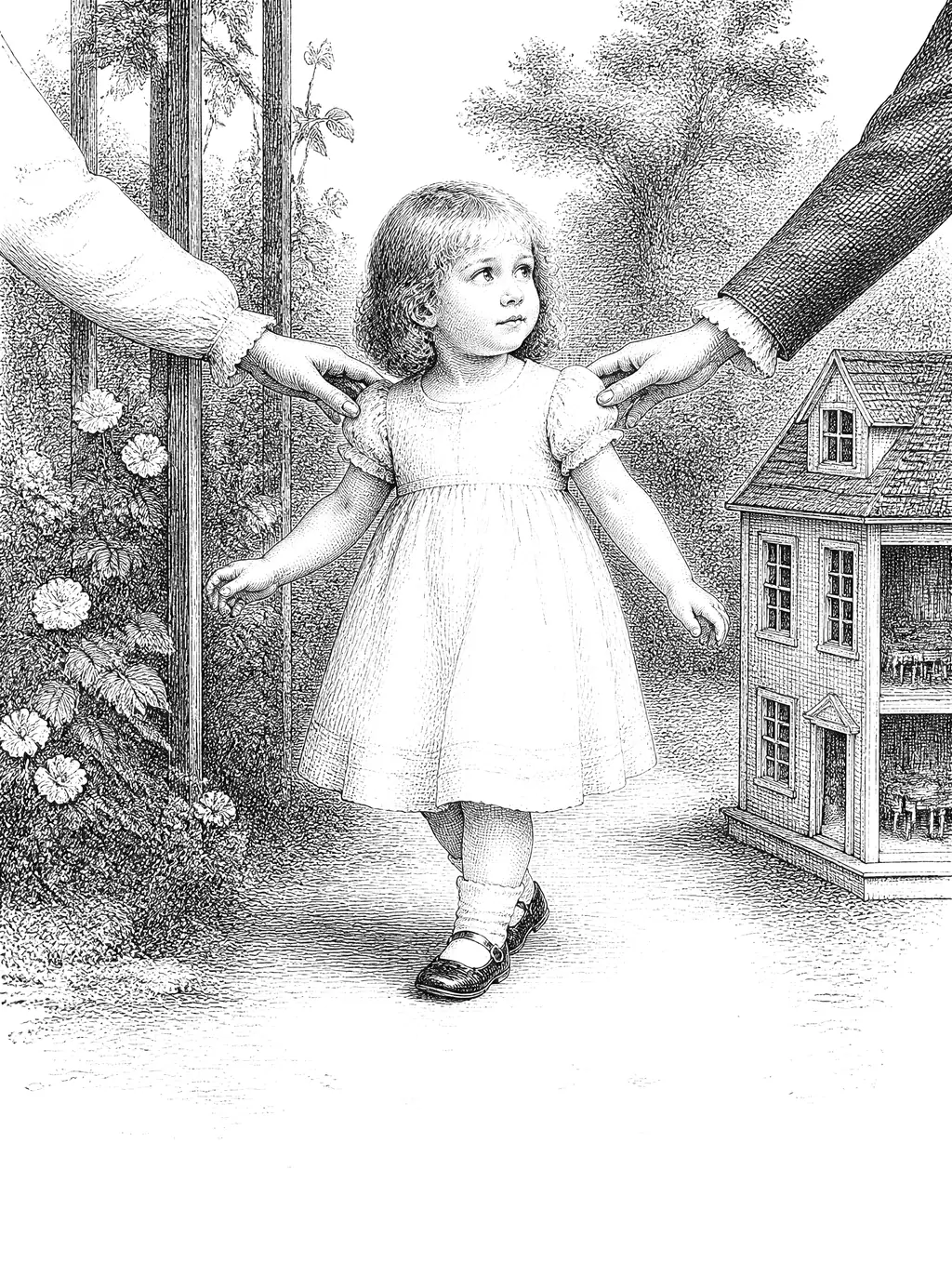
One Is Not Born, But Becomes, a Woman
A sentence that opened a second volume
Beauvoir opens the second half of her sweeping study of women's lives with a single sentence built to unsettle an assumption almost no one had questioned out loud before: that femininity itself, not just anatomy, is something manufactured. She spends the rest of the book tracing exactly how a female infant is gradually shaped, gesture by gesture, into what a given century calls a woman. The book was published in Paris in 1949, reportedly sold more than twenty thousand copies in its first week, and was denounced by Catholics and Communists alike. The sentence was doing exactly the work she meant it to.
The world it came from
Simone de Beauvoir was born in Paris in 1908 and passed the agrégation in philosophy in 1929, placing second to Sartre, who had failed it the year before. She taught for a decade, then wrote. The Second Sex grew from a plan to write about herself, which stalled on a first question: what had it meant to be a woman? France had given women the vote only in 1944. Beauvoir read biology, psychoanalysis, and history, borrowed the master and slave from Hegel and the idea of the Other from anthropology, and applied Sartre's claim that existence precedes essence to the one case her circle had never thought to test. The book appeared in 1949 and the Vatican placed it on the Index of forbidden books.
The idea
Sex is a biological fact. Womanhood, in the fuller sense of a role, a set of expectations, a way of carrying and understanding yourself, is something constructed afterward, through upbringing, culture, and the accumulated weight of how a girl is treated from birth onward. Nothing about that construction was inevitable, which means, existentially, that it was always at least partly chosen, by someone, and could be chosen otherwise. The becoming is not a single event but a training, and it starts before memory. The book's second volume walks through it stage by stage: childhood, girlhood, sexual initiation, marriage, motherhood, old age.
How the reasoning runs
Start with the observation that in every society Beauvoir could find, man is the default and woman is the Other, defined by reference to him. Ask whether biology forces this. It does not: female bodies differ, but no fact about hormones or childbirth dictates who owns property, who speaks in public, or who is expected to want what. Ask whether psychoanalysis or economics explains it; each describes a mechanism but assumes the outcome. So the role is imposed and then learned, gesture by gesture, until it feels like nature. Now add the existentialist premise: a human being is a freedom that makes itself through projects. If woman is a made thing, she was made by choices, and what is chosen can be refused.
Seen in life
Watch a girl of four in a park. Somebody has already told her, without ever saying it, which climbing frame is for her, how loud she may be, that a scraped knee gets a different response than her brother's. By nine she has absorbed the phrase like a girl, and knows it is not a compliment. By fourteen she has learned to read a room for danger. None of this is in her chromosomes. Beauvoir's claim is not that any single lesson was a conspiracy, but that the sum of them produces a person who will later be told that this is simply what women are like. You can run the same audit on your own childhood, whichever sex you were assigned.
Why it matters
This applies Sartre's existentialist claim that existence precedes essence to a case with enormous stakes: if womanhood is built rather than born, then the limits placed on women were never simple facts of nature, immune to challenge. They were choices, made and enforced by particular people in particular circumstances, and choices of that kind can always, in principle, be unmade or remade differently. It also changes who is responsible. If the role was built, then the people who benefit from it are not innocent bystanders of nature, and a woman who accepts it is making a choice too, even if the alternatives were made expensive.
“One is not born a woman: one becomes one.”
From the source
Beauvoir opens the second volume of her sweeping study, having already spent hundreds of pages tracing the biology and the long history behind it, with the claim she is now best remembered for: “One is not born a woman: one becomes one.” The French is On ne naît pas femme : on le devient, rendered here for Symposium. The sentence that follows is the argument in miniature: no biological, psychic, or economic destiny defines the figure that the human female takes on in society, and it is civilization as a whole that produces this creature which is called feminine. H. M. Parshley's 1953 translation, the one most English readers knew for fifty years, cut a great deal of the book; Constance Borde and Sheila Malovany-Chevallier restored the cuts in 2009.
The pushback
Doesn't reducing womanhood entirely to social construction risk erasing real biological difference and the lived experience built on top of it? Beauvoir does not deny biology exists; her target is the assumption that biology alone dictates the entire social role built on top of it. The claim is about what gets added afterward, not a denial that bodies differ to begin with. A second objection comes from the other side. Judith Butler asked why Beauvoir stops at gender: if womanhood is constructed, why treat the body's sex as a given, when the line between the two is itself drawn by culture? On this view Beauvoir did not go far enough.
The reply
To the first objection, Beauvoir's text is the reply: the first volume spends a hundred pages on biology and treats it as real. Her claim concerns what a society builds on the body, not whether the body exists. Butler's objection is harder because it turns Beauvoir's method against her. Beauvoir could answer that a freedom needs something given to work on, and that a body with no facts about it would leave nothing to become. But she never argued the point, because in 1949 nobody had raised it. Whether sex is a fact and gender its interpretation, or both are interpretations all the way down, is a question her sentence opened and did not close.
Where it went next
Betty Friedan read Beauvoir before writing The Feminine Mystique in 1963, and the second wave of feminism in the United States took much of its vocabulary from the Parshley translation. The distinction between sex and gender, which Beauvoir did not name but described, became standard in sociology by the 1970s. Judith Butler's Gender Trouble in 1990 opened with the sentence and pushed past it, arguing that sex too is produced by the norms that claim merely to describe it. Beauvoir became an activist late, signing the 1971 Manifesto of the 343, in which French women admitted to illegal abortions. She died in 1986 and is buried beside Sartre in Montparnasse.
Where this leads
Existence precedes essence is the philosophical foundation Beauvoir is building directly on top of, applying Sartre's claim that there is no fixed human nature to the specific, urgent case of what a society had long treated as fixed female nature. Bad faith is the other Sartrean tool she uses. A woman who tells herself she was born for the role, and a man who tells himself nature arranged his advantage, are both hiding a freedom they know they have. The Second Sex is, among other things, an inventory of the ways a whole society can act in bad faith at once.