Symposium · Metaphysics · Pl. 7Heraclitus · c. 535 – c. 475 BC
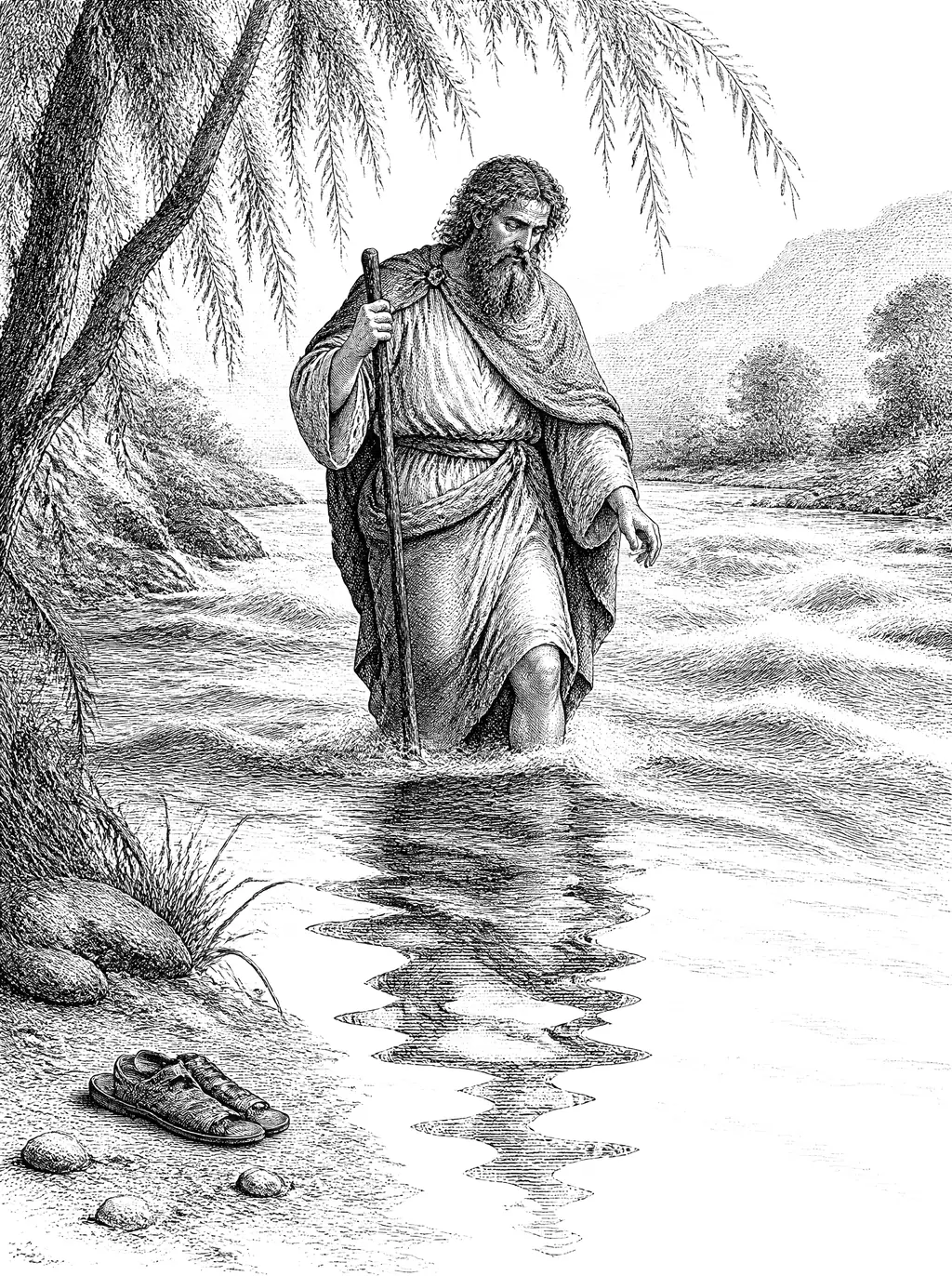
You Cannot Step in the Same River Twice
The water has already moved on
You call it the same river every time you visit: same banks, same name on the map, same bend where it bends. Heraclitus looked past the name to the actual water, which is never the same water twice, already replaced by fresh water flowing in from upstream the instant you notice it at all. That is the easy half of the thought. The harder half is the one he leaves you to find: the person stepping in has also been replaced. Different cells, different memories, a slightly different mood than yesterday. Two flows meet at the riverbank and you call the meeting a repetition. Heraclitus says there are no repetitions. There is only the pattern, and the pattern is made of change.
The world it came from
Heraclitus lived in Ephesus, a Greek city on the Ionian coast under Persian rule around 500 BC. He came from the ruling family and is said to have given up a hereditary office to his brother. Ancient reports describe him as proud and solitary, and he wrote in dense, riddling prose that earned him the nickname the Obscure. He deposited his one book in the temple of Artemis. His targets were the Milesian thinkers before him, who had looked for a single stable stuff beneath the world, and the poets and polymaths he named with contempt: Homer, Hesiod, Pythagoras. Much learning, he said, does not teach understanding. His answer to the Milesians was that the underlying stuff was not a thing but a process.
The idea
You cannot step twice into the same rivers, for fresh waters are ever flowing in upon you. What looks like one stable thing, a river, a person, an institution, is really a pattern of continuous change wearing a fixed name. The name stays put. The substance underneath it never once stops moving. Heraclitus generalised the point. Everything flows, later readers summarised, and the fragments back the summary: the sun is new every day, cold things grow warm, the living become the dead. His favoured image for the whole was fire, which exists only by consuming and transforming. A river is fire slowed down enough to see. Stability, where it appears, is a balance of exchanges, not an absence of them.
How the reasoning runs
The reasoning is short and it turns on what the word river names. First premise: the river is its water, in the plain sense that if you removed the water nothing would be left to call a river. Second premise: the water is never the same from one moment to the next; what touched your foot is already downstream. Conclusion: the river you step into the second time is not the same river. But Heraclitus does not stop at the dissolving conclusion. A second fragment adds that we step and do not step into the same rivers. The river stays the same river as a river, a continuous structure of flow, precisely because the water keeps changing. Sameness of pattern requires difference of material.
Seen in life
Look at a photograph of yourself from ten years ago. The cells in your skin have been replaced many times over. Most of the beliefs you would have defended that afternoon have been quietly revised. The friends in the picture have drifted, and the you that speaks to them now would say different things. Yet you say, without hesitation, that is me. Heraclitus asks you to notice what that sentence is doing. It is not pointing at a persisting substance; there is none. It is pointing at a river: a continuous pattern that has stayed recognisable only by exchanging all of its parts. The comfort you take in the word same is real, but it is a comfort in the pattern, not the stuff.
Why it matters
This challenges the comfortable assumption that the things around you, and you yourself, hold still between one glance and the next. Bodies replace their own cells, relationships shift in small ways daily, institutions quietly become something else while keeping their old sign out front. Naming something stable is often just agreeing to stop looking closely at it. The practical consequence cuts two ways. It loosens your grip on what you thought was fixed: the company you joined is not the company you work for now, and the person you married has been replaced gradually by someone who consented to none of it. It also makes change less frightening, since it was already happening. You cannot lose the stable thing. You never had it.
“You cannot step twice into the same rivers; for fresh waters are ever flowing in upon you.”
From the source
Heraclitus states the image directly: “You cannot step twice into the same rivers; for fresh waters are ever flowing in upon you.” A later fragment pushes the same thought even further: we step and do not step into the same rivers; we are and we are not. Nothing of his book survives whole. What we have are around a hundred sentences quoted by later writers, Plato, Aristotle, Plutarch, and Christian authors among them, often to make their own points. Plato reports the river as the doctrine that everything flows and nothing stays, and some scholars think the neat slogan is Plato's rather than Heraclitus's. The fuller fragment, with its stepping and not stepping, reads as the more authentic voice: a paradox held open rather than a slogan closed.
The pushback
If nothing ever stays the same, doesn't ordinary language, and ordinary life, become impossible, since you could never meaningfully call anything by the same name twice? Heraclitus is not denying that patterns persist; the river keeps its shape and course even as its water constantly turns over, which is closer to his actual point than pure chaos would be. Plato pushed the objection harder in the Cratylus and Theaetetus. If everything is changing in every respect at every moment, then nothing can be known, since the thing you tried to know has already become something else before the thought is finished. Cratylus, a follower of Heraclitus, drew that conclusion and reportedly stopped speaking, only moving his finger. Aristotle treated that as the view's reduction to absurdity.
The reply
The tradition answers by separating two claims Plato ran together. Heraclitus said that the material of things is always in flux. He did not say that the structure is. His word for the structure was logos, the account or measure according to which the exchanges happen, and he insisted it was common to all and stable. The river can be known as a river because the flow follows a measure. Fire is kindled in measures and put out in measures. So knowledge is possible, but it is knowledge of patterns of change, not of unchanging things. What the reply leaves open is where the logos itself lives. If it is not the water and not any stuff, Heraclitus never says clearly what kind of thing it is.
Where it went next
Plato took Heraclitus as the spokesman for the changing world of sense, and built his theory of unchanging Forms partly in reaction. Aristotle's doctrine of substance is in part an attempt to say what stays fixed while properties flow. The Stoics adopted Heraclitus's fire and logos as the basis of their physics, and Marcus Aurelius quotes him. Hegel said there was no proposition of Heraclitus he had not taken into his own logic. Nietzsche called him the philosopher he felt closest to. In the twentieth century, process philosophers like Alfred North Whitehead made events rather than things the basic units of reality, and the river became a standard example in the personal-identity debates that run from Locke to Parfit.
Where this leads
The bundle theory of self reaches a strikingly similar conclusion about persons specifically, finding no fixed self sitting behind experience at all, only a rapid, ever-changing succession of perceptions that Hume himself compares to a river of its own kind. The unity of opposites is the other half of Heraclitus's own thought, and the river needs it: a thing that stays the same by changing is an opposition held in balance, the same trick as the bow and the lyre. The ship of Theseus takes the river and slows it down until you can watch each plank being replaced. Read together, they ask one question three ways: what survives when all the parts are gone?