Symposium · Philosophy of Religion · Pl. 8David Hume · 1711–1776
No Testimony Is Sufficient
A rule for weighing witnesses
Hume does not simply declare that miracles cannot happen. He builds a rule for evaluating any report of one: weigh the strength of the testimony against the strength of our uniform experience that the laws of nature hold, and believe whichever side of that comparison is less improbable to be false. The essay, Section X of the Enquiry of 1748, was the most attacked thing Hume ever wrote. He said he first thought of the argument as a young man in France, walking the cloisters of a Jesuit college after a priest had defended a miracle to him.
The world it came from
Hume published the essay as Section X of An Enquiry Concerning Human Understanding in 1748, though he had drafted it a decade earlier and cut it from the Treatise for fear of the reaction. Britain in the 1740s was arguing about miracles in public. Deists like Woolston had ridiculed the Gospel accounts; Thomas Sherlock's Trial of the Witnesses (1729) had answered with a mock courtroom in which the apostles were cross-examined and acquitted. The debate was being run as a question about testimony. Hume accepted the terms and asked a prior question: what would any testimony have to be like to establish an event of that kind? He wrote the Treatise at La Flèche, where he said the argument first came to him.
The idea
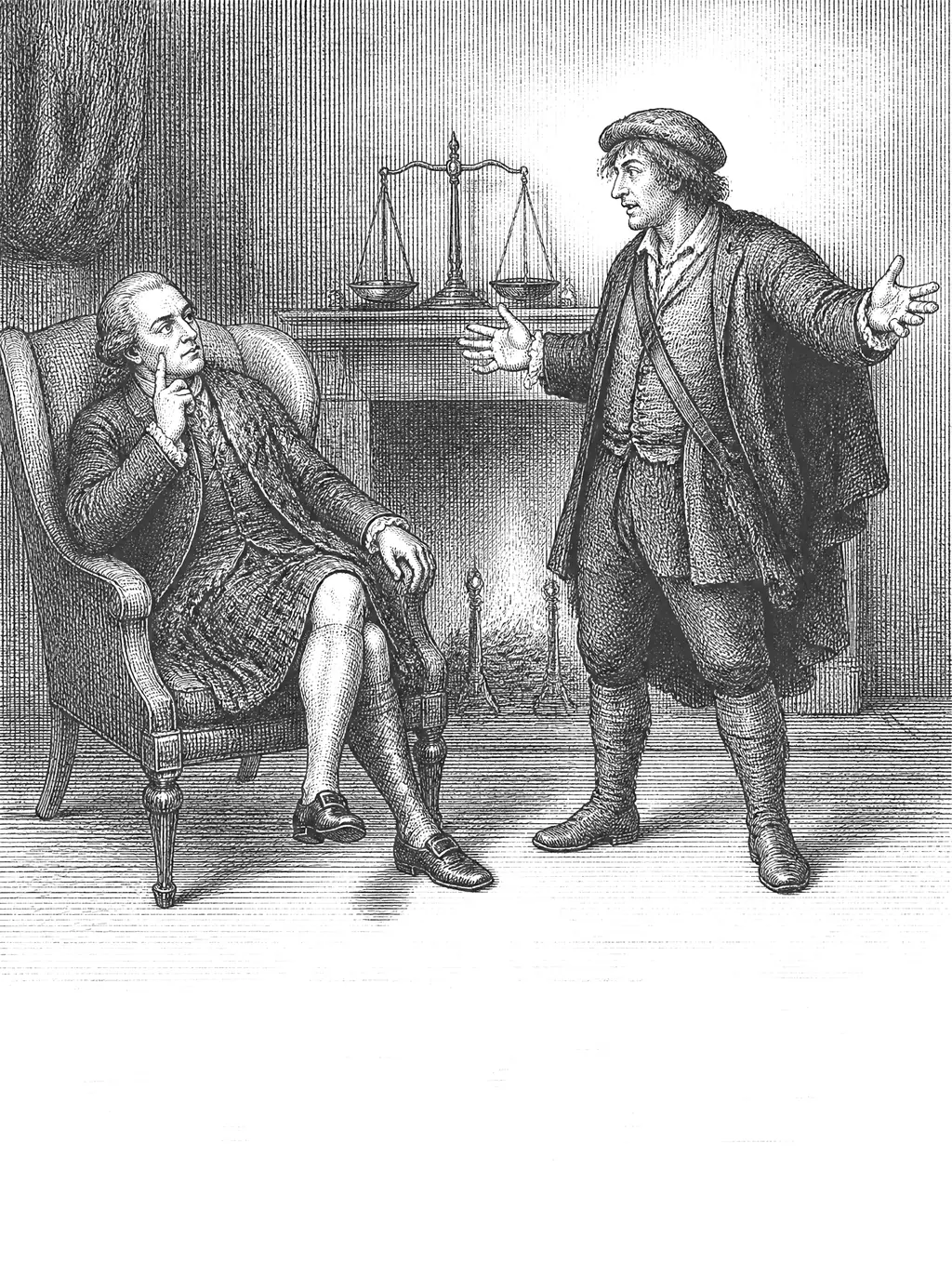
No testimony is sufficient to establish a miracle, unless the testimony be of such a kind, that its falsehood would be more miraculous than the fact which it endeavours to establish. Since a violation of a law of nature is, by definition, the least likely kind of event possible, the bar any testimony must clear to outweigh that improbability is correspondingly extreme. The rule does not say that miracles are impossible. It says that in a contest between two improbabilities, the report of one and the failure of a law, you should always take the smaller. Hume's wager is that the smaller is nearly always the report.
How the reasoning runs
Set out the steps. First, a wise person proportions belief to evidence. Second, the evidence for a law of nature is a uniform experience, the largest body of evidence there is, so a violation of such a law is, by definition, as improbable as any event can be. Third, testimony gets its authority from experience too: we believe witnesses because witnesses have usually been right. Fourth, so when testimony reports a miracle, experience is set against experience, and the weaker must yield. Fifth, ask which is weaker: a uniform law, or the honesty and accuracy of a few witnesses to a marvel? The second part of the essay adds the empirical points: the witnesses' number and character, their love of wonder, and the way rival religions cancel each other's evidence.
Seen in life
A video of a statue weeping goes round your family group chat. Your aunt believes it; your cousin says it is a hoax. Hume gives you a way to think before you take a side. Which would surprise you more, a stone that produces tears, or a phone, a lighting trick, an eager crowd, and a story that grew in the telling? You have seen the second a hundred times. Notice what the rule does not do. It does not call your aunt a fool, and it does not settle whether there is a God. It only says that for this report, on this evidence, the mundane explanation has the shorter odds. A believer can accept the rule and still hope the statue wept.
Why it matters
This gave skeptics a general, reusable standard for evaluating extraordinary religious claims without needing to investigate each miracle story individually on its own specific merits. It also shaped later scientific and legal thinking about how much evidence an unlikely claim genuinely requires before it can be reasonably accepted as true. The maxim is the ancestor of the slogan that extraordinary claims require extraordinary evidence, and of the practice, in medicine and law, of weighing a striking report against the base rate of error. Sagan popularized the slogan; Hume supplied the argument behind it.
“No testimony is sufficient to establish a miracle, unless the testimony be of such a kind, that its falsehood would be more miraculous, than the fact, which it endeavours to establish.”
From the source
Hume states the maxim as a general rule worthy of attention: “No testimony is sufficient to establish a miracle, unless the testimony be of such a kind, that its falsehood would be more miraculous, than the fact, which it endeavours to establish.” Human testimony, he notes, is itself often mistaken or dishonest. He then gives the test in the form of a question to put to yourself: when someone tells you a dead man was restored to life, ask whether it is more probable that the witness should deceive or be deceived, or that the event should really have happened. Weigh one miracle against the other, he says, and reject the greater. Only if the falsehood would be the greater miracle can you believe.
The pushback
Doesn't this rule quietly guarantee its own conclusion, since it treats a law of nature as something no evidence could ever genuinely overturn, rather than as a generalization that remains open, in principle, to correction by new observation? Defenders reply that Hume is only demanding evidence proportioned to how extraordinary a claim actually is. A second, technical objection came from probability theory. If many independent witnesses each have a modest chance of error, their agreement can make even a very improbable event likely; Hume's argument seems to ignore how testimony compounds. Charles Babbage worked out the arithmetic in 1837.
The reply
Hume's defenders reply that the circularity charge misreads him. He does not say laws cannot be broken; he says that the evidence needed to believe they were broken must outweigh the evidence that they hold, and that is the ordinary standard applied to an extraordinary case. On the compounding objection, they concede the mathematics and answer with the second part of the essay: witnesses to miracles are rarely independent, since the story passes from one to the next, and the love of wonder and the interests of religion make the errors correlated. That answer is partial. It shows that Hume's rule can survive as a rule of thumb, but not that it is the absolute bar he first presents, and later Humeans have retreated to the modest version.
Where it went next
The essay drew replies for a century, from George Campbell in 1762 to Paley's Evidences of Christianity, and it shaped the whole Victorian argument about the Gospels. Babbage's probabilistic reply led into the modern Bayesian treatment, in which John Earman's Hume's Abject Failure (2000) argued that the maxim is either trivial or false, and others answered that the second part of the essay carries the weight. The maxim survives outside philosophy as the working rule of every skeptical society and every fraud investigator, and Carl Sagan's version, extraordinary claims require extraordinary evidence, is Hume with the epigram sharpened. Theologians from Lessing to C. S. Lewis have written whole books against it, which is its own kind of tribute.
Where this leads
Epicurus's old questions shows Hume turning his skeptical method toward a different theological target in a separate work, the classic problem of evil, applying the same cold, evidence-weighing style of argument to ask not whether miracles happened, but whether a good and powerful God could really coexist with so much ordinary suffering. Falsifiability is the twentieth-century echo. Popper asked what evidence a scientific claim would allow against itself; Hume asked what evidence a miracle report could offer for itself. Both are rules about the size of the claim against the size of the proof.