Symposium · Philosophy of Religion · Pl. 9David Hume · 1711–1776
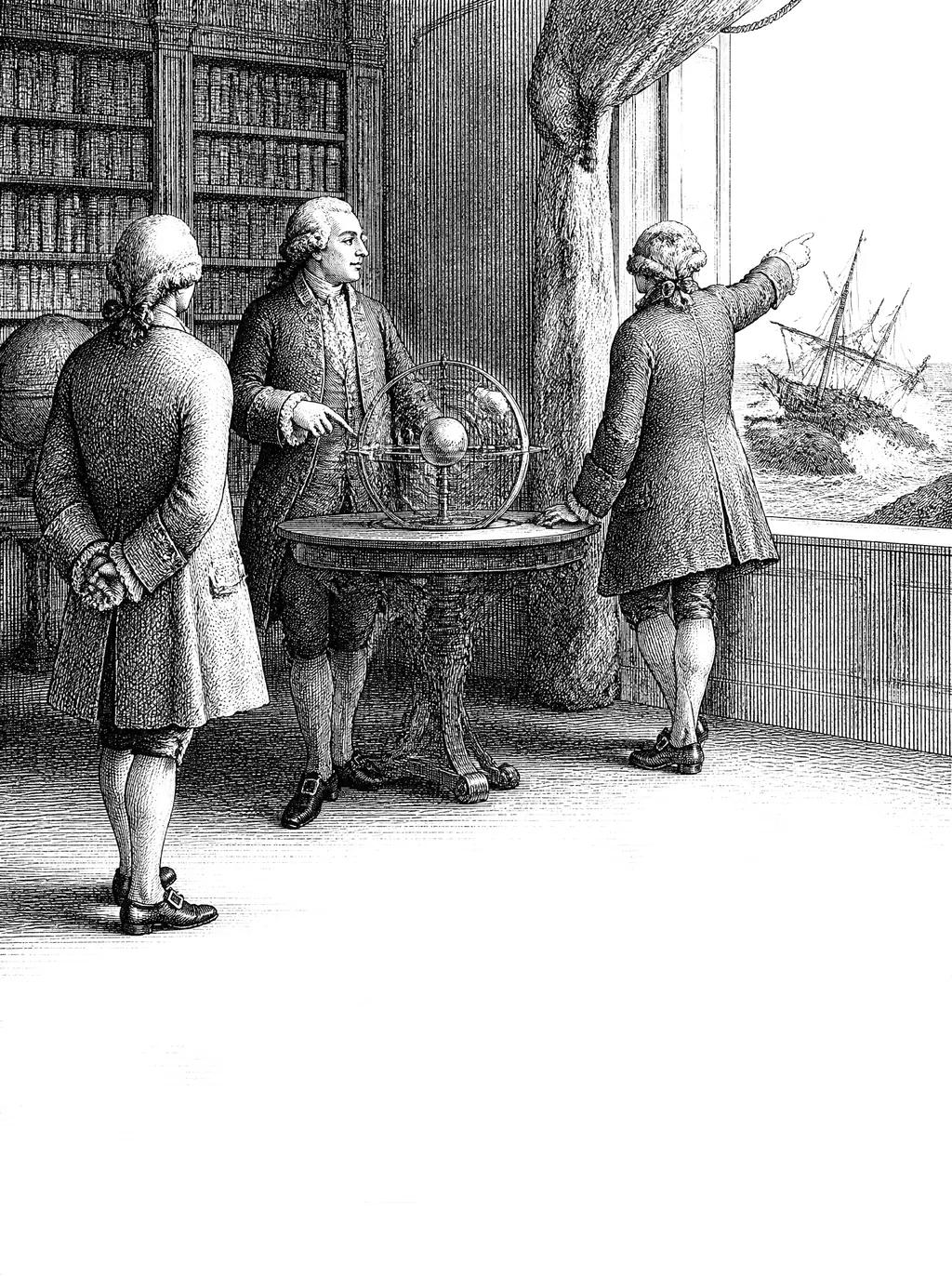
Epicurus's Old Questions
An old puzzle, still unanswered
In Hume's dialogue, the skeptic Philo does not invent a new objection to religion. He reaches back to Epicurus, dead two thousand years, and points out that his old dilemma about God's power and goodness has never actually been resolved, only avoided, ignored, or restated with different words attached to it. Hume wrote the Dialogues in the 1750s and kept them in a drawer for a quarter century. He knew what they would cost him. They were published in 1779, three years after his death, by his nephew.
The world it came from
Hume drafted the Dialogues Concerning Natural Religion around 1750 and revised them for the rest of his life. He had already lost the chair of philosophy at Edinburgh in 1745 on the charge of atheism, and his friends, including Adam Smith, begged him not to publish. He arranged in his will for the book to appear after his death; it came out in 1779. The target was the natural religion of his day, the confident argument from the order of the world to a wise and good designer, made fashionable by Newton's success. Hume gave the design argument to Cleanthes, the orthodoxy to Demea, and the doubts to Philo. Part X is where the polite conversation stops being polite.
The idea
Epicurus's old questions are yet unanswered. Is he willing to prevent evil, but not able? then is he impotent. Is he able, but not willing? then is he malevolent. Is he both able and willing? whence then is evil? Each horn of this dilemma, Philo argues, forces a concession that standard religious belief in an all-powerful, all-good God cannot easily accommodate. The dilemma predates Christianity; Lactantius reports it as Epicurean in the fourth century. Hume's contribution is to place it after the design argument, so that the reader who has just inferred God from the world's order must now infer God's character from the world's pain.
How the reasoning runs
Philo's argument has two stages. The first is the old trilemma: an all-powerful being can prevent evil, an all-good being wants to, and evil exists, so one of the three has to give. The believer can deny none of them without abandoning traditional theism, and so needs the evil to be somehow necessary. The second stage is where Hume's real force lies. Grant that a good God might have reasons we cannot see; the question is not whether evil is compatible with such a God but whether the world, taken as evidence, would ever lead you to infer one. Philo answers no. From a mixed world you may infer a mixed cause, or an indifferent one. You will never infer infinite goodness.
Seen in life
A child on the oncology ward asks the chaplain why God let her get sick, and the chaplain, a good man, says that God has a plan we cannot see. Philo's point is not that the chaplain is wrong. It is that the chaplain has just given up the argument he started with. If the world's order proves a wise designer, the world's suffering must count as evidence too, and you cannot admit the one and quarantine the other. The believer at the bedside may say that faith never rested on the inference in the first place, and Hume, oddly, agrees. It is the philosophers who claimed to prove God from the world whom Philo is talking to. The chaplain is talking to a child.
Why it matters
This gave the ancient problem of evil its sharpest and most quotable modern form, a clean three-branch dilemma rather than a diffuse complaint about suffering in general. It became the template nearly every later discussion of the problem of evil, whether defending or attacking traditional theism, has had to engage with directly. The dilemma also fixed the division of labour that still governs the field. The logical problem asks whether evil and God can coexist at all; the evidential problem asks whether evil makes God unlikely. Hume raised both in a few pages, and Philo's second move is where modern work happens.
“EPICURUS's old questions are yet unanswered. Is he willing to prevent evil, but not able? then is he impotent. Is he able, but not willing? then is he malevolent. Is he both able and willing? whence then is evil?”
From the source
Philo states the dilemma without softening it: “EPICURUS's old questions are yet unanswered. Is he willing to prevent evil, but not able? then is he impotent. Is he able, but not willing? then is he malevolent. Is he both able and willing? whence then is evil?” No branch of the question, he implies, comes free. Philo then turns the design argument on its head. Look round the universe, he says in Part XI, and what you find is a blind nature pouring out its maimed and abortive children without care for their fate. He names four circumstances of evil, pain, general laws, the scarcity of powers, and the rough workmanship of the world, and asks whether any of them was necessary.
The pushback
Doesn't this dilemma ignore the possibility that evil serves some greater purpose invisible to limited human understanding, a purpose an infinitely wise God might have while finite minds cannot grasp it? Philo's dialogue partners raise exactly this defence, and Hume leaves the debate deliberately unresolved rather than declaring either side the outright winner. A second, older reply is the free-will defence: much evil is the price of creatures who choose. Philo hardly touches it, and natural evils, the earthquake and the cancer, are not obviously covered by it, but the defence has been the theist's main resource ever since.
The reply
Philo's answer to the hidden-purpose reply is to grant it and change the subject. Perhaps evil is compatible with a good God; Philo concedes that in Part X. But compatibility is cheap. The question is whether a person with no prior commitment, looking at the world, would ever arrive at a good God from it, and the honest answer is no. That reply does not defeat faith; it defeats the claim that faith is the conclusion of an inference from nature. On the free-will defence, Hume left the work to others, and it remains the strongest theistic move against the logical problem. It is weaker against the evidential problem, because the sheer quantity of suffering, much of it unrelated to any choice, still needs accounting for.
Where it went next
The Dialogues set the agenda for two centuries. Kant, who admired Hume, gave up on theodicy in 1791. Darwin's world of parasitic wasps confirmed Philo's picture, and Darwin said so in a letter to Asa Gray. In the twentieth century J. L. Mackie's Evil and Omnipotence (1955) restated the logical problem, Alvin Plantinga's free-will defence answered it to most philosophers' satisfaction, and William Rowe's evidential argument (1979), built on a fawn burning to death in a forest fire, took up Philo's second stage. Philo's four circumstances still frame the debate on natural evil. The dialogue form itself, with no winner declared, became the model for writing on religion that wants to be honest about the score.
Where this leads
The best of all possible worlds shows Leibniz offering the fullest attempt in the philosophical canon to answer exactly this dilemma, arguing that a perfectly good and powerful God was still bound by logic to select the best world available among every genuinely possible alternative, evils included. We must cultivate our garden is what the dilemma looks like as a story. Voltaire could not answer Philo's question either. He decided that a person can dig a bed and plant it without waiting for the answer, which is a reply of a different kind.