Symposium · Philosophy of Mind · Pl. 7William James · 1842–1910
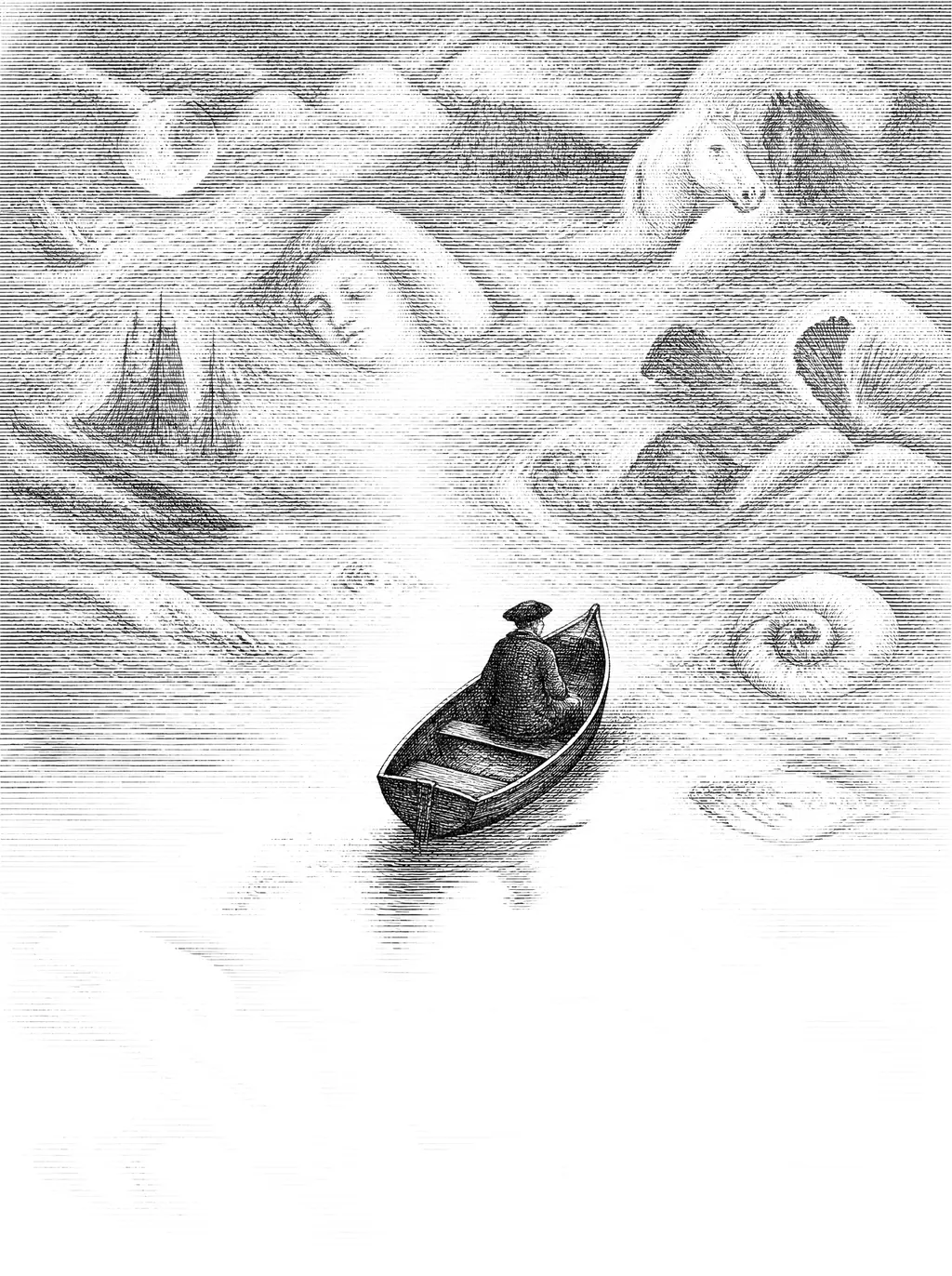
The Stream of Consciousness
The wrong metaphor, finally dropped
Chain. Train. Both words suggest thought moves in discrete, separable links, one thought ending cleanly before the next begins. James examined his own inner life closely and found nothing of the kind: no joints, no clean breaks, just one continuous, shifting flow with earlier moments blending into later ones without a seam anywhere to be found. Try it yourself. Attend to the moment between one thought and the next and look for the gap. What you find is not a gap but a lean, a sense of where the mind is going before it arrives. James thought earlier psychologists had missed that lean because it is nearly impossible to catch, like trying to see darkness by turning the light on fast.
The world it came from
James published The Principles of Psychology in 1890, twelve years late and twice the contracted length, from Harvard, where he had set up one of the first psychology laboratories in the 1870s. The chapter on the stream of thought had appeared in an earlier form in the journal Mind in 1884. His opponents were the associationists, Locke, Hume, and John Stuart Mill among them, who built the mind out of simple ideas glued together by habit, and Wilhelm Wundt's new experimental school in Leipzig, which trained observers to break experience into elementary sensations. James, trained as a physician and a painter, thought both had mistaken the products of analysis for the facts of experience. The stream was his correction.
The idea
Consciousness does not appear to itself chopped up in bits. Such words as 'chain' or 'train' do not describe it fitly as it presents itself in the first instance. It is nothing jointed; it flows. A river or a stream are the metaphors by which it is most naturally described, and stream of consciousness became the name for this continuous, ever-moving flow of experience. James lists five characters of thought. Every thought belongs to someone. Within each person thought is always changing, so no state ever recurs. It is continuous. It always seems to deal with objects beyond itself. And it is selective, attending to some things and ignoring the rest. Continuity is the third of these, and the one the old metaphor got wrong.
How the reasoning runs
Step one: ask how thought presents itself, before any theory. Step two: the associationists start from simple ideas, but no simple idea is ever found in experience; the same sensation never comes twice, because the brain that receives it has changed. Step three: distinguish the substantive parts of the stream, the resting places where an image sits, from the transitive parts, the feelings of relation that carry you from one to the next: the felt and, the felt but, the felt if. Step four: the transitive parts are hard to introspect, because stopping to look at them stops them. So psychologists overlooked them and saw only the resting places, which is why thought looked like a chain. Conclusion: the joints were an artifact of the method.
Seen in life
You are halfway through composing a difficult message when the doorbell rings. You sign for a parcel, exchange a word about the weather, and come back to the screen. The thought is waiting, and it is warm. You do not reread what you wrote to find out what you meant; you feel the direction you were heading and pick it up. James would point to three things in that minute. The interruption did not sever the stream; the thought came back as yours, not as a stranger's. The sense of what you were about to say was real even though it had no words yet. And a chatbot that lost your thread at the doorbell would have shown you exactly what a chain, rather than a stream, looks like.
Why it matters
This reframed how psychology, and later literature, approached the mind: not as a sequence of separable mental snapshots to be catalogued one by one, but as one continuous, seamless process that resists being cut into discrete units at all. Novelists soon borrowed the phrase directly to describe a new way of narrating a character's unbroken inner flow of thought. It also carries a warning that James applied to his own field. He called it the psychologist's fallacy: confusing the theorist's view of a mental state with the state itself. The associationists had cut thought into pieces on paper and then reported finding pieces. Any science of the mind, James argued, must start from how experience actually presents itself, and check its theories against that.
“Consciousness, then, does not appear to itself chopped up in bits. Such words as 'chain' or 'train' do not describe it fitly as it presents itself in the first instance. It is nothing jointed; it flows.”
From the source
James makes the case, and coins the term, directly: “Consciousness, then, does not appear to itself chopped up in bits. Such words as 'chain' or 'train' do not describe it fitly as it presents itself in the first instance. It is nothing jointed; it flows.” The passage is from Chapter IX of the Principles, titled The Stream of Thought. A few lines later James adds the sentence that gave the idea its name: in talking of it hereafter, let us call it the stream of thought, of consciousness, or of subjective life. The chapter also gives his image of the transitive parts as a bird's flights and the substantive parts as its perchings, and his complaint that introspecting a flight is like seizing a snowflake to see its shape.
The pushback
Don't sudden shocks, interruptions, and jarring changes of subject argue against a perfectly seamless flow, cutting the stream across at the exact moment they occur? James addresses this objection directly, arguing the sense of continuity survives these breaks because each new moment still recognizes itself as belonging to the same ongoing self, however abruptly its content shifts. The harder objection comes from the laboratory. Vision is built from saccades and blinks, attention samples the world in cycles, and the brain stitches over gaps you never notice. If the mechanism is discrete and the felt continuity is a construction, then James's introspection has reported the finished product, not the process, which is the very psychologist's fallacy he warned against.
The reply
James can grant nearly all of it. His claim was never about the machinery. The first chapters of the Principles are about the brain, and he expected the physiology to be discrete and complicated. The stream is a claim about how thought appears to itself, and a construction that appears continuous is still continuous as experienced, which is the level psychology has to describe. That answer holds, but it also shrinks the thesis. If the seamlessness is assembled, then the appearance is a report the brain makes to itself, not a datum beneath all reports, and James's method of careful introspection has no special access to what lies under it. He would probably accept that. He called introspection difficult and fallible on the same pages where he used it.
Where it went next
Henri Bergson developed a parallel idea of lived duration in France in the same years, and the two admired each other. Edmund Husserl's analysis of time-consciousness owes James a debt he acknowledged. In 1918 the novelist May Sinclair used James's phrase to describe Dorothy Richardson's fiction, and it became the label for the technique of Joyce's Ulysses in 1922 and Virginia Woolf's Mrs Dalloway in 1925. Gertrude Stein had studied under James at Radcliffe. In psychology the stream went underground during behaviorism and resurfaced with the study of mind-wandering: the discovery of the brain's default mode network around 2001 gave the unbidden flow of thought a physiology. Buddhist psychology had used the same image of a stream for two thousand years.
Where this leads
The bundle theory of self reaches a related picture from an entirely different direction, finding only a rapid succession of perceptions where a fixed self was long expected, a flow not unlike the very stream James is carefully describing here. The first act of freedom is James's own next move. If thought is a stream, what decides which way it flows? His answer was attention: the effort to hold one idea in view against the pull of others is the one place where he thought a will might act. He made his first free act, he said, the decision to believe in free will. The stream describes the mind; the act of attention is where James thought you could steer it.