Symposium · Epistemology · Pl. 1David Hume · 1711–1776
The Bundle Theory of Self
Nobody home
Hume tried an experiment nearly anyone can repeat: turn attention inward and search for the self itself, apart from any particular thought, feeling, or sensation. He reported that he never once caught himself without a perception attached, and never observed anything at all except the perception. Whatever the self was supposed to be, it never showed up on its own. Try it now. Look for the one who is reading. You will find the words, a faint tension in the eyes, perhaps a thought about whether this is working. You will not find a reader standing apart from those. Hume's claim is that this is not a failure of the search. It is the result.
The world it came from
Hume wrote the section called Of Personal Identity for A Treatise of Human Nature, finished in his mid-twenties and published in 1739. The question was live because of Locke, who had argued in 1694 that a person is held together not by a soul but by memory, and had drawn objections from Joseph Butler and later Thomas Reid for it. Descartes had made the thinking self the first certainty, and Berkeley had kept spirits while abolishing matter. Hume applied his one rule to all of them: every real idea must trace back to an impression. He went looking for the impression of the self, and the Treatise reports, with some visible unease, that there was nothing there to report.
The idea
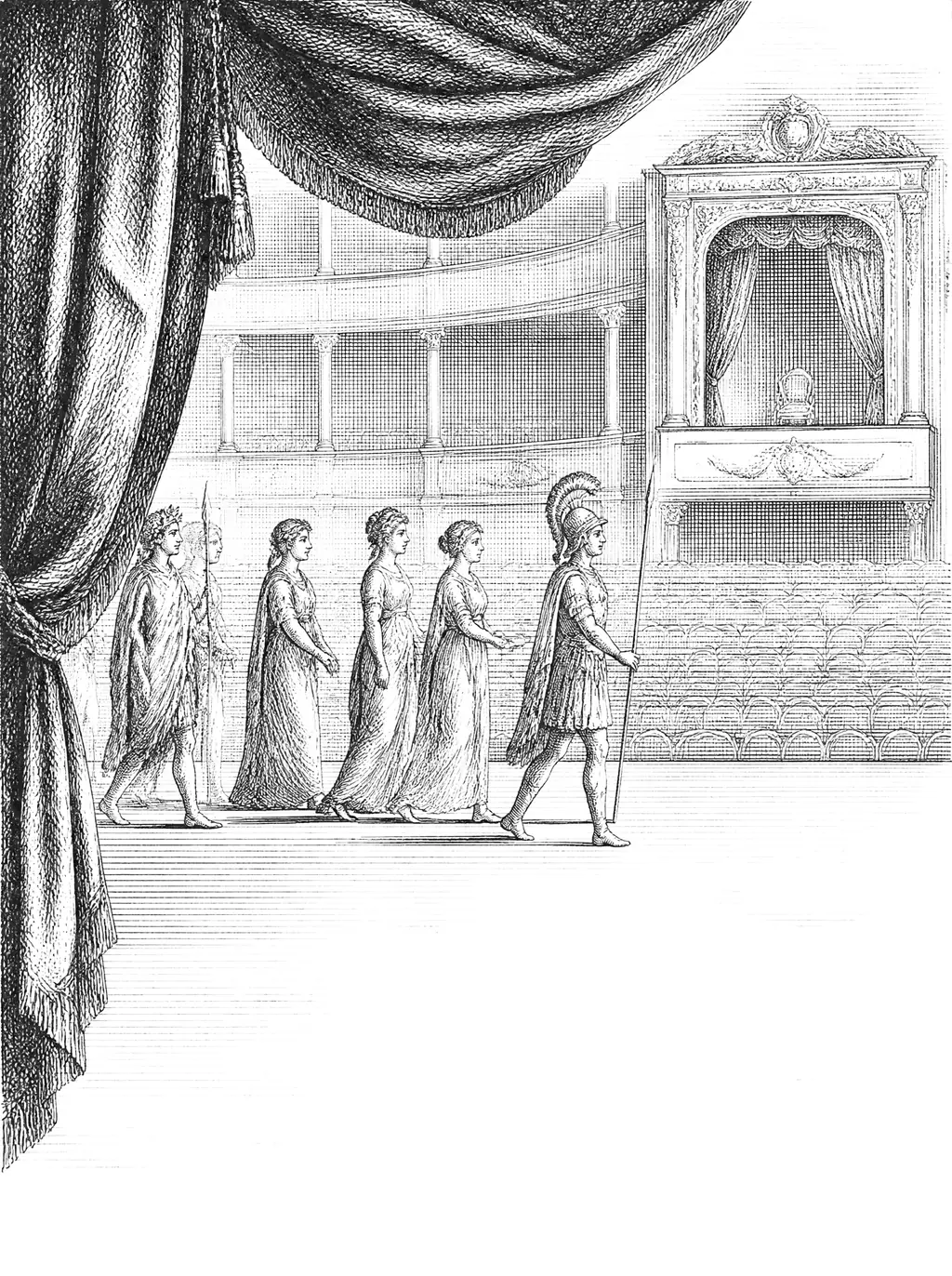
There is no single, continuous self sitting behind your experiences like an owner behind a house. There is only the succession of experiences themselves, thoughts, sensations, feelings, following one another in rapid, shifting sequence, which the mind mistakes for a single unified thing because the sequence happens to be continuous and closely connected, the way frames blur into motion. Hume's own image is a theatre, where perceptions make their appearance, pass, and mingle in endless variety. Then he withdraws the image before it misleads. There is no stage, no building, no seat. The theatre is the performances. Identity is something the imagination adds, not something the perceptions contain.
How the reasoning runs
First, every genuine idea derives from some impression, some experience it copies. Second, the self is supposed to be something we are intimately aware of, the same through a whole life. Third, if there were an idea of such a self, there would have to be one impression that stays constant and invariable through life. Fourth, but no impression does that; pains, pleasures, sights, and sounds all succeed one another and never stay. Fifth, look inward and check: you always stumble on some particular perception and never on yourself apart from it. Therefore there is no idea of a simple, continued self. What we call one is a bundle, and the feeling of unity comes from resemblance, causation, and memory chaining the perceptions together.
Seen in life
You scroll back through eight years of messages with an old friend and reach the ones from when you were nineteen. The jokes are unfamiliar. The worries are about people you cannot place. The person writing them wanted things you no longer want and would have been baffled by what you want now. You say I wrote that, and the word I does a great deal of work. Ask what it is pointing at. Not the body, which has replaced most of its cells. Not the memories, which are patchy and shared. Not the character. What links the nineteen-year-old to you is a chain of overlapping days, each resembling the last, and Hume's claim is that the chain is all there is.
Why it matters
This undercuts a deep assumption running through most thinking about identity, morality, and even survival: that there is a stable core self persisting unchanged underneath all your changes. If Hume is right, that core was never observed, only assumed, and everything built on the assumption, promises kept over decades, a fixed character, moral responsibility over time, needs a different foundation than a permanent self. The result can be frightening or freeing. If there is no fixed you, then the fear of death is partly the fear of losing something you never had, and the person who wronged someone twenty years ago is connected to you by a chain, not an identity. Hume did not draw those conclusions. Others did.
“They are nothing but a bundle or collection of different perceptions, which succeed each other with an inconceivable rapidity, and are in a perpetual flux and movement.”
From the source
Hume writes in the Treatise, venturing to affirm of the rest of mankind: “They are nothing but a bundle or collection of different perceptions, which succeed each other with an inconceivable rapidity, and are in a perpetual flux and movement.” The sentence follows his own report. When he enters most intimately into what he calls himself, he always stumbles on some particular perception, of heat or cold, light or shade, love or hatred, and never catches himself without one. He concedes that some metaphysician may perceive something simple and continued that he calls himself, and adds, with a straight face, that he is certain there is no such principle in him. Then he offers the theatre, and takes it back.
The pushback
Doesn't this contradict ordinary experience, in which you clearly feel like the same person who woke up this morning and will go to sleep tonight? Hume does not deny the feeling of continuity; he denies that introspection actually finds a thing producing it. The feeling, on his account, is the mind's own habit of linking connected perceptions together, not evidence of a separate, persisting self underneath them. The harder objection is that the bundle needs a bundler. Someone did the looking and found only perceptions; someone stumbles on the heat and the cold. Kant made the point systematic: for perceptions to be linked as mine, there must already be a unity of consciousness doing the linking, and that unity cannot be one more item in the bundle.
The reply
To the first objection, Hume's account of the feeling is the reply: resemblance, causation, and memory give the imagination an easy passage from one perception to the next, and ease of passage is what identity feels like from inside. To the bundler objection, the honest answer is that Hume did not have one. In the appendix to the Treatise, published a year later, he confessed that when he came to explain what unites our successive perceptions, he found the account very defective, and that all his hopes vanished. He could neither give up the bundle nor say what binds it. Few philosophers have admitted a failure so plainly. The problem he left open is still the problem, and his candor is part of why it is still his.
Where it went next
Kant's answer, the transcendental unity of apperception, was built to fill the hole Hume admitted. Buddhist philosophers had reached a no-self doctrine two thousand years before, and one historian has suggested that Hume met Buddhist ideas through Jesuits at La Flèche, though the evidence is thin. Derek Parfit's Reasons and Persons in 1984 made the bundle the basis of an ethics: if identity is not what matters, then the boundary between you and your future self is less deep than you think, and so is the boundary between you and others. Daniel Dennett called the self a center of narrative gravity, a useful fiction. Neuroscientists went looking for a self in the brain and, like Hume, found a great deal of activity and no one in charge.
Where this leads
Cogito ergo sum assumed exactly the persisting thinker Hume's bundle theory later denies ever finding, which makes the two ideas a direct disagreement about what careful introspection actually delivers, once you look as closely as either philosopher claimed to have looked. Descartes found a thinking thing; Hume found thinking and no thing. Existence precedes essence draws the practical moral. If there is no fixed self, Sartre says, then who you are is not discovered but made, one choice at a time, and the bundle is something you are responsible for tying. Hume would have found that too dramatic, and would have played backgammon instead, which is what he says he did whenever the argument got too dark.