Symposium · Metaphysics · Pl. 6William James · 1842–1910
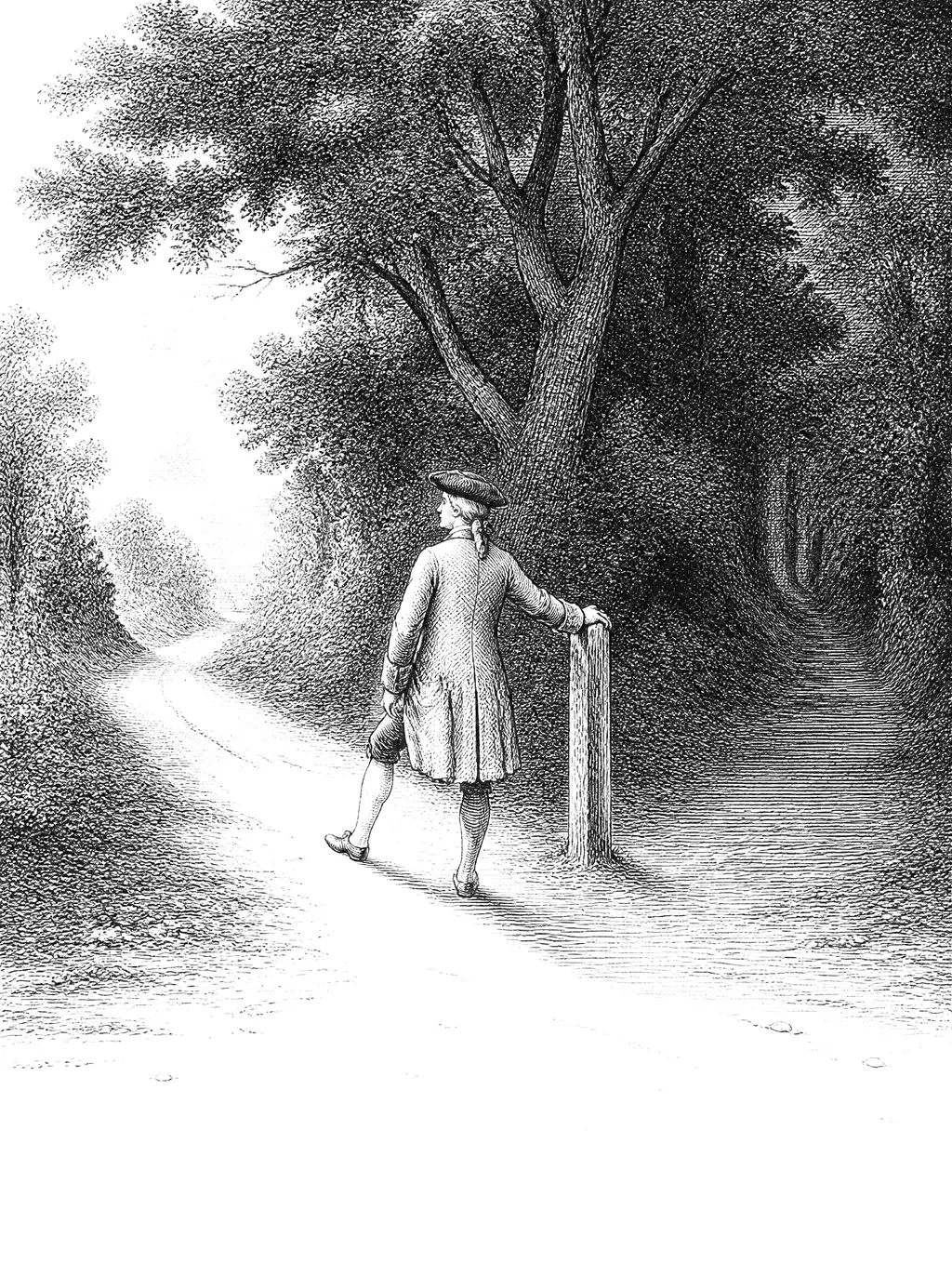
The First Act of Freedom
A debate James refuses to settle
The free-will controversy asks whether human choices are ultimately determined by prior causes or genuinely open. James, addressing the question directly, announces at the outset that he will not try to prove freedom is real. His actual target is narrower and stranger: what follows logically once you notice that the decision to believe in freedom might itself be an exercise of it. He had performed the act himself, fourteen years earlier, in a diary entry written at the bottom of a long depression. He had been reading Charles Renouvier on free will and wrote that his first act of free will would be to believe in free will. He was twenty-eight. The essay he wrote later is that private decision made into an argument.
The world it came from
William James trained as a physician at Harvard, never practised, and taught there for the rest of his life, first physiology, then psychology, then philosophy. In the winter of 1869 to 1870 he suffered a crisis of depression tied to the fear that he was a machine. Reading the French philosopher Charles Renouvier gave him a way out, recorded in the diary entry of April 1870. The Dilemma of Determinism was an address to Harvard Divinity School students in 1884. Its opponents were the scientific determinists of the age, Herbert Spencer and T. H. Huxley among them, who held that a complete physics leaves no room for open choices. James's answer was not physics but a question about what a person can consistently affirm.
The idea
James's sentence runs: our first act of freedom, if we are free, ought in all inward propriety to be to affirm that we are free. Believing in determinism can be defended by an appeal to prior causes outside your control. Believing in freedom, if freedom is real, has to start somewhere, and starting by freely affirming it is the one act that is not just consistent with the belief, but required by it. James called this the postulate of freedom. It cannot be proved from the outside, because any proof would be a chain of causes, which is what the determinist already has. It can only be enacted. The believer in freedom does not conclude that she is free; she begins by being free.
How the reasoning runs
Step one: the question of free will cannot be settled by evidence, because the same past is consistent with both hypotheses, and no experiment can rerun a moment to see whether it could have gone otherwise. Step two: so the choice between determinism and freedom is itself a choice, made on grounds other than proof. Step three: if determinism is true, that choice was caused, and the determinist can accept this without strain. Step four: if freedom is true, the choice is free, and a believer in freedom who claimed to be forced into the belief would be contradicting herself. Conclusion: the only belief in freedom that is consistent with freedom is one freely adopted.
Seen in life
You have relapsed for the third time, and the counsellor asks whether you think you can stop. A voice inside says no: look at the record, three attempts, three failures, and a family history. The record is a determinist's argument, and a good one. James's point is that agreeing with it is not a neutral act of observation. It is a choice about which story to live in, and if the choice is open, you have just used your freedom to deny you have any. The alternative is not to pretend the record does not exist. It is to notice that the first free act available to you is the act of treating the next attempt as open. That act is the only proof of freedom you will ever get.
Why it matters
This reframes an apparently abstract metaphysical debate as something with an immediate, personal stake: which belief you can actually live inside coherently. A determinist can consistently believe determinism without contradiction. Someone convinced of freedom faces a small, self-referential demand the determinist never has to meet: to freely choose the very belief that freedom exists at all. James thought the demand was a gift rather than a burden. It means the question is not waiting on physics, and that no future discovery can take the first act away from you. It also means that indecision is not neutral. To wait for proof before believing in freedom is already to have decided against it, since a freedom that waits for permission has conceded that permission is what governs it.
“In other words, our first act of freedom, if we are free, ought in all inward propriety to be to affirm that we are free.”
From the source
James states the position directly: “In other words, our first act of freedom, if we are free, ought in all inward propriety to be to affirm that we are free.” He disclaims, in the same breath, any pretension to force this conclusion on an unwilling reader. The sentence comes near the start of The Dilemma of Determinism, delivered in 1884 and collected in The Will to Believe in 1897. The essay then leaves the postulate behind and argues from a different direction, through regret: if the murder you regret could not have been otherwise, then regret is a mistake; and if regret is not a mistake, the universe contains real alternatives. Either way, James thought, the determinist has to give something up.
The pushback
Doesn't this argument only work if you already grant free will exists, making it circular rather than a genuine reason to believe in it in the first place? James openly admits exactly this limitation; his essay is not offered as proof, only as a way of showing what is actually at stake for someone deciding, of their own accord, which side of the debate to live by. A harder objection comes from compatibilists. They hold that freedom and determinism are not rivals: a free act flows from your own desires without compulsion, and can be fully caused. On that view the compatibilist can be caused to believe in freedom and still be free in the only sense worth having. James's first act then proves nothing about causes.
The reply
James accepted the circularity and reframed it. The argument was never meant to move a determinist; it was meant to show a believer in freedom what her belief commits her to, and to show that the commitment is not irrational. To compatibilism, he was harsher: he called it a quagmire of evasion, because it redefines freedom so that it no longer means the thing people were worried about, the possibility that the future is genuinely open. Whether that is fair is still argued. Compatibilists reply that James wanted a metaphysical freedom nobody can make sense of, and that his own first act, on their reading, was a caused event that happened to save his life. James might have accepted that description and still called it free.
Where it went next
The postulate of freedom became a central theme of pragmatism, the movement James named and led with Charles Peirce and later John Dewey: a belief is judged by what it lets you do, and the belief in freedom passes the test. The Will to Believe generalised the argument to religion and drew a century of criticism from those who thought it licensed wishful thinking. Existentialists, Sartre above all, reached a similar conclusion by another road: you are condemned to be free, and denying it is bad faith. In psychology, the finding that people who believe their traits can change tend to change more, associated with Carol Dweck's work on mindset, is James's diary entry restated as data.
Where this leads
The will to believe supplies the wider theory this specific argument is drawn from, James's broader case that some genuinely open questions are rightly settled by a person's own free, passionate commitment, rather than by argument alone deciding the matter. Moral luck pulls the other way. Nagel and Williams show how much of what we praise and blame depends on factors nobody chose, and the determinist's record, the one James asks you to answer with a free act, is built out of exactly that luck. Read the two together and the question sharpens: James does not deny that most of your life was handed to you. He asks what you will do with the one act that was not.