Symposium · Political Philosophy · Pl. 5John Locke · 1632–1704
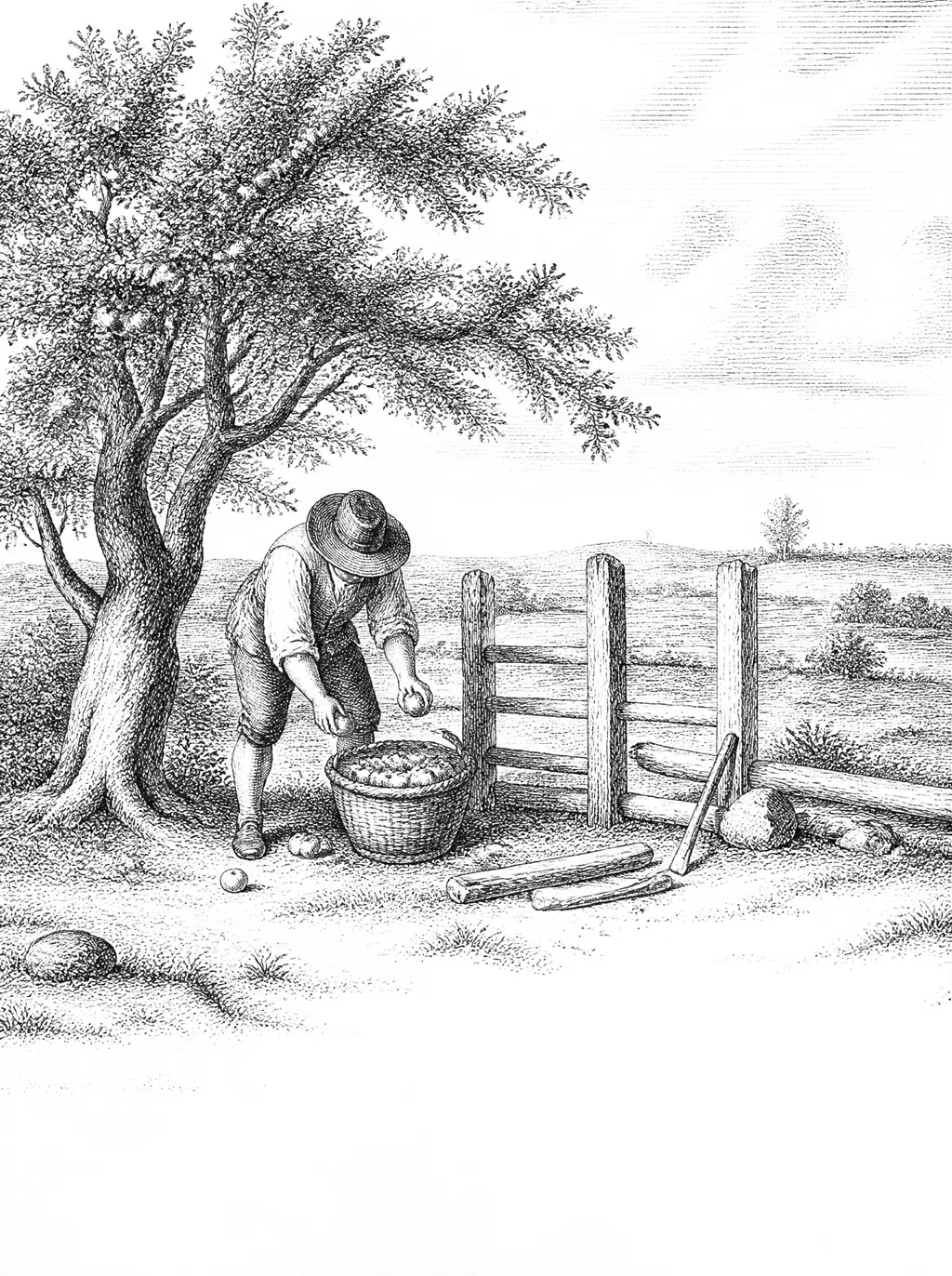
You Own What You Work For
A puzzle hiding in plain sight
If God gave the earth to all people in common, as most of Locke's readers already believed, then a real puzzle follows immediately: how does any individual come to own a particular apple, field, or house without first getting everyone else's permission? Locke needed an answer that did not require humanity to hold a single meeting before anyone could eat. He also needed an answer that did not run through the king. His opponents said all property was originally the monarch's gift. If that were true, then the king could take it back, and no subject could ever tell him no. The apple, for Locke, was the first line of defense against that.
The world it came from
Locke drafted the Second Treatise around 1680, during the fight over whether the Catholic James could be excluded from the English throne. The court's theorist, Robert Filmer, held that God gave the world to Adam and that kings inherited Adam's title, so all property came from the crown. Locke's patron, the Earl of Shaftesbury, was leading the opposition, and Locke was helping him. Locke also had a working knowledge of colonies. He had drafted constitutions for Carolina and served on the Council of Trade, and his chapter on property treats America as the model of land still lying in common. That connection is why later critics read the chapter as a theory written with colonization in view.
The idea
Every man has a property in his own person, and the labour of his body and the work of his hands are properly his own. Thus labour, in the beginning, gave a right of property, wherever any one was pleased to employ it upon what was common. Mixing your own labor with something unowned removes it from the common stock and makes it yours. Locke attaches two limits. You may take only what you can use before it spoils, and you must leave enough, and as good, for others. He then argues that money, which does not spoil, lets people accumulate beyond those limits by an agreement everyone has tacitly made.
How the reasoning runs
Begin with two premises Locke's readers already accepted: the earth was given to humanity in common, and each person owns his own body. From the second, it follows that a person owns his labor, since labor is the body at work. Next, when labor is applied to something unowned, the labor and the thing become inseparable; you cannot pick up the acorn without your picking becoming part of it. So the thing now contains something that is yours, and no one else can take it without taking your labor too. Therefore it is your property, and the consent of the rest of humanity is not required, or nobody could ever eat. Two limits follow from the purpose of the gift: no waste, and enough left for others.
Seen in life
There is a vacant lot at the end of your street, fenced, weedy, owned by nobody anyone can name. One spring you and three neighbors cut the fence, haul out the rubbish, dig beds, and plant. By August there are tomatoes. Then a letter arrives: the city has found the deed and is selling the lot to a developer. Your instinct is that something has been taken from you, and Locke tells you why. The lot was common, in the sense that nobody was using it. You mixed your labor with it. The tomatoes are yours by any standard you can articulate. Whether the ground is yours too is where the argument gets hard, and where the developer's lawyer will start.
Why it matters
This grounds private property in effort rather than in decree, conquest, or inherited title, giving ordinary work a moral claim that does not depend on a king's grant or a government's permission. It became one of the most influential justifications for property rights in the modern world, cited by revolutionaries and economists alike for centuries afterward. It also sets the terms of every later fight about ownership. If labor is what creates a right, then someone who lives on the labor of others has a weaker claim than someone who works, and a system in which the workers own nothing looks like theft. Locke did not draw that conclusion. Marx did, using Locke's premise.
“Thus labour, in the beginning, gave a right of property, wherever any one was pleased to employ it upon what was common, which remained a long while the far greater part, and is yet more than mankind makes use of.”
From the source
Locke states the principle directly: “Thus labour, in the beginning, gave a right of property, wherever any one was pleased to employ it upon what was common, which remained a long while the far greater part, and is yet more than mankind makes use of.” The sentence closes an argument in Chapter V of the Second Treatise. Locke has already given his examples: the acorns a man gathers under an oak become his when he picks them up, not when he digests them, and the deer an Indian kills is his though the forest is common. He adds that labor accounts for nearly all the value of anything, since an acre left to nature yields almost nothing compared with an acre tilled.
The pushback
Locke's own theory includes a limit, that enough and as good be left for others, a condition much harder to satisfy once land grows genuinely scarce. Critics have long pointed out that a theory built for a world of open, unclaimed land travels awkwardly into a crowded one, where one person's labor-based claim increasingly forecloses everyone else's. Robert Nozick added a sharper puzzle in 1974. Why does mixing what you own with what you do not gain you the second thing rather than lose you the first? If you pour a can of tomato juice you own into the sea, you do not come to own the sea. You have wasted your juice. Locke never explains why labor works differently.
The reply
Lockeans answer Nozick by dropping the mixing metaphor and keeping the point underneath it: labor adds value, and the person who adds it has the best claim to what was added. Nobody labors on the sea by pouring juice into it. That answer works for the tomatoes and weakens for the ground beneath them, which the gardener did not create. The scarcity objection has a serious answer too. The provisos are real constraints, not decoration, and a strict reading of them supports redistribution rather than accumulation, which is why some left-libertarians call themselves Lockeans. What no reading fully rescues is the money passage, where Locke waves away the limits with a tacit consent to inequality that nobody remembers giving.
Where it went next
Jefferson had Locke's triad of life, liberty, and property in front of him when he wrote the Declaration, and swapped the last term for the pursuit of happiness. Adam Smith and David Ricardo turned the claim that labor makes value into economics, and Marx turned that economics against the owners, arguing that profit is the labor of workers kept by someone else. The Homestead Act of 1862 was Lockean policy: five years of working the land earned title to it. Nozick's entitlement theory in 1974 rebuilt libertarian property on Locke's foundation, and his critics rebuilt egalitarianism on the same foundation using the provisos. Arguments over who owns a song, a gene, or an asteroid still start with the sentence about labor.
Where this leads
The history of all hitherto existing societies is the history of class struggles reaches the opposite conclusion from the same starting puzzle, treating private property not as a natural right earned by labor, but as the very mechanism by which some hoard the labor of others. Marx and Locke agree that labor is the source of value. They disagree about who ends up holding it. Consent of the governed shows what the property is for in Locke's own system: people leave the state of nature to secure what their labor has made theirs, so the right to property comes first and the state exists to guard it.