Symposium · Ethics · Pl. 15John Rawls · 1921–2002
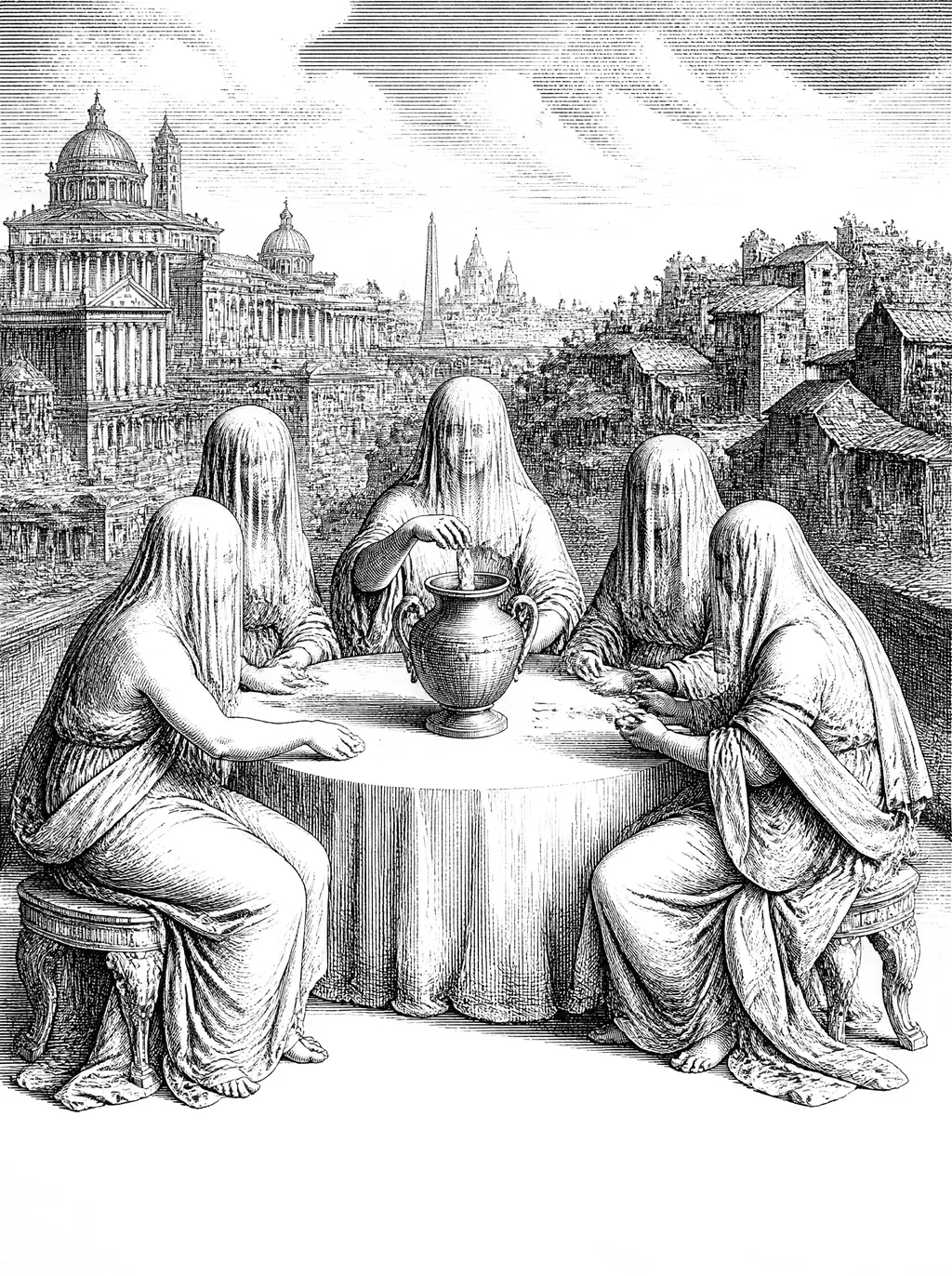
The Veil of Ignorance
Design it blind
Ask people to design a fair society and most will, consciously or not, tilt the rules toward whatever group they already belong to. Rawls proposed a thought experiment to strip that bias out entirely: imagine the designers do not yet know their own race, class, sex, talents, or position in the society they are about to build. They know how societies work in general. They know nothing about where they will land in this one. Then ask them to choose. Rawls bet that people choosing under that condition would agree on principles, and that the principles they agreed on would deserve the name justice.
The world it came from
Rawls was born in Baltimore in 1921. Two of his brothers died in childhood of diseases they caught from him, a fact his biographers connect to his lifelong attention to undeserved luck. He fought as an infantryman in the Pacific and was in Japan soon after the bombing of Hiroshima; he came home having lost his Christian faith. He taught at Harvard from 1962 and published A Theory of Justice in 1971, in the middle of the civil rights movement and the Vietnam war. The philosophical target was utilitarianism, which could in principle sacrifice a minority for the sum of happiness. Rawls wanted a theory of justice that took each person seriously and could still be argued for step by step.
The idea
Behind this veil of ignorance, rational people choosing principles of justice would not gamble on rules that might leave them destitute, since they might turn out to be the very person at the bottom. Rawls argued this hidden self-interest, no longer able to target any specific advantage, would push the designers toward genuinely fair principles, ones anyone could accept regardless of where they ended up. He thought they would choose two. First, each person gets the most extensive basic liberties compatible with the same liberties for all. Second, social and economic inequalities are allowed only when the positions are open to everyone and the inequality works to the benefit of the least advantaged.
How the reasoning runs
Start with a claim about fairness: a principle is fair if people would agree to it from a position where nobody could exploit an advantage. Second, build that position: the veil removes every fact that could be exploited, your class, your talents, your religion, even your taste for risk. Third, ask what such a chooser would rationally do. You might be anyone, including the worst off, and you cannot buy the outcome back once the veil lifts. So you protect the bottom. Rawls calls this maximin: choose the arrangement whose worst position is best. Fourth, the principles that follow are the ones any citizen can be given a reason to accept, which is what a just society owes each of its members.
Seen in life
Your team is writing the policy for who gets the office when two people want it. The senior engineer wants seniority to decide. The person who arrives earliest wants first-come. Everyone's proposal happens to favor themselves. Run the veil. Suppose you do not know whether you will be the new hire, the parent who cannot arrive before nine, or the twenty-year veteran. Seniority now looks like a rule you might be on the wrong side of for a decade. Rotation, or need first, starts to look better. Nothing about the office changed. What changed is that you can no longer see where you stand, and the rule you pick when you cannot see is the one you can defend to everyone.
Why it matters
This gives a concrete procedure for testing whether a proposed rule is actually fair, rather than just convenient for whoever is currently in charge of proposing it: would you still accept this rule if you did not know which position in society you would occupy under it? A rule that only looks fair from the top of the arrangement fails the test immediately. The veil also changes how you see your own advantages. Your talents, your health, and the family you were born into are, from behind the veil, a lottery you happened to win. Rawls does not say you may not benefit from them. He says a just society lets you benefit only in ways that also lift the people who lost.
“The principles of justice are chosen behind a veil of ignorance.”
From the source
Rawls states the core mechanism of his whole theory of justice as plainly and as briefly as the idea will allow, at the very center of the book's argument: “The principles of justice are chosen behind a veil of ignorance.” The sentence sits in the opening pages of A Theory of Justice, where Rawls introduces what he calls the original position. Nobody, he explains, knows his place in society, his class or social status, his fortune in natural assets, his intelligence or strength, or even his conception of the good. The point of the device, he says, is to ensure that nobody is advantaged or disadvantaged in the choice of principles by natural chance or social circumstance.
The pushback
Critics question whether people stripped of all knowledge of their own values and life plans could meaningfully choose anything at all, since the very act of choosing seems to require some perspective, some sense of what one cares about, to reason from in the first place. Rawls's answer restricts the veil to particular personal facts, while keeping general knowledge of psychology and economics intact. A harder objection came from the economist John Harsanyi: a rational chooser behind the veil would not play it safe with maximin but would maximize average expected welfare, which lands you back in utilitarianism. Robert Nozick objected from the other side. People are entitled to what they earn and are given, and no distribution chosen behind a veil can override that.
The reply
To Harsanyi, Rawls replies that the choice is not an ordinary bet. You choose once, for a whole life, with no chance to try again, and the stakes at the bottom are liberty and self-respect, not a smaller pile of goods. Under those conditions guarding the floor is the rational policy. To Nozick, Rawls answers that nobody earns the talents or the family the market rewards, so entitlement cannot go all the way down. To the communitarians, who said the veil imagines a self with no attachments, Rawls conceded ground in Political Liberalism and reframed the theory as one for citizens who already hold many different creeds. That concession is real. Whether it saves the original argument or replaces it remains disputed.
Where it went next
A Theory of Justice revived political philosophy in the English-speaking world almost by itself; for a generation, work in the field was either a development of Rawls or a reply to him. Nozick's Anarchy, State, and Utopia in 1974 was the libertarian reply. Michael Sandel's Liberalism and the Limits of Justice in 1982 led the communitarian one. Susan Moller Okin ran the veil through the family and found Rawls had not. Amartya Sen and Martha Nussbaum built the capabilities approach partly by asking what the least advantaged actually need. Rawls himself wrote Political Liberalism in 1993 and The Law of Peoples in 1999, extending the method to religious pluralism and to relations between nations.
Where this leads
The categorical imperative anticipates a similar move a century and a half earlier, asking whether a rule could be willed as a universal law binding on everyone, a test that shares the veil's basic instinct: strip out your own special case and see what survives. Rawls acknowledged the debt and called his theory Kantian in spirit. The harm principle marks the boundary his first principle protects: the basic liberties are exactly the space Mill wanted to keep free of interference. Read the three as a sequence. Kant asks what you can will for everyone, Mill asks where society must stop, and Rawls asks what rules you would accept if you could be anyone.