Symposium · Political Philosophy · Pl. 8Karl Marx and Friedrich Engels · 1818–1883 / 1820–1895
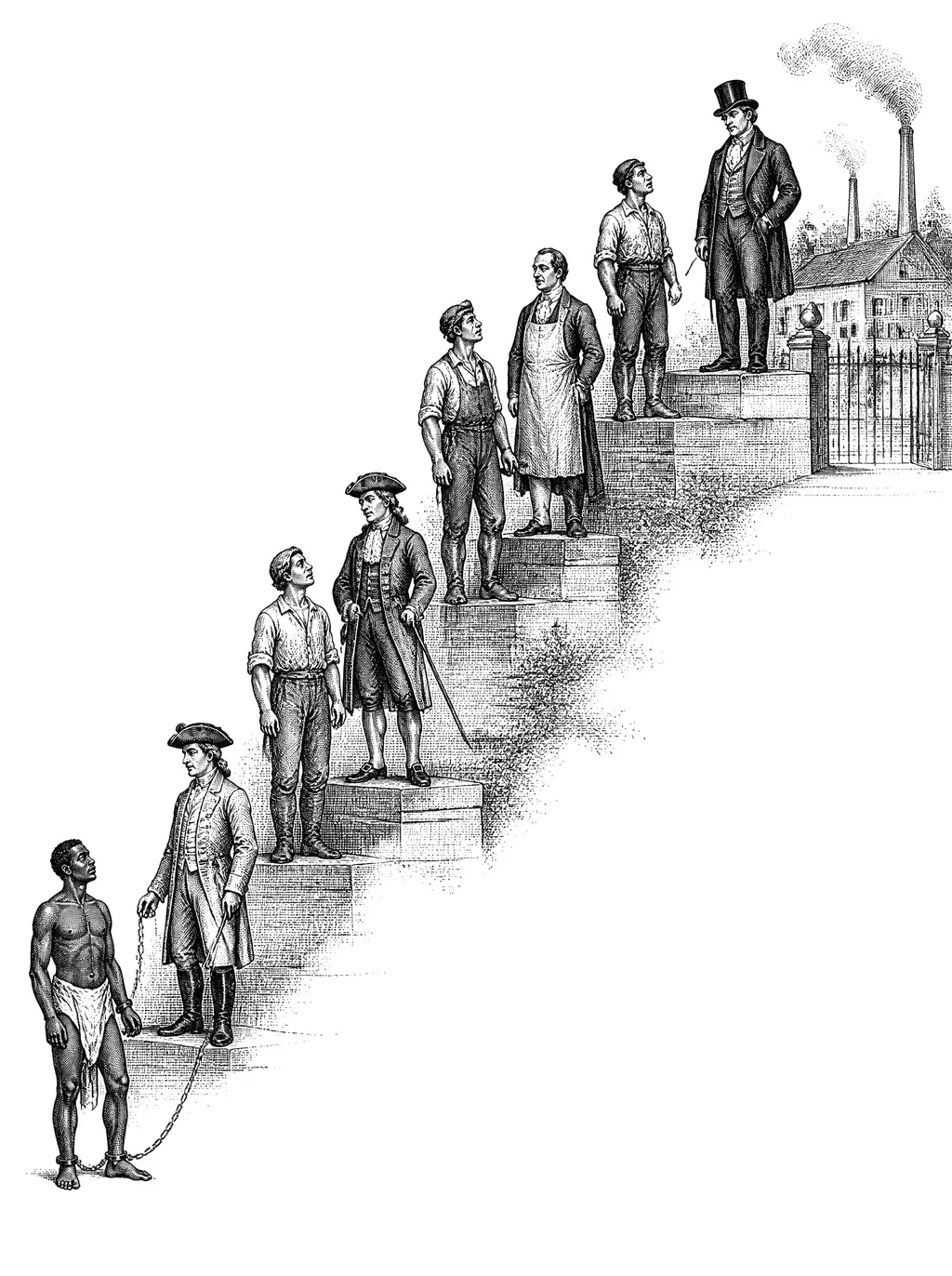
The History of Class Struggles
One story, told a hundred ways
Free and slave, patrician and plebeian, lord and serf, master and journeyman: Marx and Engels line up centuries of apparently different social arrangements and argue they are all versions of the same underlying story, one group holding power and resources, another group producing them, locked in a struggle that occasionally erupts and reshapes the entire social order. The list is doing an argument's work. Each pair names a society that thought its own hierarchy was natural, and each hierarchy fell. If the reader accepts that pattern for Rome and for feudal Europe, the Manifesto has only to add one more pair, bourgeois and proletarian, and ask why this one should be the exception.
The world it came from
Marx was born in Trier in 1818 and Engels in Barmen in 1820, both in the Prussian Rhineland. Engels worked in his family's cotton firm in Manchester and in 1845 published a study of the condition of the English working class, written from the slums he had walked through. Marx had been expelled from Paris in 1845 and was living in Brussels. In late 1847 the Communist League, a small group of German émigré workers based in London, asked them to write its program. The Manifesto was printed in London in February 1848, days before revolution broke out in Paris and then spread to Berlin and Vienna. The 1840s were a decade of famine, factory misery, and Chartist marches, and the authors expected the fight to be short.
The idea
The history of all hitherto existing societies is the history of class struggles. Freeman and slave, patrician and plebeian, lord and serf, guild-master and journeyman, in a word, oppressor and oppressed, stood in constant opposition to one another, a fight that each time ended, either in a revolutionary re-constitution of society at large, or in the common ruin of the contending classes. A class, for Marx, is defined by its relation to the means of production: those who own the land, the mills, the capital, and those who have only their labor to sell. The struggle is not a matter of bad feeling. It follows from the fact that one group lives on what the other produces.
How the reasoning runs
Start with a premise about how societies work: the way people produce their living shapes everything else, law, religion, family, and ideas. Next, in every society since the earliest, one group has controlled the means of production and another has done the work. The controllers keep the surplus. So the two groups have opposed interests built into their positions, whatever they feel about each other. Third, the arrangement is unstable, because the means of production keep developing and eventually outgrow the relations built around them; then the old ruling class is overthrown by a new one. Capitalism, Marx argues, has simplified the fight to two camps and, by creating a vast propertyless workforce, has produced the class that will end the sequence. Therefore history has a direction.
Seen in life
You drive for a delivery app. The company calls you a partner and insists you are your own boss; you set your hours and own your car. Then the rate per drop falls, the algorithm starts penalizing you for declining jobs, and a rule appears about how fast you must accept. You and a few drivers start a group chat. Within a month it has four hundred members and someone is talking about a day when nobody logs on. Marx would say you have just discovered your class. Not because you read him, but because you own the car and someone else owns the platform, and the platform's profit is the gap between what you are paid and what your work brings in. The chat is what the Manifesto predicted.
Why it matters
This reframes political and economic history as driven by material conflict between classes, rather than by the ideas, virtues, or intentions of individual rulers and thinkers. On this account, laws, religions, and philosophies are not neutral; they tend to reflect and defend the interests of whichever class currently holds economic power over production. That claim changed what a historian looks for. Before Marx, history was mostly kings, battles, and doctrines. After him, it became possible to ask of any institution who paid for it, who profited, and what work it was quietly doing for its owners. You do not have to accept his conclusions to find that you have absorbed his question.
“The history of all hitherto existing societies is the history of class struggles.”
From the source
The Communist Manifesto opens its first chapter with the claim directly: “The history of all hitherto existing societies is the history of class struggles.” Every subsequent stage of the argument, feudalism collapsing into capitalism, capitalism producing its own opposition, follows from this single starting claim. The chapter is titled Bourgeois and Proletarians. Engels added a footnote to the English edition of 1888 narrowing the claim to all written history, since by then the study of prehistoric societies had shown communities without classes at all. What follows the opening sentence is a long and admiring account of what the bourgeoisie has built: it has created more massive productive forces, the authors say, than all preceding generations together, and has thereby forged the weapons that will be turned against it.
The pushback
Critics argue this frame oversimplifies history into a single axis of conflict, flattening religious, national, ethnic, and personal motivations into economic class interest, when many historical conflicts resist being explained that cleanly. Defenders respond that the theory identifies a dominant pattern, not the only force ever operating in any given period. Max Weber pressed the point with a rival scheme: class is one source of power, but status and party are others, and they do not reduce to it. A harder objection comes from what happened next. The Manifesto predicted the proletariat would grow larger and poorer until it swept capitalism away. Instead, in the countries Marx studied most closely, wages rose, a middle class expanded, and the revolution did not arrive.
The reply
Engels answered the first objection himself, in a letter of 1890, conceding that he and Marx had overstated the economic side in the heat of argument: the economy is the determining factor only in the last instance, and ideas, law, and politics all act back on it. Marx's own study of France in 1852 analyzes a half-dozen classes and their factions, not two. On the failed prediction, defenders point out that wages rose in part because workers organized, which is class struggle working as described, and that the Manifesto was a call to arms, not a forecast. Those replies rescue the diagnosis better than the prophecy. A theory that explains every outcome, including the ones it predicted against, has stopped predicting anything.
Where it went next
The Manifesto sank almost without trace in 1848 and became the most read political pamphlet in the world after Lenin's revolution of 1917 claimed it. Social democratic parties across Europe took the class analysis and dropped the revolution, building welfare states instead. Weber wrote his account of class, status, and party as a reply. Antonio Gramsci asked why the ruling class rules by consent as well as force. E. P. Thompson's Making of the English Working Class in 1963 recast class as something people make in struggle rather than a position they occupy. The word class, as a tool for reading a society, is Marx's, and it is used every day by people who would never call themselves Marxists.
Where this leads
Working men of all countries, unite! is the Manifesto's own proposed response to the struggle this opening line diagnoses, calling for a very specific kind of collective action rather than simply leaving the whole conflict to run its course unaddressed. The diagnosis says the fight is structural and has always been there; the call to action says that this time the losing side can organize across borders and win. You own what you work for is the theory Marx took and turned around. Locke said that labor makes property. Marx agreed, and asked how it came about that the people who labor own nothing and the people who own do not labor.