Symposium · Political Philosophy · Pl. 7Niccolò Machiavelli · 1469–1527
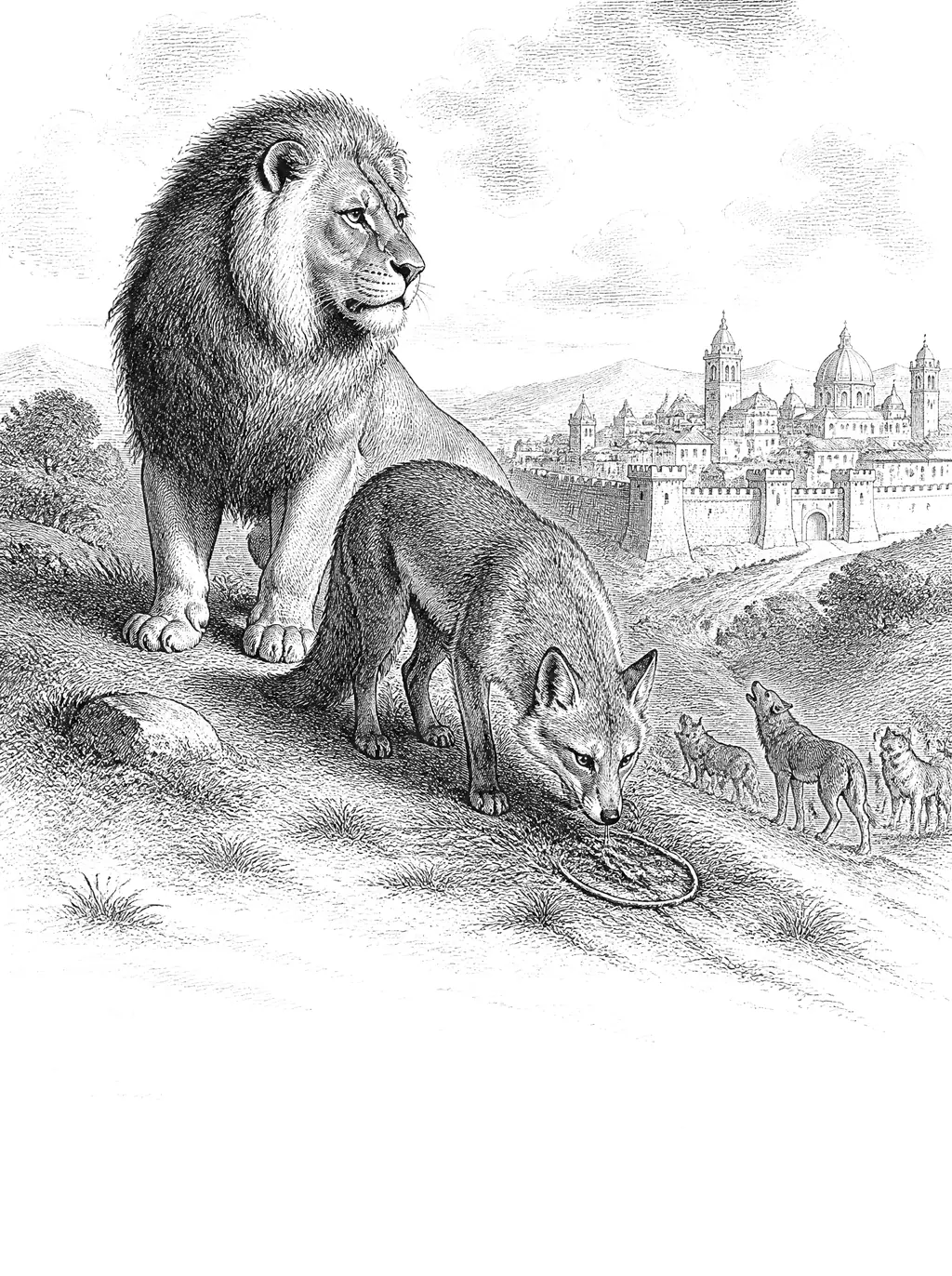
The Fox and the Lion
Two animals, one ruler
Machiavelli reaches for an old image, princes raised half by a man and half by a beast, and asks what kind of beast is actually worth becoming. Raw strength alone, the lion's whole strategy, misses the snares laid by cleverer enemies. Pure cunning alone, the fox's whole strategy, cannot stand up to open, brute force when it finally arrives. The image was not decoration. Machiavelli had watched Florence lose its republic to men who could do both, and he had been tortured by the winners. So the question of which beast to be was, for him, the question of who survives.
The world it came from
Machiavelli served the Florentine republic for fourteen years as a diplomat and secretary, from 1498 until 1512. He negotiated with Cesare Borgia, Louis XII of France, and Pope Julius II, and watched how each of them won. Italy in those years was a battlefield for foreign armies, its small states surviving by alliance, bribery, and betrayal. In 1512 the Medici returned to Florence behind Spanish troops, the republic fell, and Machiavelli lost his post. In 1513 he was accused of conspiracy, imprisoned, and tortured. Released and confined to his farm, he wrote The Prince that same year, addressed to the Medici who had ruined him, as a bid to be useful again.
The idea
A prince, being compelled knowingly to adopt the beast, ought to choose the fox and the lion, because the lion cannot defend himself against snares and the fox cannot defend himself against wolves. It is necessary to be a fox to discover the snares and a lion to terrify the wolves, and a wise ruler cannot keep faith when honesty would work against him. The order matters. Law alone fails against men who ignore it, so the prince must sometimes be a beast. No single animal covers every threat, so he must be two. And the promise he made when it suited him may be broken when it does not, provided he can disguise the breach.
How the reasoning runs
Machiavelli begins with a division. There are two ways of contending, by law and by force; the first belongs to men, the second to beasts, and the first often fails, so a prince must know both. Next, force itself splits. Open strength deters the enemies who attack openly, the wolves. It does nothing against a hidden trap, which only perception can detect. So a ruler who is only a lion walks into the snare, and a ruler who is only a fox is eaten. Third: a promise is a kind of law, and against men who break theirs it becomes a snare. Therefore the prudent prince keeps faith when it serves, breaks it when it does not, and takes care to look like a man who never breaks it.
Seen in life
You run a small company and a larger one offers a partnership. The terms are generous, the people are warm, and the contract is long. The lion in you wants to negotiate hard on price and walk away if pushed. The fox notices something else: an exclusivity clause on page nine that would leave you unable to sell to anyone else if the partner quietly stopped ordering. Strength would not have caught that; only suspicion did. But suspicion alone is not enough either. Once you have spotted the trap, you still need the leverage to strike the clause out, which means being visibly able to walk away. Machiavelli's point is that the two skills are not alternatives. You needed both on the same afternoon.
Why it matters
This extends Machiavelli's realism from force alone to force paired with perception: power that cannot see danger coming is just as fragile as power with no teeth at all. It argues that effective rule requires both vigilance against deception and the willingness to use strength decisively, refusing to pretend either quality alone would be sufficient on its own. It also explains why Machiavelli is hated and read in equal measure. He does not tell the prince to break faith for pleasure; he tells him that faith is a tool, kept while it works. The uncomfortable part is that he may be right about how power is held, and wrong about what it costs to hold it that way.
“A prince, therefore, being compelled knowingly to adopt the beast, ought to choose the fox and the lion; because the lion cannot defend himself against snares and the fox cannot defend himself against wolves.”
From the source
Drawing on the old image of Achilles raised by a centaur, half man and half beast, Machiavelli states the image directly: “A prince, therefore, being compelled knowingly to adopt the beast, ought to choose the fox and the lion; because the lion cannot defend himself against snares and the fox cannot defend himself against wolves.” The passage sits in Chapter XVIII, on how princes should keep faith. Machiavelli praises the ancient writers who sent Achilles to be raised by Chiron the centaur, and reads the story as a lesson: a ruler must know how to use both natures, since one without the other does not last. He adds that if men were all good the advice would be wicked, but they are not, and they will not keep faith.
The pushback
Doesn't openly advising rulers to break faith whenever convenient corrode the very trust that makes governing possible in the long run, turning short-term cunning into long-term instability once subjects learn a ruler's word means nothing? Machiavelli would answer that he is describing how successful princes actually behave, not proposing an ideal to admire. There is a second, harder objection. Machiavelli's fox depends on a public that can be fooled: he says men are so simple that a deceiver will always find someone to deceive. But a reputation is a shared record, and a prince who breaks faith once is watched forever after. The advice may work for one betrayal and fail for the second.
The reply
Machiavelli answers the first objection in the same chapter: the prince must not merely break faith but appear to keep it, and the appearance is what most people judge by, since few touch what you are and many see what you seem. He also limits the advice. Break faith only when keeping it would harm you, and only when the reasons that bound you have gone. The second objection he answers less well. He assumes a world of short memories and weak institutions, which sixteenth-century Italy largely was. Where records are kept and rivals talk to each other, the fox's trick wears out fast. His defenders say he was describing survival in a crisis, not a stable state. That is true, and it narrows the claim.
Where it went next
The Prince circulated in manuscript and was printed in 1532, five years after Machiavelli's death. The Church placed it on the Index of Prohibited Books in 1559, and his name became an adjective for cunning within a generation. Frederick the Great published an Anti-Machiavel in 1740, then governed much as the book advised. Rousseau read The Prince as a warning to republics disguised as advice to kings. Antonio Gramsci, writing in a Fascist prison, recast the prince as the modern political party. Realist thinkers in international relations still cite the fox and the lion as the plainest statement that power needs both intelligence and force. And every negotiation manual that tells you to read the fine print and keep your walk-away option is quoting him without the credit.
Where this leads
Better feared than loved supplies the emotional register this cunning is meant to serve, using the fox's sharp perception and the lion's raw force together to secure the fear Machiavelli argues is the far safer foundation for holding onto power. Moral luck sharpens the discomfort from a different side. Machiavelli's prince is judged by results, and results depend on fortune as much as on skill; the same deception that saves one ruler destroys another. If praise and blame track outcomes we did not fully control, then the fox who succeeds and the fox who fails may have made identical choices, and only the dice decided which one history calls wise.