Symposium · Ethics · Pl. 11Bernard Williams · 1929–2003
Moral Luck
The same choice, two different verdicts
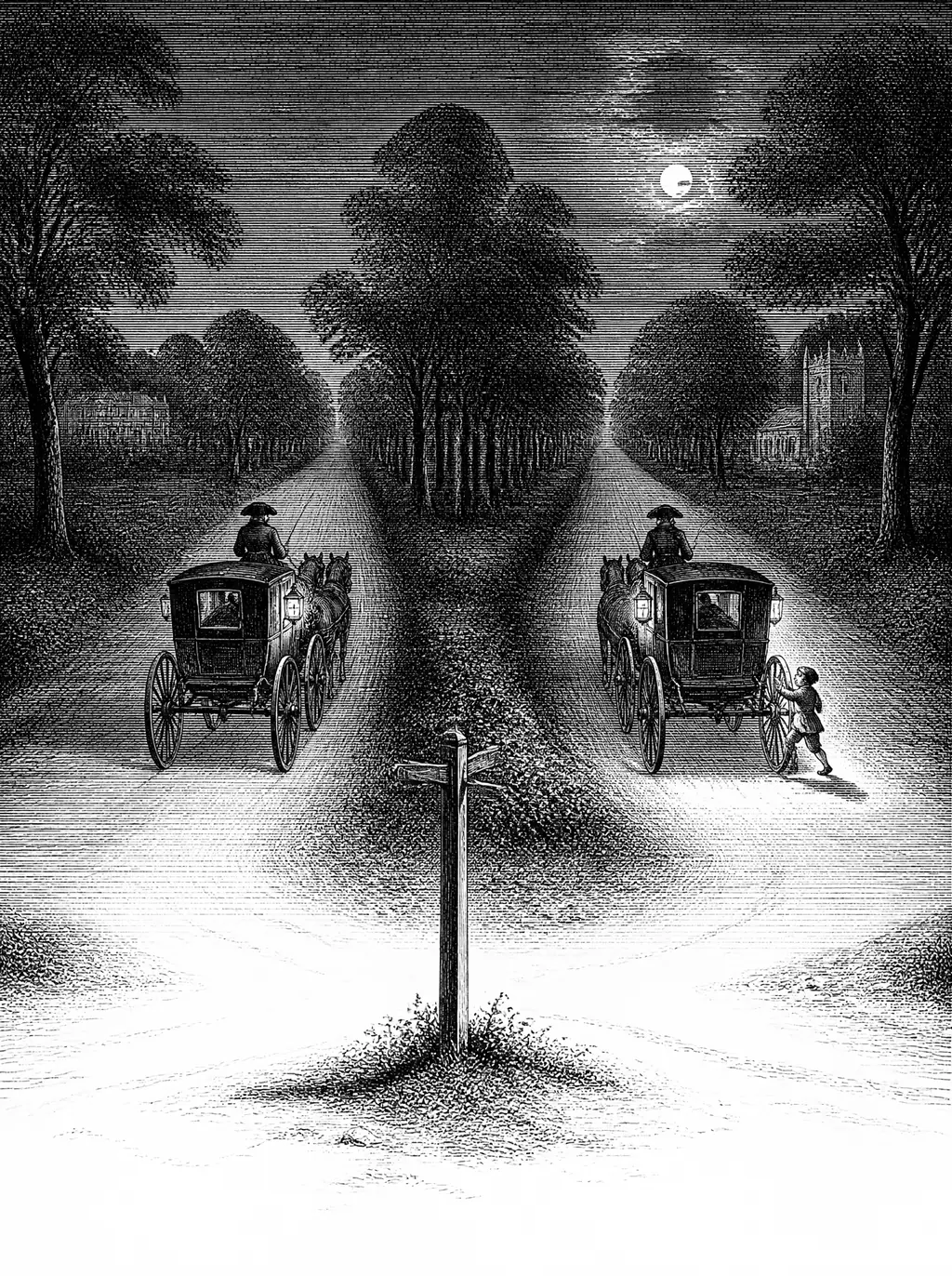
Both drivers made the identical decision: drive home drunk, at the same speed, on similar streets, with the same disregard for the risk. Only one of them, purely by chance, happens to encounter a child in the road. We punish that driver far more severely, and judge him far more harshly, even though the choice that actually deserves judgment was made before either of them knew how the story would end. The law agrees with the gut here: manslaughter for one, a fine for the other. Williams's question is whether that verdict is a mistake we should correct, or a truth about morality that the theories have been hiding.
The world it came from
Bernard Williams read the paper called Moral Luck to the Aristotelian Society in 1976, with Thomas Nagel replying, and the two essays were published together. Williams was then Knightbridge Professor at Cambridge, formerly married to the politician Shirley Williams, and already the most feared critic in British philosophy. His target was the Kantian picture in which morality is the one thing beyond the reach of fortune: whatever happens to you, your good will is untouched. Williams thought that picture was a consolation, not a description. His own central example was not a driver but Gauguin, who abandons his family to paint in Tahiti. Whether that choice was justified, Williams argued, depends on whether the paintings turned out to be great, which Gauguin could not know when he left.
The idea
Moral luck names the uncomfortable fact that factors entirely outside a person's control, whether a child happened to be crossing at that exact moment, whether a risky decision happened to pay off, routinely shape how we morally judge that person, even though standard moral theory says people should only be assessed for what is genuinely up to them. Luck keeps intruding anyway. Nagel sorted the intrusions into four kinds. Resultant luck is how things turn out. Circumstantial luck is what situations you face: the German who would have joined the party had he not emigrated in 1930. Constitutive luck is the temperament you were born with. Causal luck is everything that made you the person who chose. Together they leave very little that is purely yours.
How the reasoning runs
Start with a principle nearly everyone accepts: you can only be blamed for what was within your control. Second, look at actual judgment. The driver who kills is blamed more than the driver who does not; the general who won is praised over the one whose identical plan failed. Third, note that the difference between the pairs is luck alone. So either the practice violates the principle, or the principle is false. Fourth, try to save the principle by subtracting luck: judge only the will. But Nagel's four kinds show that the will itself is a product of luck. Subtract all of it and nothing is left to judge. Williams concludes that the Kantian principle describes no possible practice, and our judgments were never built on it.
Seen in life
You check the figures on a Friday, decide they are close enough, and send the report. Nothing happens. Your colleague does exactly the same thing a week later, and her rounding error lands in a board presentation, costs a client, and ends up in a disciplinary file. You both cut the same corner with the same care. Only one of you is the person who made the mistake, and it is not you. Notice what you feel: relief, and underneath it the knowledge that the relief is not earned. Williams would say that knowledge is correct. You were not better. You were luckier. And yet you would not accept the same sanction she got, and nobody would think to give it to you.
Why it matters
This exposes a real tension inside ordinary moral judgment: we officially believe blame should track only what someone controls, yet we consistently blame people more or less based on outcomes they did not control at all. Either our everyday practice of judging people is systematically confused, or the tidy theory that moral assessment tracks only what is within a person's control was wrong from the start. The stakes are not only theoretical. Criminal law punishes the completed crime more than the attempt. Professional bodies discipline the surgeon whose patient died and not the one who took the same risk and got away with it. And each of us carries a private ledger of near misses that, on the Kantian account, should weigh exactly as much as the hits.
“When I first introduced the expression moral luck, I expected to suggest an oxymoron.”
From the source
Williams introduced the whole problem in his 1976 essay with a note of surprise at his own coined term, before spending the rest of the paper taking it seriously: “When I first introduced the expression moral luck, I expected to suggest an oxymoron.” The surprise was that the phrase did not sound absurd to his readers. Williams goes on to describe what he calls agent-regret: the special feeling of the lorry driver who, through no fault of his own, runs over a child. A bystander may feel sorry; the driver feels something no bystander can, and Williams thought we would think less of a driver who did not. That feeling, he argued, is rational, and no theory that calls it confused has understood what it is like to act.
The pushback
Kant's tradition offers the cleanest reply available: true moral worth lies entirely in the will and the intention behind an act, never in its outcome, so the reckless driver who got lucky is exactly as culpable as the one who did not, whatever the law ends up punishing. Williams's challenge is that almost no one, including Kantians in practice, actually judges people this consistently in real life. A second objection turns the argument around. Perhaps the practice is not evidence against the principle but simply a practice we should reform. We once judged people by their birth too, and stopped. The fact that the lucky driver feels relief shows only that he is human, not that his relief is a moral verdict.
The reply
Williams's answer to the reform objection is that there is nothing to reform toward. A morality purged of luck would have to judge a will that was itself not the product of luck, and Nagel showed there is no such will. The Kantian can retreat and say the principle is an ideal we approximate; Williams replied that an ideal nobody can state coherently is not guiding anything. Nagel himself was less sure. He agreed the problem was real and called it a paradox rather than a refutation: we cannot give up the control principle, and we cannot live by it. That is where the matter still sits. Williams thought the honest response was to stop calling the luck-free system morality and start describing the ethical life we actually have.
Where it went next
Nagel's reply became as widely read as the original, and the two essays are now taught as a pair. Williams pressed the argument further in Ethics and the Limits of Philosophy in 1985, where morality itself, in the narrow Kantian sense, is called a peculiar institution. Martha Nussbaum's The Fragility of Goodness in 1986 traced the same worry back to Greek tragedy. Legal theorists took up the puzzle of why attempts are punished less than completed crimes and have not settled it. The phrase moral luck now names a standing sub-field, with a literature on whether constitutive luck undermines desert altogether. Michael Sandel's recent argument against meritocracy, that the successful mistake their luck for their virtue, is the same thought applied to an economy.
Where this leads
The dichotomy of control drew this same line twenty centuries earlier, insisting that your judgments and choices are yours to own while outcomes are not, which is exactly the distinction moral luck shows most people quietly abandon the moment an outcome actually lands. The categorical imperative is the target Williams aimed at: Kant's claim that a good will shines like a jewel whatever it accomplishes is the purest statement of a morality immune to luck. Read the three together and a choice emerges. Epictetus and Kant tell you to judge yourself by what you controlled. Williams tells you that you never will, and that the lorry driver who cannot stop thinking about the child is not confused but honest.