Symposium · Political Philosophy · Pl. 9Karl Marx and Friedrich Engels · 1818–1883 / 1820–1895
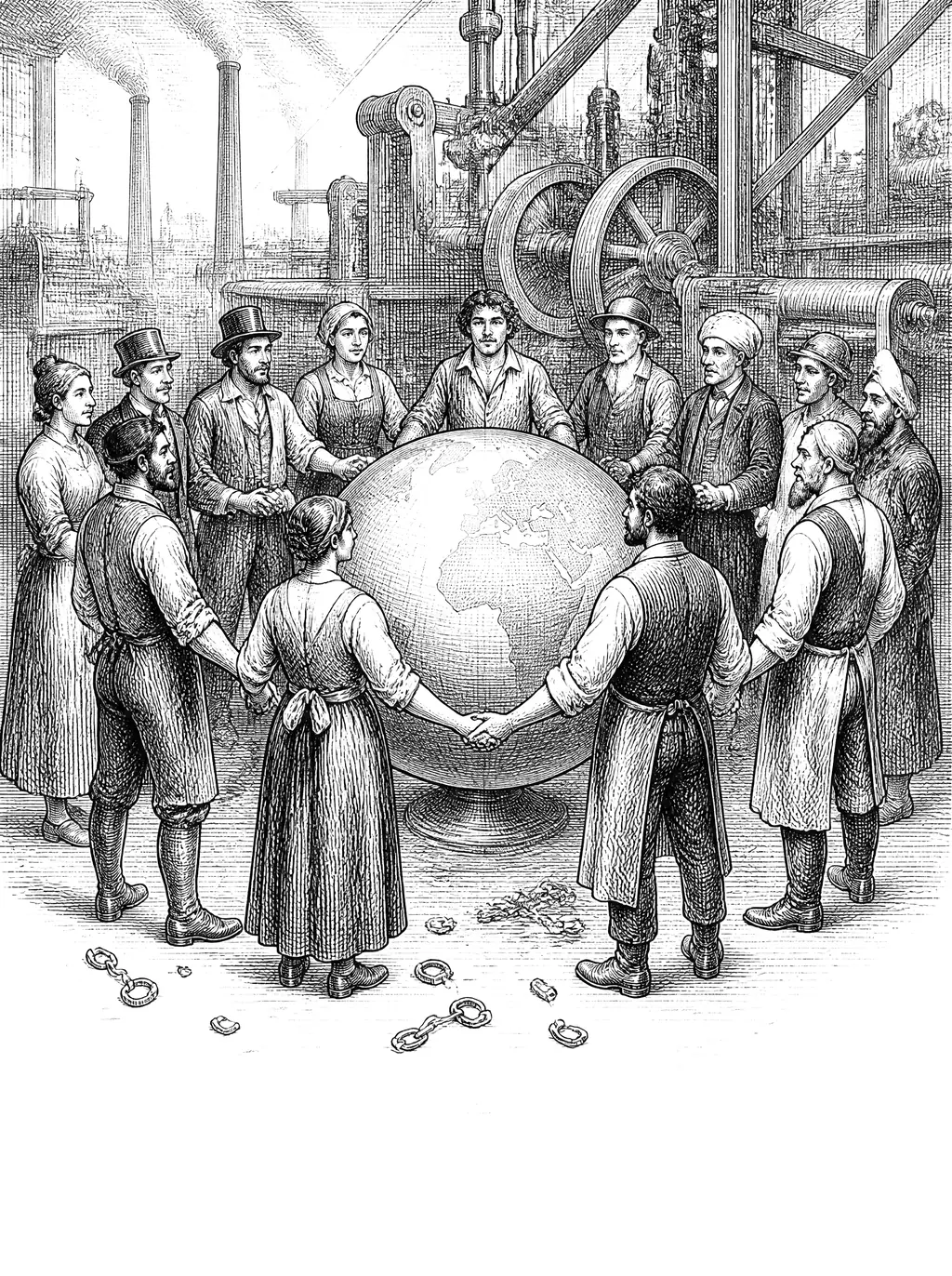
Workers of the World, Unite
A closing line built to travel
Most political pamphlets end quietly, summarizing what came before. The Communist Manifesto ends with a command aimed past its own readers, at an audience the authors could not see or count: laborers in every country, in every trade, urged to recognize a shared interest with strangers they would never meet, stronger than any tie to their own national rulers. The line was already a slogan before the book existed. The Communist League had adopted it in 1847, replacing its older motto that all men are brothers. Marx and Engels thought the older line was sentimental. Brotherhood asks everyone to love each other. Unity asks one class to recognize its enemy.
The world it came from
The Manifesto was written in Brussels in the winter of 1847 and printed in London in February 1848 for the Communist League, a small society of German émigré workers. Its authors were a journalist expelled from Paris and the son of a cotton manufacturer who had seen the mills of Manchester. Within weeks, revolutions broke out in Paris, Vienna, Berlin, and across Italy, and the authors hurried home to join them. Those revolutions were national, fought under national flags for national parliaments, and by 1849 they had all been crushed. Marx fled to London, where he stayed for the rest of his life. The internationalism of the closing line was a bet placed against the nationalism that was already winning.
The idea
The proletarians have nothing to lose but their chains. They have a world to win. Working men of all countries, unite! National differences and antagonisms, Marx and Engels argue, are daily more and more vanishing, owing to the development of the bourgeoisie, and the resulting shared condition of workers everywhere makes international solidarity not just possible but necessary. The argument has two halves. The first is about cost: someone with no property risks nothing by fighting. The second is about scale: capital operates across borders, so a working class that organizes only within them is bringing a smaller weapon to the fight than its opponent already holds.
How the reasoning runs
Start with a claim from the Manifesto's first chapter: the bourgeoisie has created a world market, chasing raw materials and customers across every border. Next, the condition of the worker under that system is the same everywhere: the same wage labor, the same dependence, the same insecurity. So the worker's real interest is defined by his class, not by his country, and the Manifesto says outright that working men have no country. Third, capital is organized internationally and workers are not, and a divided opponent loses. Fourth, the proletarian has no property to defend, so revolt costs him only his chains. Therefore the rational move for workers everywhere is to organize as one class across borders, and the closing line is the instruction to do it.
Seen in life
You work in a warehouse for a company whose name is on packages in forty countries. One night a message arrives in the workers' chat from someone doing your job in another language, three time zones away. Same scanners, same targets, same rule about bathroom breaks, same manager's phrase about the team. She writes that they are walking out next Friday. Your first thought is that her country is not your country. Your second is that her building and your building report to the same spreadsheet. Marx's bet was that the second thought wins. History says it often does not, and that flags and languages hold. But the message in the chat is exactly the recognition the Manifesto's last line was written to provoke.
Why it matters
This proposes an identity, worker, that cuts across the nationalities and borders most political movements had organized around before. It argues that shared economic position, not shared homeland, is the deeper, more binding tie, a claim that shaped labor movements and internationalist politics well beyond the specific historical moment the pamphlet was written to address. It also set a test that every labor movement since has had to face. A union that wins for its own members by shutting out workers elsewhere has, by the Manifesto's standard, joined the other side. Whether solidarity can really cross a border is one of the standing questions of politics, and it was this line that put it there.
“The proletarians have nothing to lose but their chains. They have a world to win. Working men of all countries, unite!”
From the source
The Communist Manifesto closes with the line that became its enduring rallying cry: “The proletarians have nothing to lose but their chains. They have a world to win. Working men of all countries, unite!” The original printed that last sentence in capitals. The sentences before it set the tone. The Communists, the authors write, disdain to conceal their views and aims, and declare openly that their ends can be attained only by the forcible overthrow of all existing social conditions. Let the ruling classes tremble at a communist revolution. The 1888 English translation by Samuel Moore, which Engels supervised, is the one most readers know, and it is the source of the wording quoted here.
The pushback
History has repeatedly shown national identity proving stronger than class solidarity, workers of rival countries fighting each other in wars their rulers declared, rather than uniting against those rulers as the Manifesto predicted. Whether that reflects a flaw in the theory or simply an unfinished project remains contested to this day. A second objection says the working class was never one thing. Skilled workers organized against unskilled ones, men against women, and in the United States, as W. E. B. Du Bois argued in 1935, white workers accepted a psychological wage of status over Black workers in place of a shared fight. If the class was divided inside each country, uniting it across countries was asking for the harder thing first.
The reply
Marx and Engels did not predict that unity would be easy. The Manifesto itself says that the organization of workers is continually broken up by competition among the workers themselves, and that it must be built again each time. The First International of 1864 was their attempt to build it, and it collapsed in faction within a decade. Lenin answered the nationalism objection with theory: profits from empire let employers buy off a layer of workers at home. That answer explains 1914 only partly, and it does not explain why the workers who marched to war mostly wanted to. On the second objection, the tradition has largely conceded that class does not dissolve race and sex, and has spent a century trying to hold all three at once.
Where it went next
The First International was founded in London in 1864 with Marx drafting its address; the Second, in 1889, created May Day as an international workers' holiday. In August 1914 the socialist parties of the Second International voted for their own governments' war credits, and the internationalism of the closing line was buried in the trenches. The Soviet Union put the slogan on its coat of arms in every language of its republics. Global union federations still organize across borders in shipping, mining, and manufacturing, and the International Labour Organization, founded in 1919, is the reformist version of the same idea. The line is carved on Marx's tomb in Highgate Cemetery, where people still leave flowers and still argue.
Where this leads
The history of all hitherto existing societies is the history of class struggles supplies the diagnosis this closing call to action is meant to answer, treating international worker solidarity as the necessary response to a conflict it argues has been running since the beginning of recorded history. Read the two lines together and the pamphlet is a single argument: the fight is old and structural, and this time the losing side can win it by organizing across borders. The general will is the older idea the slogan quietly depends on. Rousseau asked citizens to will what is good for the whole body. Marx asked workers to do the same, and then redrew the body so that it stopped at no border.