Symposium · Eastern Philosophy · Pl. 2Buddha · c. 563 – c. 483 BC
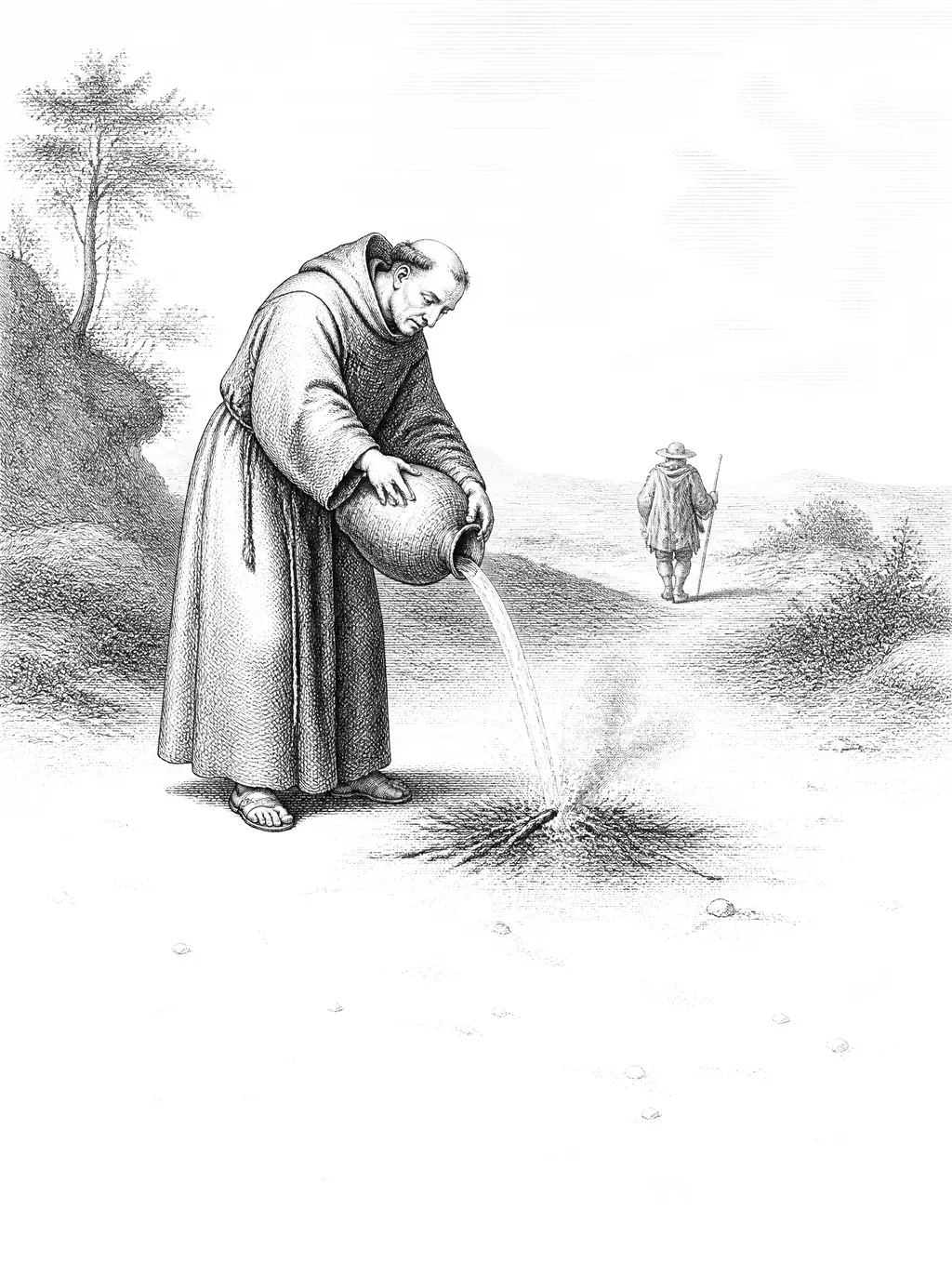
Hatred Ceases by Love
The sentence that keeps hatred alive
The Dhammapada names the exact thought that keeps a grudge burning: he abused me, he beat me, he defeated me, he robbed me. Anyone who keeps rehearsing that sentence, the text warns, keeps hatred alive on purpose, and anyone who sets the sentence down finds the hatred has nothing left to hold onto. The verses make no appeal to the wrongdoer. They are addressed entirely to the person holding the grudge, and they treat the grudge as a fire that needs tending, and that can be left to go out.
The world it came from
The Dhammapada is a Pali collection of 423 verses from the Theravāda canon, attributed by tradition to the Buddha, passed on orally, and written down in Sri Lanka around the first century BC. These verses stand at the very start, numbers three to five of the opening chapter. The Buddha taught in the fifth century BC in the Ganges kingdoms of Magadha and Kosala. His own clan, the Shakyas, was destroyed in a war during his lifetime, according to the tradition. Among the rival teachers, some preached that action had no consequence at all, and Brahmin ritual offered no answer to a personal injury. The Buddha's reply was neither revenge nor resignation. It was to look at what hatred does inside the person carrying it.
The idea
Hatred does not cease by hatred at any time; hatred ceases only by love, an old rule the Buddha presents as settled fact rather than gentle suggestion. Retaliation, however satisfying it feels in the moment, adds fuel to the very fire it claims to be extinguishing, since matching harm with harm only produces more of exactly what started the cycle. The Pali words are vera, enmity, and avera, its absence; the rule is that enmity is never stilled by enmity. Love here is metta, active goodwill, not fondness for the person who harmed you.
How the reasoning runs
Begin with the mechanism. A grudge is not a fact about the past; it is a sentence you keep saying, he abused me, he beat me. Second, notice that the sentence is fuel. Each repetition renews the injury and the anger with it, so the hatred does not fade with time but is maintained by effort. Third, ask what retaliation does. It answers the other person's hatred with yours, which gives them a fresh sentence to repeat: she struck me. Fourth, ask what could end it. Only a move that adds no fuel. Ceasing to repeat the sentence starves your own fire; goodwill toward the other refuses to light theirs. Fifth, the Buddha calls this an old rule, a law like gravity, not a preference.
Seen in life
Your sister said the thing at the funeral, the thing about who did the caring and who only sent money. Four years later you can still recite it word for word. You have not spoken since. Notice what keeps it alive: not her, who is a hundred miles away and probably remembers it differently, but you, rehearsing the line on the drive home from work. The Dhammapada's suggestion is not to decide she was right. It is to stop reciting. Then, when you can, to wish her well, which at first feels like lying and later feels like putting down something heavy. Whether she ever apologises is her fire. The one you have been tending for four years was yours.
Why it matters
This challenges an instinct nearly everyone shares: that a wrong deserves an equal and opposite response before the account is settled. The teaching argues that account never actually gets settled that way. Each retaliation simply reopens the ledger for the other side to balance in turn, endlessly, unless someone eventually declines to keep it running. There is also a claim about the direction of harm. Hatred is held inside the one who feels it, and it burns there first and longest. The wrongdoer may never feel it at all.
“For hatred does not cease by hatred at any time: hatred ceases by love, this is an old rule.”
From the source
The Dhammapada states the rule plainly: “For hatred does not cease by hatred at any time: hatred ceases by love, this is an old rule.” It follows directly from the warning against replaying the grievance sentence, he abused me, he beat me, he robbed me, which alone keeps the fire supplied. These are verses three to five in Max Müller's 1870 translation. The sixth verse widens the frame: people forget that they must die, and those who remember it stop quarrelling. The old rule, sanantano dhammo, is presented as something the Buddha found rather than invented, a law about how enmity behaves.
The pushback
Doesn't refusing retaliation just invite more harm, letting wrongdoers act without consequence while their victims absorb the cost twice over? The teaching does not forbid seeking justice or protection through legitimate means; its target is narrower, the private fire of hatred kept burning inside a person, which harms the one holding it regardless of what happens to the wrongdoer. A harder objection: the verse is addressed to the injured, and it asks the injured to do the work. Told to the wrong person at the wrong moment, it is a way of silencing a victim while the wrongdoer is not asked to change at all.
The reply
The tradition answers the first objection cleanly: the rule speaks of hatred as an inner state, not of law or self-defence, and the same collection is full of verses aimed at the one who harms. The second objection is the one the text answers least well. Nothing in these verses addresses the wrongdoer, and a teaching that lands only on the injured can be misused by anyone who wants a quiet victim. Two things can be said. The rule is offered as a description of what works for the person suffering, not as a duty owed to the offender. And the timing is left to the reader. Said too early, the rule is a wound. Said when the person is ready, it is a door.
Where it went next
Buddhaghosa's fifth-century commentary attached to these verses a story of a feud carried across lifetimes and ended only when one party let go, and the story became a standard sermon across Theravāda Asia. Metta meditation, the deliberate cultivation of goodwill toward friends, strangers, and enemies in turn, grew from the same root and is now taught in secular programmes and studied in clinical trials. In 1963 Martin Luther King Jr. wrote that hate cannot drive out hate and only love can do that; the sentence echoes the Dhammapada, though King drew on the Gospels and on Gandhi. Thích Nhất Hạnh made the verse central to his teaching during and after the Vietnam War.
Where this leads
The categorical imperative approaches the same territory from the opposite direction, asking whether retaliation could ever be willed as a universal rule for everyone, a test that runs directly into the same endless cycle the Buddha names here by a different route entirely. Kant reasons from the rule outward; the Buddha reasons from the fire inward. One asks whether the world could run on retaliation. The other asks what retaliation does to the person who chooses it. Both answer no.