Symposium · Eastern Philosophy · Pl. 14Buddha · c. 563 – c. 483 BC
Self Is the Refuge of Self
Refuges that do not hold
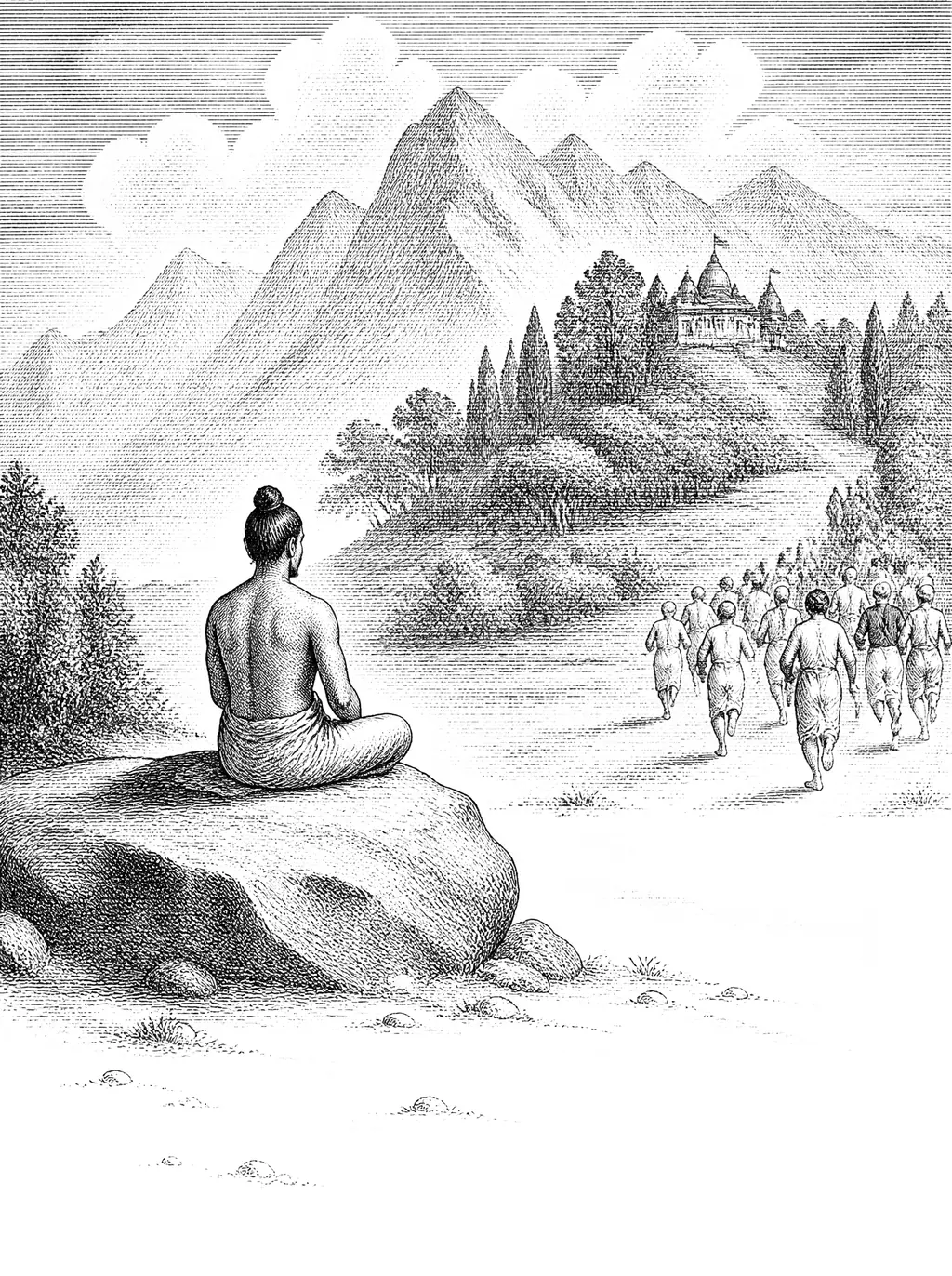
Fear sends people looking for shelter in all directions: a mountain retreat, a sacred grove, a trusted friend's advice. The Buddha names these ordinary refuges directly and calls them unreliable, not because they are worthless, but because none of them can actually carry the weight a person needs carried in their hardest moments. The Dhammapada puts it in a pair of verses about frightened people running to mountains, forests, groves, and shrines. That, it says, is not the safe refuge. The safe refuge is the one you carry, and it has to be trained before the fear arrives.
The world it came from
The Dhammapada is an anthology of 423 Pali verses in twenty-six chapters, included in the Khuddaka Nikāya of the Theravāda canon. Tradition attributes every verse to the Buddha, who taught in the Ganges plain, in the kingdoms of Magadha and Kosala, sometime in the fifth century BC; the exact dates are disputed. The verses were passed on orally and written down in Sri Lanka around the first century BC. This verse sits in the chapter on the monk, and it answers a live question of its time. Renunciants of every school were leaving home. The Buddha's rivals offered ritual, austerity, or a teacher's authority as shelter. His answer was that the shelter had to be built inside the person, by the person.
The idea
Self is the lord of self; self is the refuge of self. No external shelter, however comforting, does the deep work of curbing and steadying a person the way their own trained attention can. The instruction is not isolation from others, but a shift in where ultimate responsibility for your own steadiness actually rests. The Pali word is attā, the ordinary self, not a hidden soul. The Buddha is not asking you to find something inside; he is asking you to take charge of the mind you already have. Nobody else can do your watching for you.
How the reasoning runs
Start with what a refuge is for: it has to hold when you are afraid. Now test the candidates. A mountain cannot follow you home. A shrine cannot stop a thought arising. A friend can advise you and then has to leave. Each of these fails at the moment of need, which is when the mind is unsteady. What does not leave? The mind itself, and whatever training you have given it. So the only refuge present at every crisis is your own attention, curbed and steadied in advance. The merchant's horse is the model: not broken, not left wild, but handled every day until it answers the rein. That daily handling is the refuge being built.
Seen in life
Your phone buzzes at 11 p.m. with the message you had been dreading. The first move is to call someone, and you do, and it helps, and then the call ends and you are alone with the same message. The second move is to scroll until you are numb. Neither is a refuge. The Dhammapada's suggestion is quieter. Sit down. Watch the fear as it rises and falls without letting it write the reply. That watching only works tonight if you practised it on a hundred ordinary nights when nothing was wrong. The friend, the scroll, the reassurance: all borrowed. The trained attention: yours, and it does not hang up.
Why it matters
This locates real safety somewhere that cannot be taken away by circumstance: not in people, places, or possessions, which can all be lost, but in a disciplined relationship with your own mind, which travels with you into every situation and cannot be confiscated the way an external refuge always eventually can be. The teaching also removes an excuse. If steadiness depends on the right teacher or the right retreat, you can wait for the right conditions forever. If it depends on you, the training can start this afternoon, in whatever room you are in.
“For self is the lord of self, self is the refuge of self; therefore curb thyself as the merchant curbs a good horse.”
From the source
The Dhammapada states it directly: “For self is the lord of self, self is the refuge of self; therefore curb thyself as the merchant curbs a good horse.” The image is deliberate: not suppression, but the same skilled, patient handling a good rider gives a spirited animal. The verse is number 380, in the chapter on the monk. Its companion, verse 160, gives the same claim as a question: self is the lord of self, who else could be the lord? Max Müller's translation, from 1870, was among the first to bring the book to English readers, and the horse has stayed in nearly every version since.
The pushback
Doesn't this undersell real community, teachers, and support, which genuinely help people through hardship no amount of private discipline alone could carry them through? The Buddhist tradition itself built extensive communities around exactly this teaching; the point is not that others are worthless, but that no refuge outside yourself can substitute for the steadying you have to do inside. There is a harder version. Buddhists formally take refuge in three things, the Buddha, the teaching, and the community, and recite that vow daily. A verse that names the self as the refuge seems to cut against the tradition's own front door.
The reply
The tradition holds both. The three refuges tell you where to look for the teaching; this verse tells you who has to apply it. Nobody in the community can slow your breath or watch your mind. The Buddha, in the account of his last days, is remembered telling his followers to be islands to themselves and refuges to themselves, with the teaching as their island, and to seek no other refuge. So the self is refuge in the sense of agent, not of substitute for the sangha. That said, the reply is partial. The same tradition teaches that the self is not a fixed thing at all. How a self that is not a thing can be a refuge is a puzzle the verse does not solve.
Where it went next
The Theravāda commentator Buddhaghosa, writing in Sri Lanka in the fifth century AD, attached a story to nearly every Dhammapada verse, and the book became a primer for monks across Sri Lanka, Burma, and Thailand. In the twentieth century the lay meditation movements of Burma, through teachers such as Mahasi Sayadaw and, later, S. N. Goenka, turned the training of one's own attention into something a householder could do on a ten-day course. Jon Kabat-Zinn's mindfulness-based stress reduction, begun in 1979, took the same practice into hospitals without the doctrine. Self-reliance means something different in Emerson, and the Buddhist idea should not be folded into it: the refuge here is attention, not confidence.
Where this leads
The inner citadel reaches a nearly identical conclusion from Rome rather than India, describing a retreat inward that no crowd or crisis can occupy without permission, the same shelter the Dhammapada locates in curbing the self like a well-handled horse. Both texts agree on the site of the shelter. They disagree on what is found there. Marcus finds a rational self to retreat into. The Dhammapada finds a mind to be trained, and elsewhere denies that any fixed self is there at all.