Symposium · Logic & Paradoxes · Pl. 8Robert Nozick · 1938–2002
Newcomb's Paradox
A choice with the outcome already set
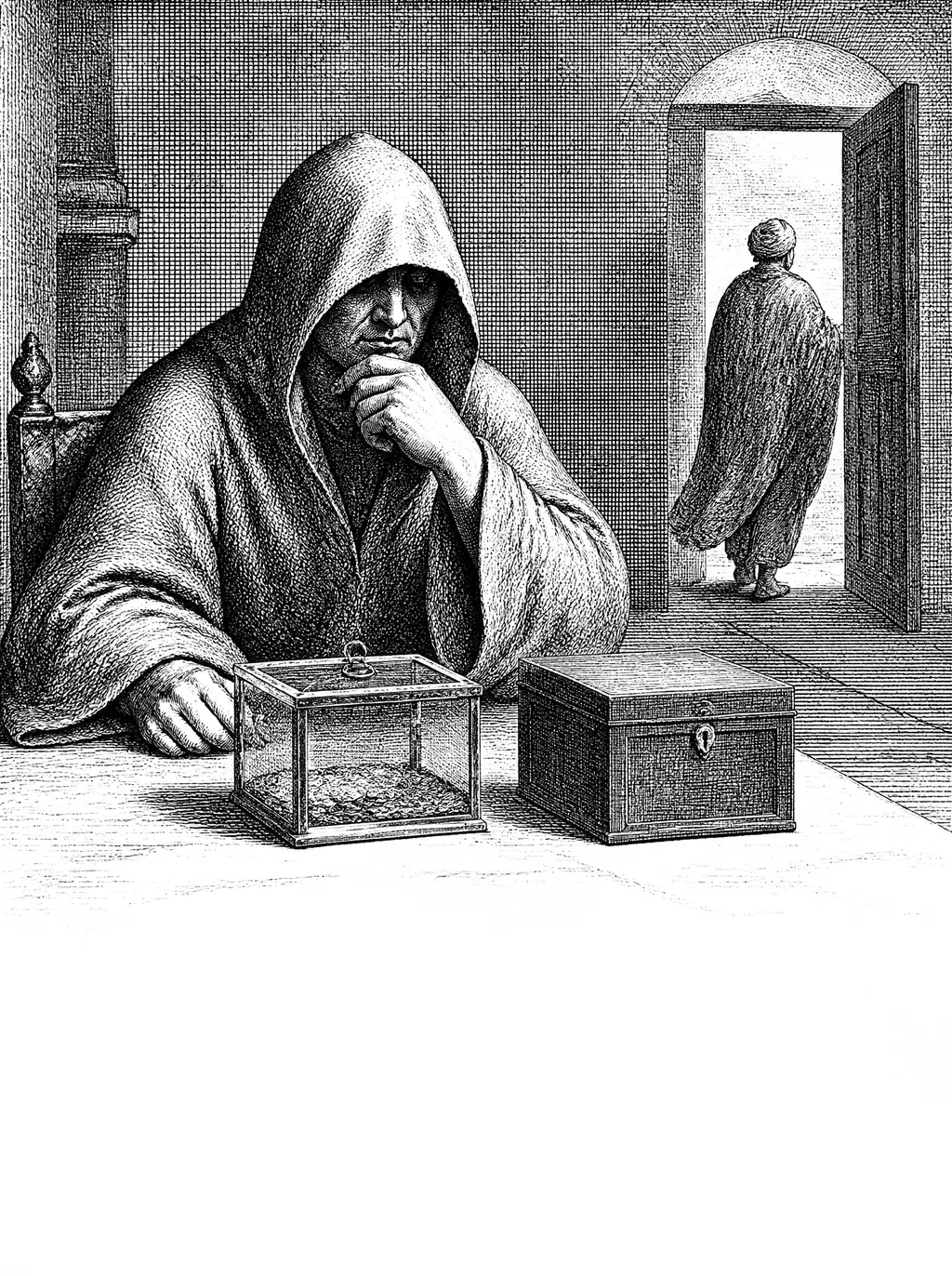
Two boxes sit in front of you. One is transparent, holding a visible thousand dollars. The other is opaque, holding either a million dollars or nothing, decided in advance by a predictor with an outstanding track record. If the predictor foresaw you taking both boxes, the opaque one is empty. If it foresaw you taking only the opaque one, it holds the million. The predictor has already acted. The money is already in the box, or it is not. Nothing you do now changes that. You may take both boxes or the opaque one alone. Choose.
The world it came from
The puzzle is named for William Newcomb, a physicist at the Lawrence Livermore laboratory, who thought it up around 1960. It reached Robert Nozick, then a young philosopher at Harvard, through a mathematician friend, and Nozick published it in 1969 in a volume honoring Carl Hempel. Decision theory was newly formal. Savage had set out expected-utility theory in 1954, Richard Jeffrey had published The Logic of Decision in 1965, and both seemed to rest on principles that always agreed. Nozick's paper showed a case where they split. Martin Gardner put it in Scientific American in 1973, letters poured in, and Nozick reported that his correspondents divided just as his students had. Nozick himself leaned, uneasily, toward taking both boxes.
The idea
Two apparently sound principles collide. Take both boxes, since whatever the opaque box already contains was fixed before your choice, so grabbing the visible thousand too can only help. Take only the opaque box, since every past case where someone took both boxes ended in the smaller total, and every case of taking only one ended in the larger. Both arguments feel airtight, and they disagree. Every decision problem you have ever met let these two principles agree. This one is built so that they cannot.
How the reasoning runs
Argument one, dominance. There are two possible states: the opaque box holds a million or it holds nothing. In either state, taking both boxes gives you a thousand more than taking one. A choice that does better in every state is better. Take both. Argument two, expected value. Suppose the predictor is right nine times in ten. Take one box and you get a million with probability nine tenths: about nine hundred thousand on average. Take both and you get a million only when the predictor erred, plus the thousand: about a hundred and one thousand. Take one. The contradiction bites at a hidden assumption. Dominance is safe only when the states are independent of your act. Here they are not, and each argument denies what the other needs.
Seen in life
Your track record has already been read. You are negotiating a lease, and the landlord uses a model that predicts, from years of tenants like you, whether you will walk away over a small fee. The fee was set yesterday, on that prediction. Tenants the model tagged as walkers had the fee waived; tenants tagged as stayers were charged. You now see a fee on your contract. Walking away costs you a good flat; staying costs the fee. Argument one says the fee is fixed, so decide on the flat alone. Argument two says people who reason like that are the ones who were charged. You cannot change the model's reading, and yet the reading was of exactly the reasoning you are doing now.
Why it matters
This forces a genuine split between two respected theories of rational choice, one urging you to dominate every possible state of the world no matter what, the other urging you to maximize expected outcome given the evidence your own choice provides about what has already happened. Ordinary decision theory quietly assumed these two approaches always agreed, and Newcomb's case shows they do not. Since then decision theorists have split into camps that agree on almost every ordinary case and disagree only here. The disagreement is about what your choice is for: to bring about the best result, or to be the kind of choice that goes with the best result.
“These people seem to divide almost evenly on the problem.”
From the source
Nozick, reporting how audiences reacted again and again to the puzzle, noted the striking, stubborn split it reliably produces, writing that, to almost everyone, the right answer looks perfectly obvious, and yet the split holds: “These people seem to divide almost evenly on the problem.” He added the detail that makes the split painful: a large number of people on each side think the other side is simply being silly. The paper does not pretend to settle it. Nozick works through the dominance principle and the expected-utility principle, shows that each is compelling in cases where the other stays quiet, and then builds the box problem as the case where they must speak at once. His own conclusion, offered with visible reluctance, favors taking both boxes.
The pushback
Doesn't the whole puzzle depend on an impossible premise, a predictor who can foresee free choices with near-perfect accuracy, a power nothing in the real world actually has? Nozick's defenders reply that the thought experiment does not need to be realistic to expose a genuine structural tension inside decision theory itself, one that shows up, in weaker form, wherever your choices are correlated with evidence about their own likely outcome. A second objection targets the one-boxer: if the money is already there, refusing the visible thousand is superstition dressed as strategy, an attempt to change the past by acting well in the present.
The reply
Two theories took shape around the split. Evidential decision theory, in Richard Jeffrey's line, tells you to choose the act that is the best news about the world, and one-boxing is the best news. Causal decision theory, developed by Gibbard and Harper in 1978 and by David Lewis, tells you to choose the act that causes the best outcome, and since your act cannot cause the box's contents, take both. Lewis argued the problem is the prisoner's dilemma in disguise. Surveys of professional philosophers lean toward two boxes; the wider public leans toward one. Newer proposals, such as functional decision theory from 2017, try to one-box without superstition by asking what policy the predictor would have modelled. No consensus exists.
Where it went next
Martin Gardner's 1973 column made it a public puzzle, and Nozick returned in the same magazine to answer the flood of letters. Gibbard and Harper, then Lewis, built causal decision theory largely to handle it. Philosophers produced cousins: the smoking-lesion case, where a gene causes both smoking and cancer, and Gregory Kavka's toxin puzzle of 1983, where you are paid for intending to drink something unpleasant. The problem crossed into economics and game theory through the link to the prisoner's dilemma, and into artificial-intelligence research, where a program that can be simulated by another faces a predictor in the literal sense. It is one of the few thought experiments invented after 1950 that every decision theorist must answer.
Where this leads
The first act of freedom reaches for a related tangle from a different angle entirely, William James asking what it would even mean to freely choose a belief about your own freedom, a choice that is at once evidence and action in exactly the way Newcomb's box also is. Moral luck is the other neighbour. Both puzzles ask how far you are answerable for results that were fixed by something outside your control, and both refuse to let the ordinary answer stand.