Symposium · Eastern Philosophy · Pl. 1Bhagavad Gita · composed c. 2nd century BC – 2nd century AD
Detached Action
A warrior who wants to quit
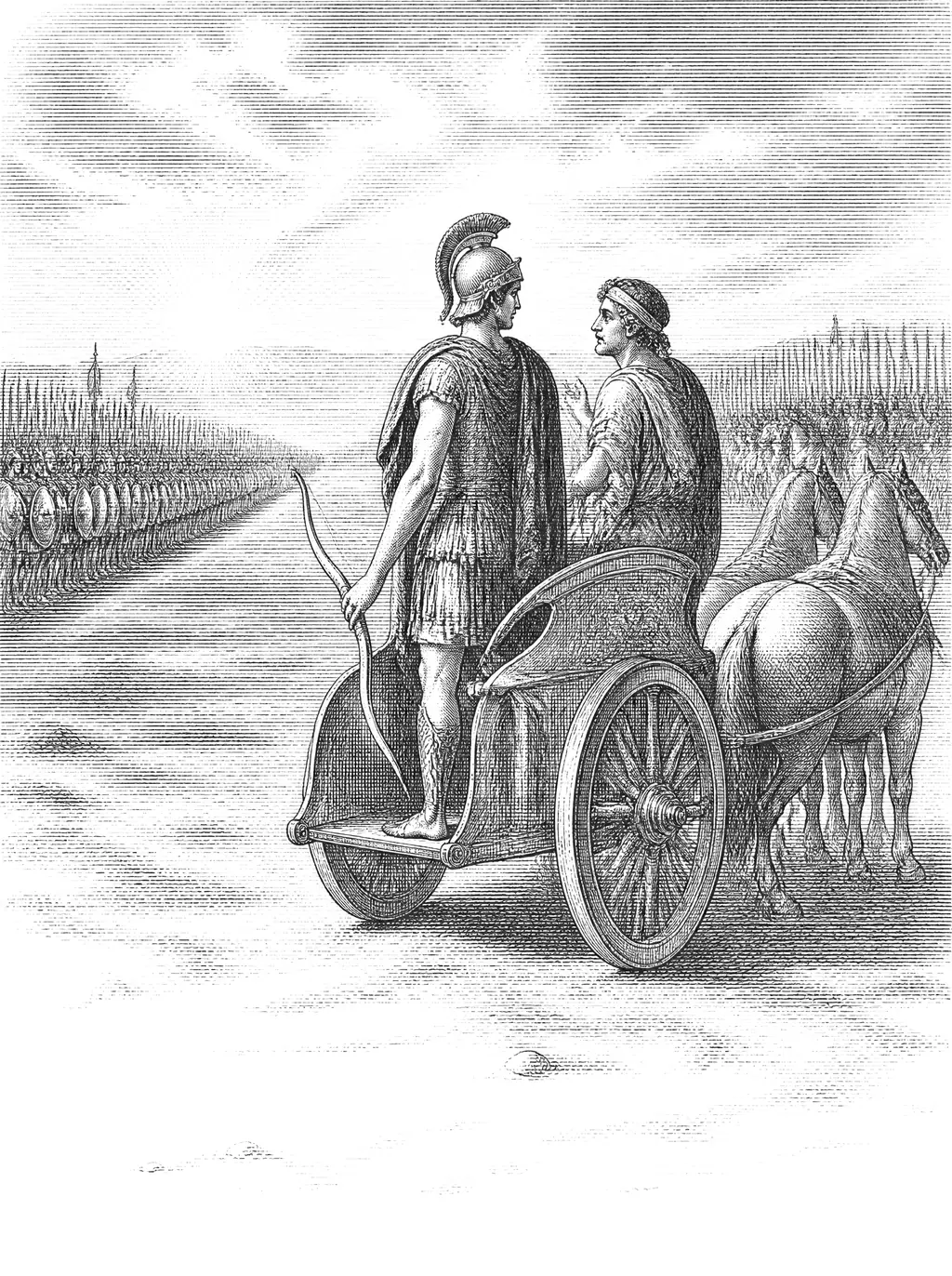
Arjuna stands on a battlefield facing relatives and teachers on the opposing side, and his resolve collapses; he would rather lay down his weapon than fight people he loves. Krishna's answer does not tell him the war is easy or the outcome guaranteed. It tells him where to put his attention instead: the doing, not the winning. The whole Gita is that answer expanded. It begins with a man sitting down in the back of his chariot, refusing to fight, and it ends, seven hundred verses later, with the same man standing up.
The world it came from
The Bhagavad Gita is seven hundred verses set inside the Mahabharata, just before the battle of Kurukshetra. It was composed somewhere between the second century BC and the second century AD; the date is disputed. It answers a live argument of its time. Buddhism and Jainism had taught that action binds you and renunciation frees you, and thousands had left home to prove it. The older Vedic tradition held that duty, especially ritual duty, was the point of a life. The Gita's move is to keep the action and drop the attachment. Arjuna, a warrior whose duty is to fight, is the test case. Chapter 2, from which the verse comes, is where Krishna begins to teach him. Edwin Arnold's verse translation, The Song Celestial, appeared in 1885.
The idea
Let right deeds be your motive, never the fruit that comes from them. Full, committed action, carried out as duty rather than as a bid for a particular payoff, becomes a kind of discipline in itself, since it frees the actor from the anxious, grasping relationship most people have with the outcomes of their own effort. The Sanskrit of the verse is famous on its own: your right is to the action alone, never to its fruits. Two prohibitions follow. Do not make the fruit your motive, and do not use that as a reason to stop acting.
How the reasoning runs
Step one: separate the act from its result. The act is yours: you choose it, you perform it, it is finished when you finish. Step two: the result is not yours. It depends on other people, luck, timing, and forces you cannot see. Step three: notice what happens when you fasten your motive to the result. You act with one eye on a thing that is not in your hands, and that divided attention produces fear, haste, and worse work. Step four: notice the alternative. Act because the act is right and yours, and you act wholly. Step five: Krishna adds the warning. Detachment from fruit is not permission to quit; inaction is also a choice with fruits. So: full effort, held loosely. The Gita calls this karma yoga.
Seen in life
You have been rehearsing the audition for six weeks, and in the car outside the theatre you can feel the whole thing tipping toward the outcome: the callback, the part, what you will say to your parents. Your hands are cold. Run the Gita's separation. The audition is yours: the preparation, the choices you made in the monologue, the way you walk into the room. The casting is not: the director's picture of the character, the actor she saw yesterday, the producer's nephew. Give the first everything and the second nothing. Actors who do this describe the same thing: the fear drops, the work gets better, and the outcome, which was never yours, comes or does not. You walked in as the doer, not the applicant.
Why it matters
Outcomes are only ever partly within anyone's control, however completely the effort behind them was. Staking your peace of mind on a result you cannot fully guarantee sets up a chronic, unwinnable anxiety. Staking it instead on the wholeness of your own effort gives you something to actually stand on, whatever the outcome turns out to be. There is a second payoff the verse counts on. Work done for its own sake tends to be better work, because nothing is being withheld to hedge against failure and no attention is being spent on the scoreboard.
“Let right deeds be thy motive, not the fruit which comes from them. And live in action! Labour!”
From the source
In Edwin Arnold's verse translation, right in the middle of the battlefield conversation, Krishna instructs Arjuna: “Let right deeds be thy motive, not the fruit which comes from them. And live in action! Labour! Make thine acts thy piety, casting all self aside.” The verse is 2.47, among the most quoted lines in Sanskrit. Arnold's translation stretches it and adds the call to labour, which is his gloss on the verse that follows. Gandhi first read the Gita in Arnold's version in London in 1889 and later said the closing verses of this chapter held the whole teaching.
The pushback
Doesn't ignoring outcomes risk producing careless, indifferent effort, since nothing about results is supposed to matter to the person acting? The teaching does not ask for indifference to quality; it asks that the emotional grip on a specific result be released, which in practice tends to sharpen effort rather than dull it, since fear of failure no longer distracts from the task. Harder still: the advice is given to persuade a man to kill his relatives. Detachment from fruit can be a way of switching off the part of a person that would otherwise count the cost of what they do.
The reply
To the first objection the Gita answers that detachment is from the fruit, not the work; the next verse calls the discipline evenness of mind, and evenness produces skill, not sloppiness. The second objection has no clean reply. Gandhi turned the battlefield into an allegory of the inner life precisely because he could not accept the literal reading. Others have read the verse as a technique that is morally neutral, one a soldier and a surgeon can both use, and that says nothing about whether the act is right. The Gita's own safeguard is the word right in Arnold's line: detachment applies to right deeds. Who decides which deeds are right is left to duty, and duty in the poem is assigned by birth.
Where it went next
Shankara in the eighth century and Ramanuja in the eleventh made the verse central to their rival commentaries, one reading it as a step toward renouncing action, the other as the way of devotion. In modern India it became a political text. Tilak, writing Gita Rahasya in a Burmese prison in 1910 and 1911, read karma yoga as a duty to act in the nation's cause. Gandhi called his own reading the yoga of non-attachment and built satyagraha on it: full effort, no claim on the result. Emerson and Thoreau read the poem in Wilkins's 1785 translation; T. S. Eliot put the verse into The Dry Salvages in 1941. Today the line is quoted in Indian boardrooms and by athletes.
Where this leads
The dichotomy of control reaches strikingly similar ground from Stoic Rome: separate what is yours, your own effort and judgment, from what is not, the actual result, and place your peace of mind only on the side that was always yours to keep. The traditions differ on why. Epictetus says outcomes are not yours because of the nature of things. Krishna says they belong to a larger order you serve. The advice converges; the picture of the world behind it does not, and the difference shows in what each asks you to feel.