Symposium · Eastern Philosophy · Pl. 17Bhagavad Gita · composed c. 2nd century BC – 2nd century AD
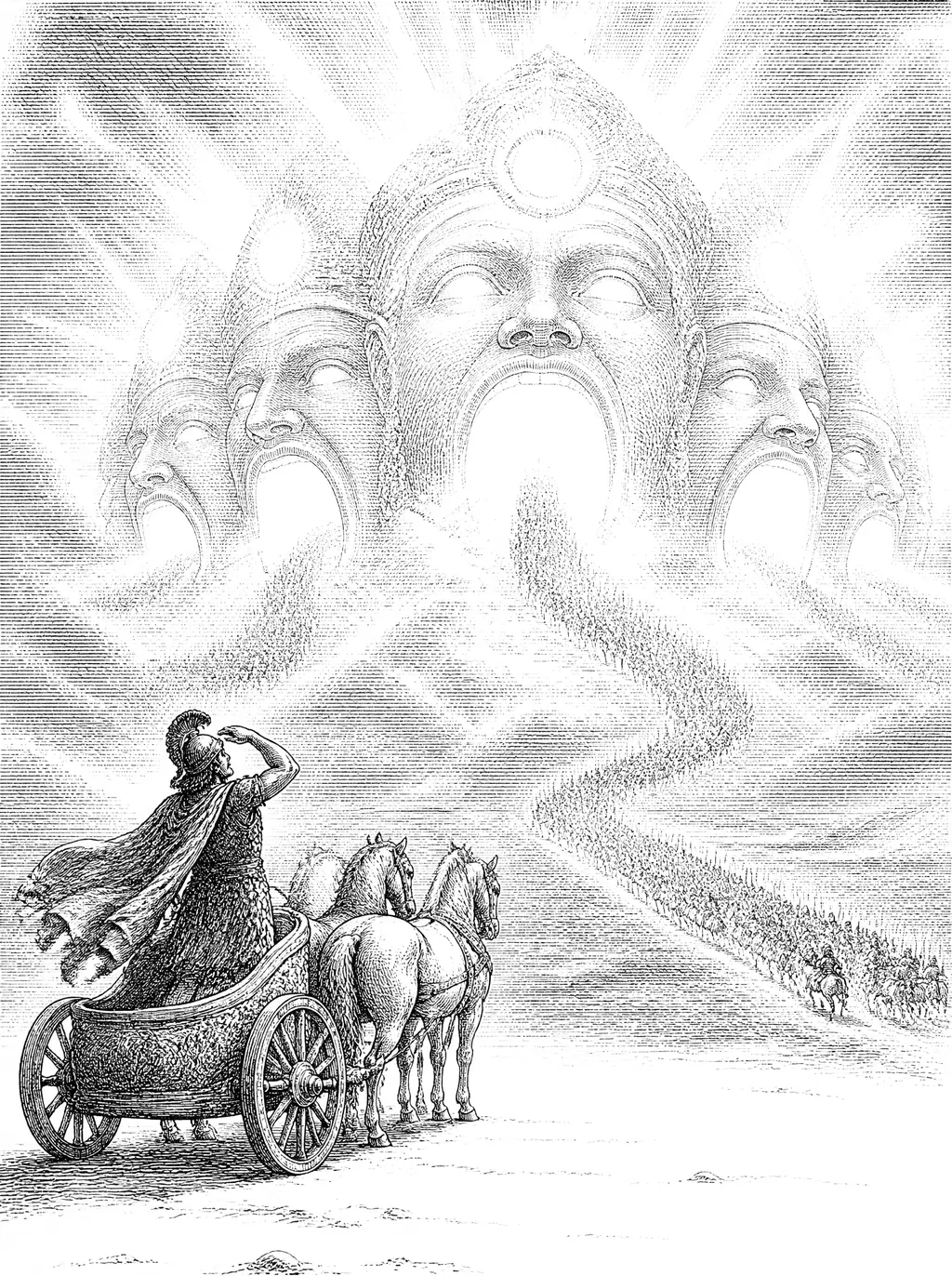
The Cosmic Vision
A request that should not be granted
Midway through their conversation, Arjuna asks Krishna, his charioteer and teacher, to show him his actual divine form rather than continuing to describe it in words. Krishna warns that mortal eyes cannot easily bear the sight, then grants a temporary, extraordinary vision anyway: all worlds, all beings, all time folded into a single blinding form. What Arjuna sees is not comfort. It is every being pouring into the god's mouths, his own enemies and his own allies among them. He asks for the vision, and then he begs for it to stop.
The world it came from
The Bhagavad Gita is seven hundred Sanskrit verses set inside the Mahabharata, India's vast epic, at the moment before the battle of Kurukshetra. Scholars place its composition somewhere between the second century BC and the second century AD; the dating is disputed. It was written in a religious landscape reshaped by Buddhism and Jainism, which taught renunciation, against a Brahmin tradition built on ritual duty. The Gita tries to hold both: act in the world, but act without grasping. Chapter 11, the vision of the universal form, comes after ten chapters of argument. Arjuna has heard the case for duty, detachment, knowledge, and devotion, and asks to see rather than hear. Edwin Arnold's verse translation, The Song Celestial, appeared in 1885 and was the version Gandhi first read, in London.
The idea
The vision overwhelms ordinary description entirely. Arnold reaches for the only comparison equal to it: if a thousand suns should suddenly rise together in the sky at once, their combined light might begin to approach the majesty and radiance of that single form. Even that, the poem admits, only might come close. Arjuna is given a divine eye to see it, because ordinary sight would not serve. The vision contains all the gods, all the worlds, and the whole army already dead in the god's jaws before the fighting has started.
How the reasoning runs
The vision is not an argument, but it does something argument was failing to do. First, Arjuna's problem was never lack of information. Krishna had explained duty, the self that does not die, and the fruits of action; Arjuna still could not move. Second, his paralysis came from a picture: himself as the agent whose choice would kill his teachers. Third, the vision replaces that picture. He sees time itself consuming the warriors, and Krishna tells him they are already slain; be only the instrument. Fourth, once the scale of the agent changes, the weight of the choice changes with it. Arjuna can act because he is no longer the one on whom everything rests. The poem then returns him to argument, now able to hear it.
Seen in life
You are the executor of a will and the family is at war, and every decision feels like a verdict you personally are passing on people you love. One night you walk out under a sky with no light pollution and, for a minute, the size of it lands. Your grandmother's house, the dispute over it, the whole century of the family, is a speck inside something that does not notice. It is not that the decision stops mattering. It is that you stop being the centre of gravity of it. In the morning you make the call you had been avoiding, calmly, and you are not sure why it was ever so heavy. The Gita would say you were briefly given a larger eye.
Why it matters
The scene marks a shift in the whole conversation, from argument and instruction to direct, overwhelming encounter. Arjuna is not persuaded by more reasoning at this point; he is undone by a vision too large for ordinary categories to hold, which the text treats as its own distinct and necessary kind of knowing, beyond what argument alone reaches. It also names a real limit of argument. Some people cannot be reasoned out of a paralysis because the paralysis is a matter of scale, not of premises. Only a change in the size of the picture reaches them.
“If there should rise suddenly within the skies sunburst of a thousand suns flooding earth with beams undeemed-of, then might be that Holy One's majesty and radiance dreamed of!”
From the source
Arnold's verse translation renders the vision this way, reaching for the one comparison equal to it: “If there should rise suddenly within the skies sunburst of a thousand suns flooding earth with beams undeemed-of, then might be that Holy One's majesty and radiance dreamed of!” This is chapter 11, verse 12, in Arnold's 1885 rendering. A few verses later the god names himself as time, come to destroy the worlds, and tells Arjuna that the warriors are dead already and he need only be the instrument. Arjuna, trembling, asks to see the familiar face again, and is given it.
The pushback
Doesn't leaning on an overwhelming vision, rather than an argument anyone could follow, settle the debate by force of awe instead of by reason? The text itself treats the vision as one register among several, not a replacement for the extended reasoning about duty and detachment that surrounds it on every side, before and after. A harder objection: the vision is used to get a reluctant man to fight a war. Awe in the service of killing is not an obviously good thing, and readers from Gandhi onward have had to work hard to make the scene mean something else.
The reply
The Gita's defenders answer the first objection by pointing at the structure: chapter 11 is framed on both sides by reasoning, and the poem's last word is Arjuna saying his doubt is gone and he will act, a conclusion the argument had prepared. On the second objection the tradition divides. Gandhi read the battle as an allegory of the struggle inside a person and refused the literal war; Tilak read it literally as a call to action. Neither reading settles it. The honest position is that the poem asks for overwhelming vision at the exact moment the moral stakes are highest, and that a reader is right to notice how convenient that is. What the vision does show, beyond dispute, is that the poem knows argument has limits.
Where it went next
Shankara commented on the Gita in the eighth century, Ramanuja in the eleventh, and the chapter of the universal form became the text's most painted scene, the many-armed god filling the frame. Emerson and Thoreau read Charles Wilkins's 1785 translation, the first into any European language. In 1945 J. Robert Oppenheimer, watching the first atomic test, recalled two lines from this chapter, the thousand suns and the god who is time, become the destroyer of worlds; he said so in a 1965 interview and the association has never left. Gandhi called the Gita his mother and read from it daily. Aurobindo's Essays on the Gita, written between 1916 and 1920, read the whole poem as a map of spiritual ascent.
Where this leads
The view from above reaches for a related, though far smaller-scaled, shift in vantage point: Marcus Aurelius climbing in imagination to a height that resizes ordinary human affairs, the way Krishna's revelation resizes an entire battlefield and a single warrior's doubts at once. Marcus climbs on purpose and comes down with proportion. Arjuna is shown, beyond his capacity, and comes down shaking. The Stoic exercise is one you can repeat at will. The Gita's vision is granted once, and the poem says even the gods long to see it.