Symposium · Metaphysics · Pl. 10Derek Parfit · 1942–2017
Personal Identity Is Not What Matters
A machine built to break intuitions
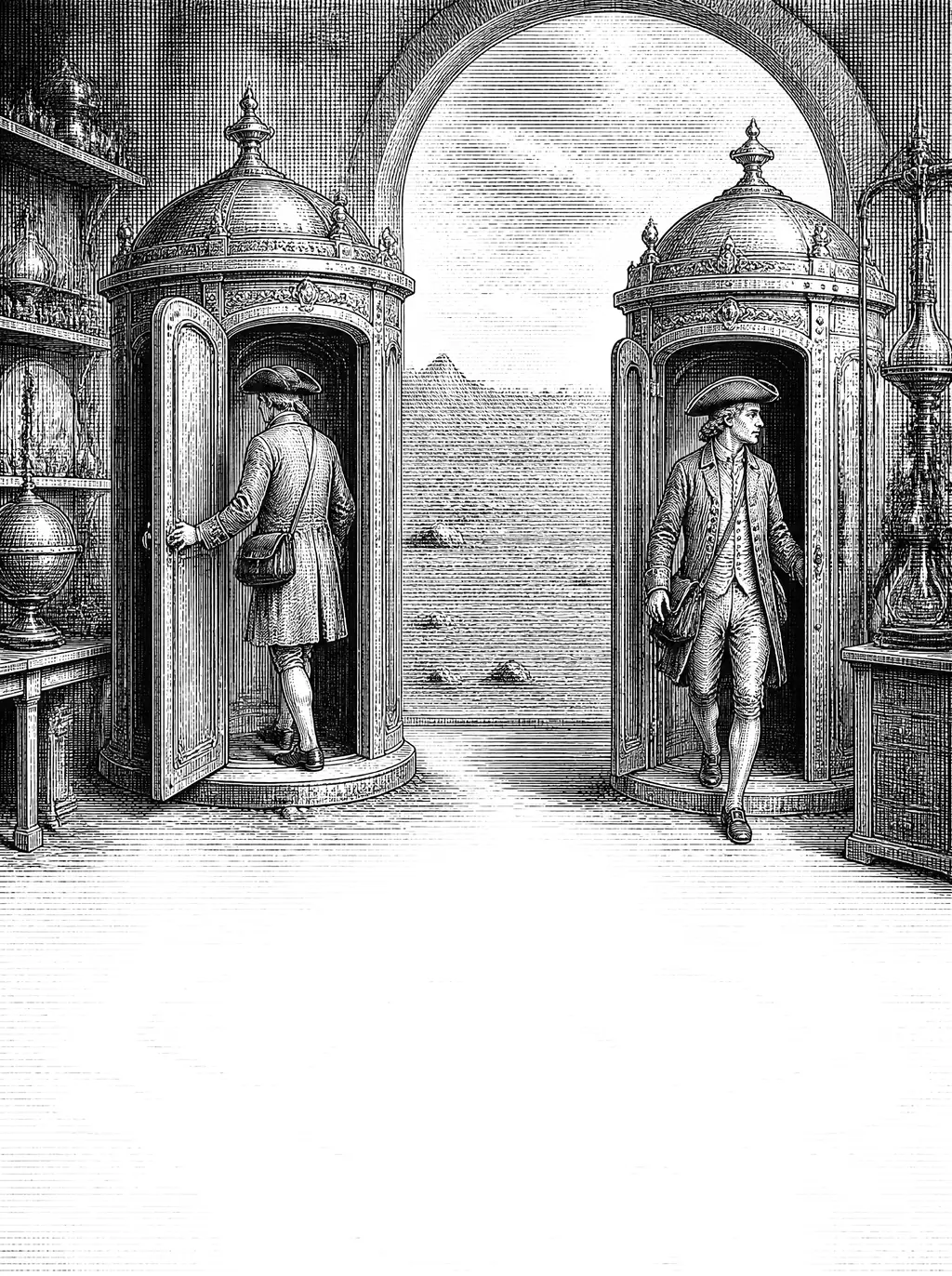
Parfit's teleporter takes you apart on Earth, transmits the information, and reconstructs an identical body on Mars, down to every last atom in its exact relative position. Philosophers had spent generations arguing over whether the person who steps out on Mars really is you. Parfit's contribution was to ask why that particular question mattered as much as everyone assumed. Then he made the machine worse. Suppose the scanner on Earth malfunctions and leaves your original body intact, dying slowly of heart damage, while the copy on Mars wakes up healthy and phones home. Now there are two candidates, and no fact about the universe settles which one is you. Parfit's point is that nothing important is left undecided.
The world it came from
Derek Parfit spent almost his whole career at All Souls College, Oxford, a fellowship with no teaching duties, and used the freedom to write one enormous book. Reasons and Persons appeared in 1984. Its third part took up a debate that had been running since Locke: what makes a person at one time the same person as someone at a later time? By the 1970s the debate had turned on thought experiments. Bernard Williams had argued from cases of torture and body-swapping that bodily continuity mattered more than memory. David Wiggins and others had raised fission, where one brain is split and each half survives in a new body. Parfit took those cases and asked a different question: not who survives, but what we should care about.
The idea
Personal identity is not what matters. What genuinely matters in survival, Parfit argues, is psychological continuity and connectedness, memories, intentions, personality carried forward, not some further fact of strict numerical identity riding on top of that continuity. Once the psychological connections are all present, whether a further, separate fact of identity also holds turns out not to be worth caring about. Parfit calls this Relation R: psychological connectedness and continuity, with any cause. Identity is a matter of degree in disguise. We speak as if it were all or nothing, because in ordinary life one body carries one stream of memory, so the two never come apart. The thought experiments pull them apart, and when they do, it is the stream that matters.
How the reasoning runs
Start with fission. Your brain is divided, each half transplanted into a different body, and both people wake with your memories and character. Are you one of them? Not both, since they are two people. Not one rather than the other, since nothing distinguishes them. Not neither, or a single successful transplant would also fail, which it plainly does not. So identity gives no answer. Second step: does your survival then look like death? Parfit says no. Each successor has everything you would have wanted preserved. Third step: if a case with no identity can be as good as ordinary survival, identity was never the thing you cared about. What you cared about was Relation R. Identity was a stand-in.
Seen in life
Your grandmother has had dementia for three years. She no longer knows your name, cannot recall her wedding, and does not recognize the house she lived in for fifty years. Everyone still calls her by her name and speaks of her as the same person, and legally she is. Parfit lets you say something more honest. The connections that mattered, the shared memories, the plans, the character you knew, have mostly thinned out. Your grief is not a mistake, and it did not need to wait for the death certificate. Equally, the woman in the chair is still connected to the child she was by chains of overlapping memory that ran for eighty years. Both facts are true, and neither needs a further fact to settle it.
Why it matters
This reframes what should actually concern you about your own future: not a metaphysical guarantee that some further essence persists, but the concrete, checkable presence of memory, character, and intention carrying forward into whoever comes next. It suggests that ordinary survival and Parfit's stranger thought experiments differ only in degree, not in the kind of thing that actually matters. Parfit found the view liberating. He wrote that when he believed in a further fact, his life seemed like a glass tunnel through which he was moving faster every year, with darkness at the end. When he gave the belief up, the walls of the tunnel disappeared. Death, on his view, breaks some connections and leaves others: the ideas, the effects, the people you shaped.
“Personal identity is not what matters.”
From the source
After walking through the teleporter case and several careful variations on it across many pages, Parfit finally summarizes his central claim in one blunt line that the whole long argument has been quietly building toward: “Personal identity is not what matters.” The line comes in Part Three of Reasons and Persons, in the chapter on what matters. Parfit spends the surrounding pages defusing the reader's resistance. He admits that he cannot make the view feel natural. He can only show that every attempt to locate a further fact beyond psychological continuity collapses under the branching cases, and that our ordinary concern, once examined, was always tracking the continuity and never the extra fact.
The pushback
Doesn't this drain something real out of the ordinary, deeply felt difference between you surviving and you being replaced by a similar but distinct person, a difference that feels like more than just a matter of degree? Parfit's answer is that the feeling of a sharp, all-or-nothing further fact is itself the illusion his teleporter is specifically designed to expose. A harder objection presses on the teleporter itself. Anticipation seems to require identity: you can dread your own pain, but you cannot dread someone else's in the same first-person way. If the copy on Mars is not you, then stepping into the machine is suicide with a consolation prize, however much continuity the copy carries. Something in the first-person perspective seems to resist being redescribed as degrees of connectedness.
The reply
Parfit meets the first objection by accepting the cost. Yes, the difference between surviving and being replaced becomes a difference of degree. He thinks that is the truth, and that the felt sharpness comes from ordinary cases where the two never separate. To the second, he replies that anticipation is a habit trained on ordinary survival, not an independent test of identity. If your successor will remember deciding to step into the machine and will feel the pain, your dread has a target. What the reply cannot do is make the fear disappear. Parfit conceded that his own belief in the view came and went, and that it was easier to hold in the study than at the door of the teleporter.
Where it went next
Reasons and Persons became one of the most discussed works of late twentieth-century philosophy. David Lewis, Sydney Shoemaker, and Christine Korsgaard each wrote responses; Korsgaard argued that the unity of a person comes from practical agency, not from a metaphysical fact. Parfit himself noted that Buddhist texts had reached a similar view of the self, and the comparison has been taken up by scholars of both traditions. Neuroscience supplied real cases: split-brain patients, whose hemispheres were surgically separated, had already been described by Roger Sperry, and Parfit used them. Debates over uploading, cryonics, and whether an AI copy of a person would be that person all run on Parfit's tracks.
Where this leads
You are your memory supplies the psychological-continuity theory Parfit is directly building on and then pushing well past, keeping Locke's basic insight about memory while denying that any further fact of strict identity needs to ride along with it too. The bundle theory of self arrives at the same destination from the other side: Hume looked inward and found no self at all, only a sequence of perceptions. Parfit calls himself a reductionist in Hume's line, but with a difference. Hume dissolved the self and stopped; Parfit asks what follows for how you should live and what you should fear. Read the three in order, Locke, Hume, Parfit, and you have the whole modern argument.