Symposium · Metaphysics · Pl. 9John Locke · 1632–1704
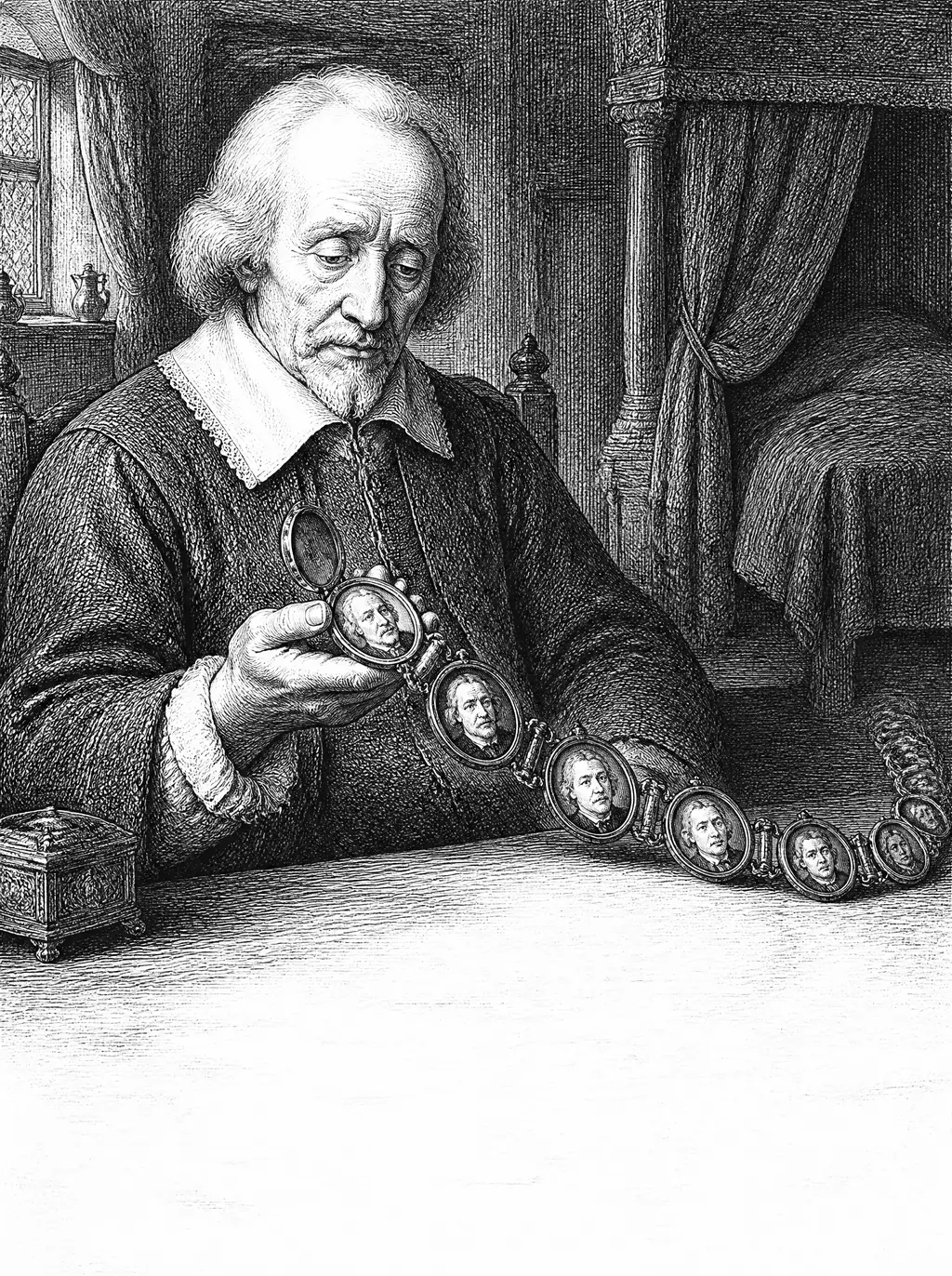
You Are Your Memory
The wrong question, cleared away first
Most people assume being the same person over time is obviously about having the same body, or the same underlying soul, persisting unbroken through every year of a life. Locke set both of those aside as beside the point, arguing that neither one, by itself, actually answers what makes you, specifically, the same person across time at all. He tested the assumption with a story. Suppose the soul of a prince, carrying with it the prince's memories, enters and informs the body of a cobbler the moment the cobbler's soul departs. Everyone who sees the cobbler sees the cobbler. But the person, Locke says, is the prince, answerable for the prince's deeds. The body is the same; the person has changed.
The world it came from
John Locke published the Essay Concerning Human Understanding in 1690, and the chapter on identity was not in it. His friend William Molyneux pressed him to address the subject, and the chapter appeared in the second edition of 1694. Locke was writing after Descartes had made the soul a thinking substance, and in a Christian culture that expected the resurrection of the dead: theologians argued about how a body scattered for centuries could be raised as the same body. Locke also had law in view. Person, he wrote, is a forensic term, a word for whoever can be held to account. He wanted a criterion that made sense of reward and punishment, on earth and at the last judgment, without leaning on substances nobody could observe.
The idea
It is the same consciousness that makes a man be himself to himself; personal identity depends on that alone, whether it is tied to one single substance or continued across a succession of different substances entirely. A person just is a thinking thing that can extend its consciousness backward, through memory, to recognize past actions and thoughts as its own. Locke separates three questions people usually run together. The same substance is a question about matter or soul. The same man is a question about a living body, one continuous organized life. The same person is a question about consciousness. The three can come apart: the same man might be two persons if his memory were split, and one person might inhabit two men if consciousness carried over.
How the reasoning runs
Step one: identity is always identity of a kind. To ask whether this is the same as that, you must first say the same what; the same mass of matter and the same oak are different questions. Step two: ask what kind of thing a person is. A person is an intelligent being that considers itself as itself across times and places, and does so only by consciousness. Step three: so the identity of a person reaches exactly as far as that consciousness reaches. Whatever past action you can own by remembering it from the inside is yours; whatever you cannot is not. Substance drops out. A soul that lost all consciousness of a life would not be the same person; consciousness transferred to a new soul would.
Seen in life
Your father, after the stroke, cannot remember the last twenty years. He knows you, but as a teenager; he asks about a job he left in 2004. The man in the bed is unquestionably your father, the same living body with a continuous history, and the law treats him so. Locke would ask you to notice how much of your grief is about something else. The person who knew your children, who made the promises of the last decade, who could be asked what he meant by that remark at the wedding: that consciousness has stopped reaching back, and the man in the bed cannot own those actions as his. Same man, Locke says, and, in the sense that matters to you, not entirely the same person.
Why it matters
This separates the question of personal identity from questions about bodies or souls entirely, and ties it instead to something psychological: the thread of memory linking a present self back to a past one. It also opens strange possibilities Locke takes seriously, that the same soul could, in principle, belong to different persons if memory failed to connect them. The consequences reach into law and morals. If a person is whoever can own an action in consciousness, then punishing someone for what they cannot remember is punishing the wrong person, which Locke admits, and adds that human law punishes anyway because it cannot see inside. It reaches into technology, too: every argument about uploading a mind, or about whether a copy would be you, starts here.
“It being the same consciousness that makes a man be himself to himself, personal identity depends on that only.”
From the source
Locke states the theory directly: “It being the same consciousness that makes a man be himself to himself, personal identity depends on that only.” It does not matter, he adds, whether that consciousness is annexed to one substance or continued through several. The passage is from Book II, chapter 27 of the Essay, the chapter Of Identity and Diversity added in 1694. Locke works through a series of cases to make the point stick: the prince and the cobbler, a man drunk and the same man sober, a person whose little finger is cut off and whose consciousness goes with the finger. Each case separates consciousness from body or soul to show which one the word person tracks. The style is plain and the examples are deliberately odd.
The pushback
What happens to identity across memory loss, since no one remembers infancy, and memory itself is famously unreliable and full of gaps even for adulthood? Critics from Locke's own century onward pressed this objection hard, noting that a theory built entirely on remembered continuity struggles badly with ordinary forgetting, let alone amnesia or dementia. Thomas Reid sharpened it in 1785 with the brave officer. A boy is flogged for robbing an orchard. As a young officer he remembers the flogging and captures a standard. As a general he remembers the capture but not the flogging. On Locke's account the general is the officer and the officer is the boy, but the general is not the boy. Joseph Butler added that memory presupposes identity and so cannot constitute it.
The reply
Locke's successors repaired the theory. Against Reid, they replaced direct memory with overlapping chains: the general is the boy because there is a series of persons each of whom remembers the previous stage, even though the ends of the chain do not connect. Against Butler, they proposed a notion of memory-like connection that does not build in whose experience it was, so that the connection can define identity without assuming it. Both repairs work at a cost. The chain view makes identity a matter of degree, and the connection view makes it possible in principle for two people to have the same memory. Parfit took both costs and paid them. What no repair does is save Locke's own clean formula, which was too simple to survive Reid's general.
Where it went next
Locke's chapter set the terms of every later debate about personal identity in English-language philosophy. Hume took the psychological approach further and found no self at all, only a bundle of perceptions. Butler and Reid supplied the standard objections, and every memory theory since has been a repair of Locke against them. In the twentieth century Sydney Shoemaker, Bernard Williams, and Derek Parfit rebuilt the theory around psychological continuity and tested it with brain transplants, fission, and teleporters, which are the prince and the cobbler with better technology. Neuroscience supplied real cases: patients with amnesia, split brains, and dementia. And Locke's insistence that person is a forensic term still governs how courts think about responsibility and memory.
Where this leads
Personal identity is not what matters answers a modern, sharpened version of this exact puzzle by giving up on finding a clean criterion for identity at all, and asking instead what actually matters in survival, whether or not strict identity turns out to be involved. The bundle theory of self is what happens when Hume takes Locke's method, looks inward for the consciousness that is supposed to hold the thread, and cannot find it. Locke, Hume, and Parfit are one argument in three generations. Locke moved the self from substance to memory; Hume noticed that memory alone gives you a sequence and not a self; Parfit said the sequence was all that ever mattered.