Symposium · Metaphysics · Pl. 12Plutarch · c. 46 – c. 120 AD
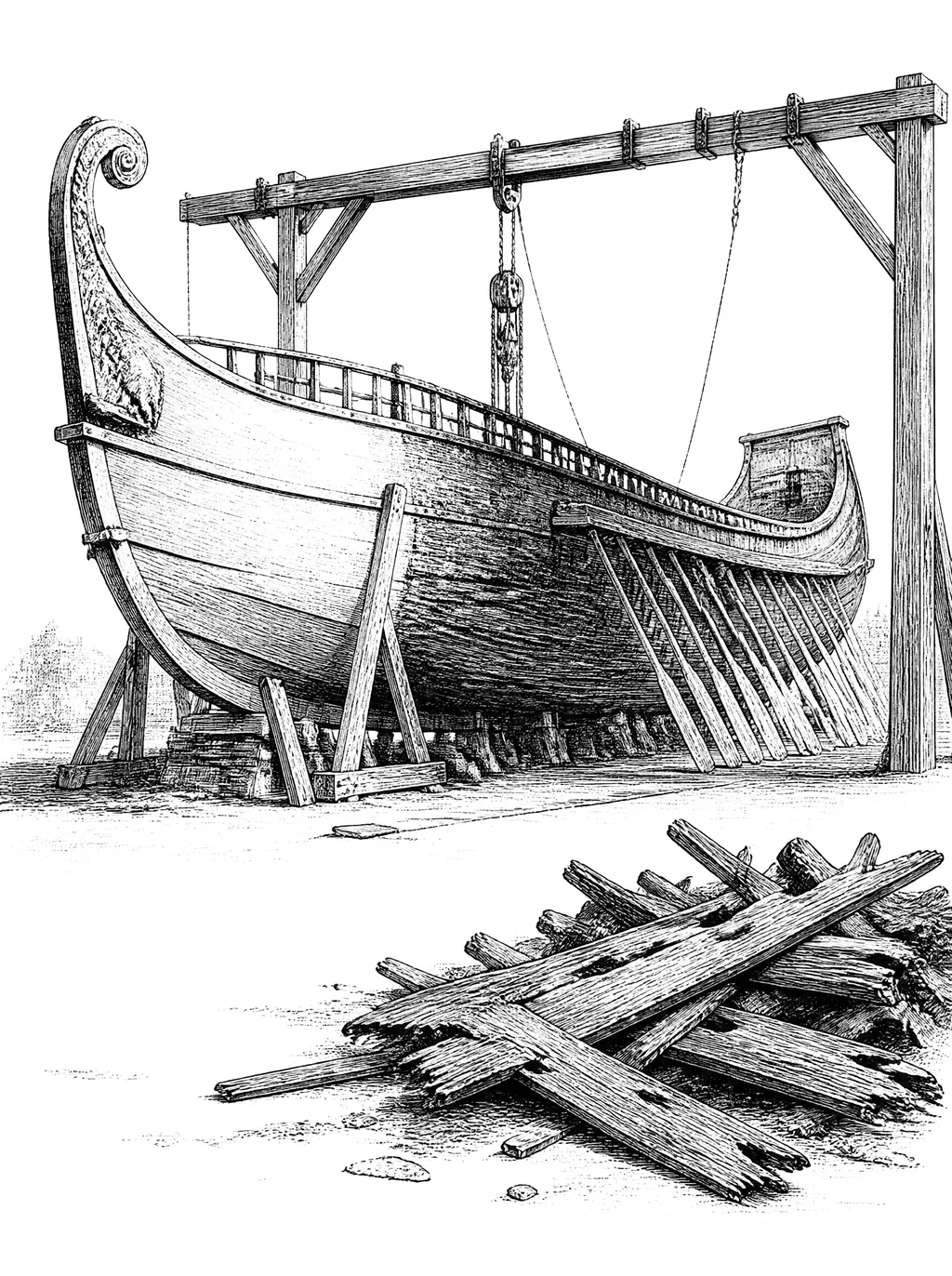
The Ship of Theseus
A ship maintained into a paradox
The thirty-oared ship in which Theseus sailed home safely was kept by the Athenians for generations after his voyage, treated as a genuine relic worth preserving. Keeping a wooden ship seaworthy for that long meant constant repair, and constant repair meant that, plank by plank, none of the original timber necessarily remained by the time the argument got started. The Athenians had a reason to keep it seaworthy. Every year they sent a ship to Delos in thanks for Theseus's return, and no execution could take place until it came home. That is why Socrates sat in prison for a month after his trial. The relic was not a museum piece. It was a working vessel with a job, and the job outlasted every plank.
The world it came from
Plutarch was a Greek from Chaeronea in Boeotia who lived under the Roman empire, held a priesthood at Delphi, and wrote the Parallel Lives, paired biographies of Greek and Roman statesmen. The Life of Theseus opens the collection, paired with Romulus, and Plutarch warns that he is entering the territory of myth. The ship anecdote is an aside in his account of Theseus's return from Crete. He reports that the Athenians preserved the vessel down to the time of Demetrius of Phalerum, about the end of the fourth century BC. The philosophers he mentions were arguing about growth and change, a puzzle the Stoics and Academics had debated for two centuries before him. Plutarch is a reporter here, not the inventor.
The idea
The Athenians constantly removed the decayed part of her timbers and renewed them with sound wood, so that the ship became an illustration to philosophers of the doctrine of growth and change, some arguing it remained the same ship, others that it did not remain the same. If every original part is eventually replaced, is what is left the same object, a different one, or a question with no single right answer? Thomas Hobbes added a twist in 1655. Suppose someone kept every discarded plank and, once all had been replaced, reassembled them into a ship. Now there are two candidates: the ship in the harbour with continuous history, and the ship in the shed with the original matter. They cannot both be the same ship.
How the reasoning runs
Premise one: a thing survives the replacement of a single small part. Repair one plank and the ship is still the ship. Premise two: what holds for one replacement holds for the next, since the ship after the first repair is just as much a ship as before. Conclusion: the ship survives the replacement of every plank. Now the other side. Premise three: a thing is the matter it is made of, and a thing made of entirely different matter is a different thing. Conclusion: the repaired ship is not the original. Both arguments look sound. The contradiction shows that same has at least two criteria, continuity of form and identity of matter, which agree in ordinary cases and split here. Hobbes's reassembled ship makes the split visible.
Seen in life
The band you loved at nineteen is touring again. The singer left in 2009, the drummer died, the bassist retired, and the name is now owned by a guitarist who joined for the third album. The set list is the same. Is it the same band? Half the comments say yes, it is the music that matters. The other half say it is a tribute act with the trademark. Now the original singer announces his own tour with the original drummer's son and the original songs, under a slightly different name. That is Hobbes's shed. You will find that your answer depends on what you wanted from the band, which is exactly Plutarch's point: the argument is about what you mean by same.
Why it matters
This is not really about ships. Bodies replace their cells, organizations replace their members, traditions replace their practitioners, all while a single name persists across the entire process. The puzzle forces a choice: locate identity in the material stuff, which changes completely, or in the continuous pattern and function, which can persist through total material turnover. The choice has consequences in law, where a company that has changed every employee and every asset still owes its old debts, and in medicine, where a patient after decades of cell turnover is held to a promise made by different molecules. It has consequences for you. If you are the pattern, then what you should protect is not any part but the continuity of the whole.
“The ship became an illustration to philosophers of the doctrine of growth and change, as some argued that it remained the same, and others, that it did not remain the same.”
From the source
Plutarch records the puzzle directly, in an aside almost in passing within his Life of Theseus: “The ship became an illustration to philosophers of the doctrine of growth and change, as some argued that it remained the same, and others, that it did not remain the same.” The phrase doctrine of growth and change translates a Greek term for a puzzle the Academic and Stoic schools had used for a long time, the growing argument, which asked how anything that gains or loses matter can remain the thing it was. Plutarch's contribution was not the puzzle but the perfect image for it, and the image has outlived every philosopher he was summarising.
The pushback
Isn't this simply a dispute over which definition of same you prefer, rather than a genuine discovery about the world, since both sides can agree completely on every physical fact and still disagree about the label? Many philosophers now treat it exactly this way, as a case study in how ordinary language quietly hides more than one workable meaning inside a single everyday word. But the deflation has a cost. If identity over time is a matter of choice, then whether you will exist tomorrow is also a matter of choice, since you are a ship of cells. Few people can believe that about themselves. The puzzle is harder to dissolve for persons than for ships, and the pressure it puts on ordinary language is the same in both cases.
The reply
The tradition's best reply is that the puzzle is not a dispute about words but a discovery about kinds. A ship is an artifact, and what counts as the same artifact depends on the purpose it serves: for the Athenians, the ship that made the voyage to Delos each year was the ship, whatever its planks. Living things and persons carry their own criterion of continuity, a process that maintains itself, and that criterion is not a choice. So the deflation is right for ships and wrong for organisms. What the reply does not settle is Hobbes's shed. When form and matter both have a continuous claim, no purpose picks a winner, and philosophers who accept everything above still divide over which ship is Theseus's.
Where it went next
Hobbes added the reassembled ship in De Corpore in 1655 and made the puzzle modern. Locke used the same structure to separate the identity of a mass of matter from the identity of a living thing and a person. In the twentieth century it became the standard opening example in analytic metaphysics, with David Wiggins, Derek Parfit, and Peter van Inwagen each building theories that had to answer it. Grandfather's axe, with three new handles and two new heads, is its folk cousin. Engineers cite it for software systems whose every line has been rewritten, biologists for bodies whose atoms turn over, and lawyers for corporations that survive the replacement of every shareholder.
Where this leads
You cannot step in the same river twice reaches for the identical structure centuries earlier from a different angle, treating apparent stability itself, in a river rather than a ship, as a pattern that persists only by constantly replacing its own material. You are your memory takes the ship into the mind. Locke asked what continuity makes a person the same person and answered with memory, a plank-by-plank replacement of experiences held together by one thread of consciousness. The river shows change that never stops; the ship shows change that can be counted; Locke shows the version that matters to you. All three refuse the answer that identity lives in the stuff.