Symposium · Pragmatism · Pl. 8Charles Sanders Peirce · 1839–1914
Hypothesis Is Where We Find
A third kind of inference
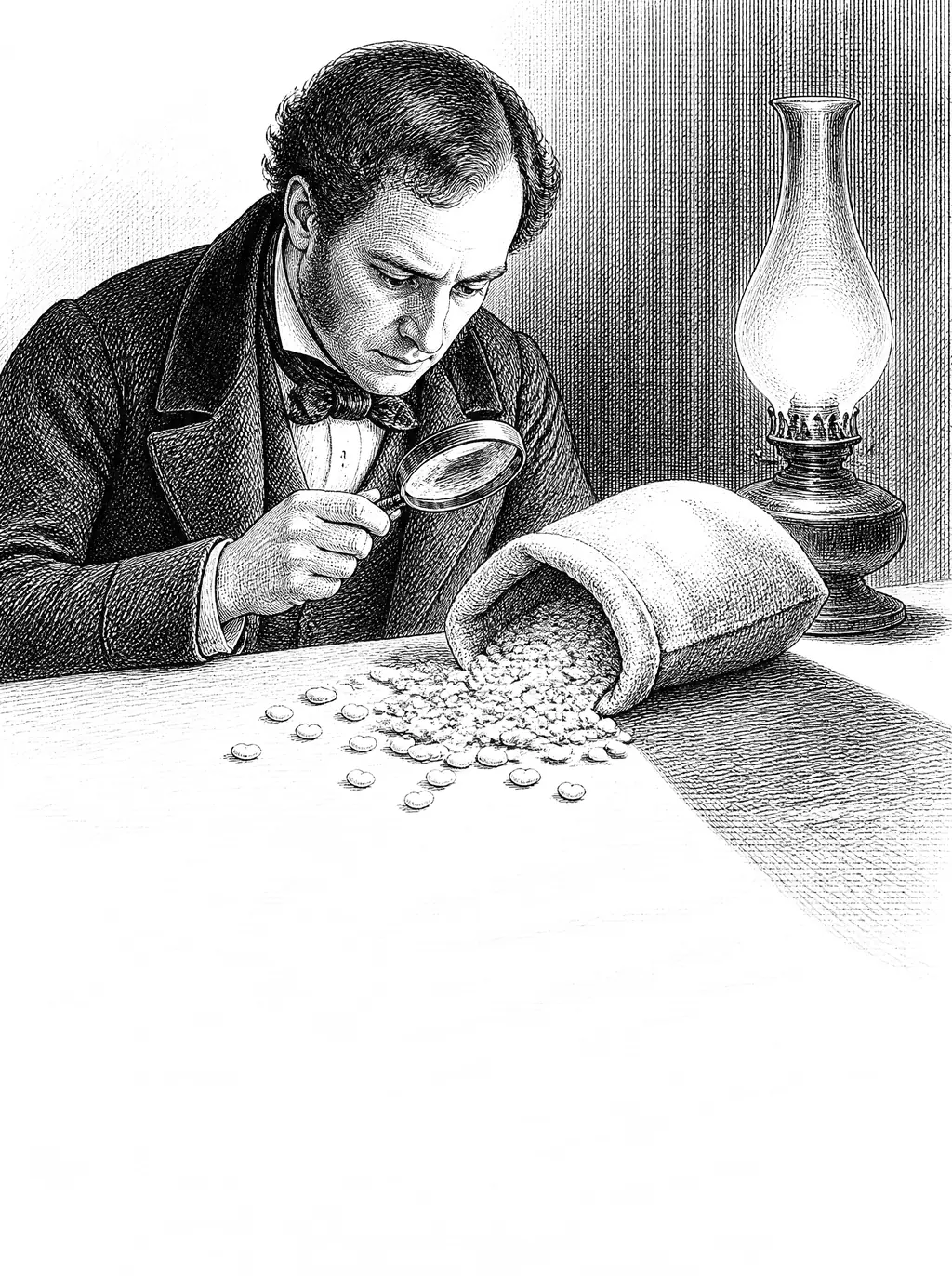
Logic textbooks before Peirce recognized deduction, drawing certain conclusions from general rules, and induction, generalizing a rule from many observed cases. Peirce insisted there was a third, distinct pattern of reasoning at work whenever a scientist encounters a single surprising fact and guesses at the rule that would make it unsurprising. His own example is a bag of beans. You find a handful of white beans on the table beside a bag you know holds only white beans. Nothing forces the conclusion, but you suppose at once that these beans came from that bag. That small, ordinary leap is the one he wants to name.
The world it came from
Deduction, Induction, and Hypothesis closed Peirce's Illustrations of the Logic of Science in Popular Science Monthly in August 1878. He wrote it while working for the Coast Survey and shortly before his only academic post, a lectureship at Johns Hopkins that began in 1879 and ended in 1884. The essay reworks the syllogism. Aristotle's logic moved from rule and case to result; Peirce noticed that the same three propositions could be arranged in three different orders, and that each order was an inference people actually made. Kepler, he thought, was the great example: a man who leapt from a few odd measurements of Mars to the hypothesis of an elliptical orbit. The problem was to give that leap a logical form.
The idea
Hypothesis is where we find some very curious circumstance, which would be explained by the supposition that it was a case of a certain general rule, and thereupon adopt that supposition. Unlike induction, which only ever generalizes from cases resembling what has already been observed, hypothesis reaches toward an explanation of a genuinely different kind entirely, often something never directly observed at all. Deduction moves from rule and case to result: all the beans in this bag are white, these beans are from this bag, so these beans are white. Induction moves from case and result to rule. Hypothesis moves from rule and result to case: these beans are white, so perhaps they came from this bag. Same three statements, third arrangement.
How the reasoning runs
Take any syllogism as three parts: a rule, a case, and a result. Step one: deduction runs rule plus case to result, and the conclusion must hold. Step two: induction runs case plus result to rule. Step three: the remaining arrangement runs rule plus result to case, and it is neither of the first two. It does not follow necessarily, and it does not generalize. It picks out a case that would make a surprising result expected. Step four: this arrangement is used constantly, so logic must recognize it. Step five: its conclusion is a supposition, held on probation, whose only warrant is that if it were true the surprise would vanish. So a hypothesis must then be tested by deducing what else it implies.
Seen in life
A junior doctor sees a patient with a rash, joint pain, and a fever that will not break. No rule tells her what this is. She runs the third inference: if this were Lyme disease, all three would be expected, and the patient did spend August in the woods. That is not a diagnosis yet. It is a hypothesis adopted because it would explain the surprise. What makes her a good clinician is what she does next. She deduces what else Lyme would imply, orders the test that could contradict it, and holds the guess loosely until the result returns. Peirce would say she has just done, in an afternoon, the three inferences that make up the whole of science: a guess, a prediction, a check.
Why it matters
This named and legitimized a pattern of reasoning scientists actually use constantly, guessing at explanatory causes rather than merely generalizing from resembling cases, giving it a distinct logical status alongside deduction and induction. Later logicians developed Peirce's third inference, eventually calling it abduction, into a whole field of study. For you, the value is permission and discipline at once. Permission, because the guess that comes before the evidence is not a lapse in rigor; it is the only place new ideas come from, and Peirce says so plainly. Discipline, because a guess is not a conclusion. It earns its keep only when you spell out what it predicts and go look.
“Hypothesis is where we find some very curious circumstance, which would be explained by the supposition that it was a case of a certain general rule, and thereupon adopt that supposition.”
From the source
Peirce defines the third form of inference directly, alongside the other two: “Hypothesis is where we find some very curious circumstance, which would be explained by the supposition that it was a case of a certain general rule, and thereupon adopt that supposition.” Napoleon's historical existence, he notes elsewhere, is itself a hypothesis in exactly this sense. He adds that hypothesis is also what we do when we infer from fossils that the sea once covered land that is now dry. In later decades Peirce renamed the inference abduction and gave it a schema: a surprising fact is observed; if a certain supposition were true, it would be a matter of course; hence there is reason to suspect the supposition.
The pushback
Doesn't calling this a distinct form of inference just dignify ordinary guessing with technical vocabulary, since adopting a hypothesis this way offers no guarantee whatsoever that the guessed explanation is actually correct? Peirce would likely reply that logic has always studied patterns of inference regardless of whether any single instance of the pattern happens to succeed. A harder objection is that for any surprising fact there are endless suppositions that would explain it. The white beans might have come from the bag, or from a neighbor's pocket, or been painted. The schema licenses all of them equally. Unless something tells you which guess to adopt, the third inference is not an inference; it is a list.
The reply
Peirce accepted that the schema alone cannot pick among hypotheses, and spent his later years on what does. He proposed rules of economy: prefer the guess that is cheapest to test, that would explain the most if true, and that can be broken quickly if false. Behind these he made a bolder claim, that human beings have an instinct for guessing right, so that among the endless suppositions the true one is usually near the top of the list. He admitted that this instinct was itself a hypothesis and could not prove it. So the reply is half method and half faith. The method is sound advice. The faith is what lets abduction count as reasoning rather than luck, and it remains the least settled part of his logic.
Where it went next
The word abduction has outlived the essay. Norwood Russell Hanson made it central to Patterns of Discovery in 1958, arguing that scientific discovery has a logic of its own. Gilbert Harman's inference to the best explanation, named in 1965, is the closest modern descendant. In artificial intelligence, abductive reasoning became a research area in diagnosis and planning. Umberto Eco compared it to the detective's method and co-edited a collection on Peirce and Sherlock Holmes. Hilary Putnam and Richard Boyd used the same inference to argue for scientific realism: the success of science would be a miracle unless its theories were roughly true. Ask a physician, a mechanic, or a debugger how they work, and they will describe abduction without the name.
Where this leads
The whole of our conception shows Peirce, in an earlier and more famous essay, supplying the test that any hypothesis reached this way must ultimately satisfy, that a genuinely meaningful explanatory guess has to cash out in some conceivable practical difference, or it was never a real hypothesis to begin with. Logic is rooted in the social principle, from the same series, explains why a single guesser's track record is not what matters. A hypothesis is adopted on behalf of a community that will test it, and it is the community's long run, not yours, that gives the method its warrant. The three essays are one argument in three parts.