Symposium · Pragmatism · Pl. 11Charles Sanders Peirce · 1839–1914
The Whole of Our Conception
A rule for genuine clarity
Peirce noticed that philosophers routinely mistake familiarity with an idea for genuine understanding of it, able to use a word confidently without being able to say what practical difference it makes. He proposed a rule for testing real clarity, one that would become the founding maxim of an entire movement in philosophy. Descartes had asked for ideas that were clear and distinct. Peirce thought that standard was a feeling, not a test. You can feel perfectly clear about a word like force or hardness and still be unable to say what would change if it were false. His maxim was meant to replace the feeling with a procedure.
The world it came from
How to Make Our Ideas Clear appeared in Popular Science Monthly in January 1878, the second of Peirce's Illustrations of the Logic of Science. Peirce had drafted its core in the early 1870s for the Metaphysical Club in Cambridge, where he met with William James, Chauncey Wright, and the lawyer Nicholas St. John Green. Green, following Alexander Bain, defined belief as that on which a person is prepared to act; Peirce later called that definition the seed of pragmatism. Peirce was a working scientist at the Coast Survey, and the essay's examples come from his bench: what it means to call a thing hard, or heavy, or a force. He wanted a rule that would do for metaphysics what measurement did for physics.
The idea
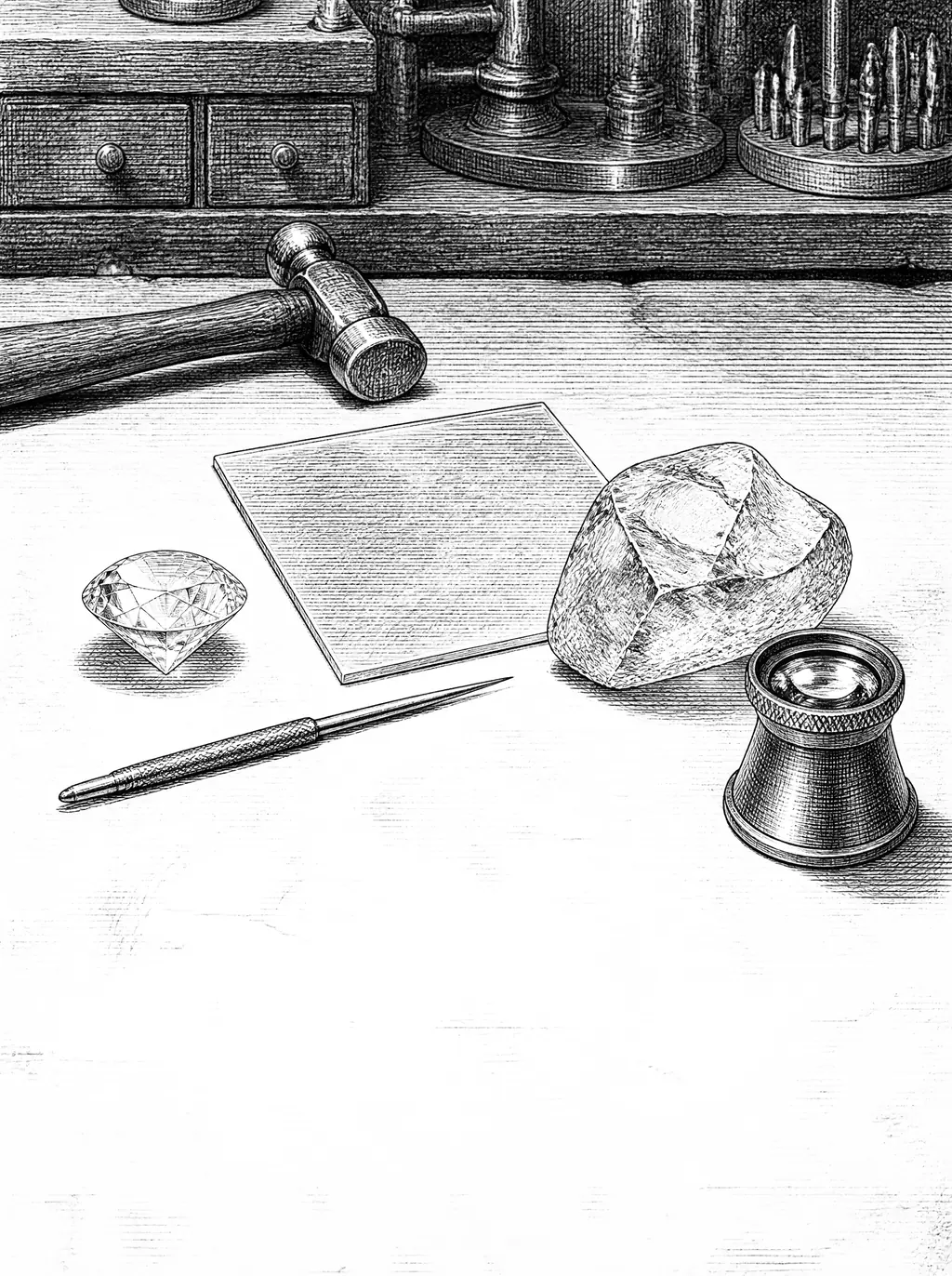
Consider what effects, which might conceivably have practical bearings, we conceive the object of our conception to have. Then, our conception of these effects is the whole of our conception of the object. If two supposedly different ideas produce identical practical consequences in every conceivable situation, Peirce argues, they are not really different ideas at all, merely different words. Meaning, on this view, lives in the conditional. To call a diamond hard is to say that if you try to scratch it with most substances, they will fail. Strip away every such if-then and nothing of the concept remains. The maxim is not a theory of truth. It only tells you what you are claiming when you speak.
How the reasoning runs
Peirce builds from three grades of clearness. The first is familiarity: you recognize the idea when you meet it. The second is definition: you can state it in other words. Both leave room for confusion; a definition only swaps words for words. The third grade asks something different. Step one: a belief is a habit of action. Step two: a habit is identified by when it acts and what it produces. Step three: so a concept's meaning is exhausted by the actions it would lead to under conceivable circumstances. Step four: if two concepts would lead to the same actions in every conceivable case, they are one concept. The maxim follows, and so does its edge: a distinction with no conceivable practical difference is no distinction.
Seen in life
Two engineers argue for an hour about whether the new caching layer is really a database. Run the maxim. Ask what you would do differently if it were. Would you back it up nightly? Would you let it be the only copy of anything? Would you write migrations for it? If the answers are the same under both labels, the hour was spent on a word. The same move settles arguments that feel much grander. Ask whether the universe is deterministic, and Peirce would ask what observation you expect to differ. If none, the question is not deep; it is empty. The maxim will not tell you what is true. It tells you when you have stopped talking about anything.
Why it matters
This gave philosophy a practical test for meaning itself, one that could expose grand metaphysical disputes as empty verbal quarrels once their rival positions were shown to carry no different practical consequences whatsoever. It founded pragmatism as a distinct movement, later taken up and reshaped by James, Dewey, and generations of American philosophers. For you the value is defensive. Most bad decisions are made in words that sound like they settle something. Culture, quality, alignment, synergy. The maxim hands you one question that cuts through all of them: what would I expect to see, and do, if this were true? A word that survives that question has content. A word that does not was decoration.
“Consider what effects, which might conceivably have practical bearings, we conceive the object of our conception to have. Then, our conception of these effects is the whole of our conception of the object.”
From the source
Peirce states the maxim as the rule for attaining the highest grade of clearness: “Consider what effects, which might conceivably have practical bearings, we conceive the object of our conception to have. Then, our conception of these effects is the whole of our conception of the object.” Every genuine idea, on this view, cashes out in some conceivable difference. He applies it at once to the Catholic doctrine of transubstantiation, arguing that to call wine blood while admitting it has every sensible property of wine is to say nothing at all, and then to the concept of force in physics. The essay closes with a definition of reality in the same spirit: the real is what the community of inquirers would finally agree on, if inquiry were carried far enough.
The pushback
Doesn't this maxim risk dismissing genuinely meaningful ideas simply because their practical consequences are subtle, distant, or not yet discovered, rather than because the ideas are actually empty? Peirce's later refinements to the maxim tried to broaden what counts as a practical effect, though critics have kept pressing on where exactly that boundary should be drawn. A second objection turns the maxim on itself. What conceivable practical effect does the maxim have? If none, it is empty by its own test. A third: many past disputes that looked purely verbal, such as whether light is a wave or a particle, turned out to have consequences nobody could then conceive. A test that depends on what we can currently conceive will misfire on exactly the ideas that matter most.
The reply
Peirce's answer to the self-application charge is that the maxim does have effects: it changes how you inquire, which questions you drop, and which experiments you run. That is a practical bearing by his own standard. To the wave-and-particle worry he would say the maxim asks about conceivable effects, not currently known ones, and that the meaning of a concept grows as inquiry discovers more of what it implies. The honest gap is the boundary. Peirce never fixed how remote or how hypothetical an effect may be before it stops counting. His late writings restated the maxim in terms of what would happen rather than what will, and in 1905 he renamed his own position pragmaticism to keep it apart from the looser versions James was teaching.
Where it went next
James took the maxim and stretched it from a theory of meaning into a theory of truth, in the Pragmatism lectures of 1907, which Peirce disowned. Dewey folded it into his account of inquiry. The Vienna Circle's verification principle in the 1920s and 1930s was a stricter cousin, though it demanded actual verification where Peirce asked only for conceivable effects. Percy Bridgman's operationalism in physics, from 1927, made the same demand of scientific concepts. Later, Hilary Putnam and Susan Haack defended a broadly Peircean realism, and Robert Brandom read the maxim as an early statement that meaning is a matter of inferential role. Wittgenstein's remark that meaning is use, though it came from elsewhere, is often placed beside it.
Where this leads
The irritation of doubt shows Peirce building the companion half of his pragmatist theory of inquiry, explaining not what an idea means once it is clear, but what actually drives the mind to search for clarity and settled belief in the first place, before any concept can be tested at all. Falsifiability is the twentieth-century relative worth reading next. Karl Popper asked not what a claim means but when it counts as scientific, and gave an answer with the same shape: a claim that no possible observation could contradict says nothing about the world. The maxim and the falsification test are two edges of one blade.