Symposium · Pragmatism · Pl. 9Charles Sanders Peirce · 1839–1914
Logic Is Rooted in the Social Principle
A problem hiding inside probability
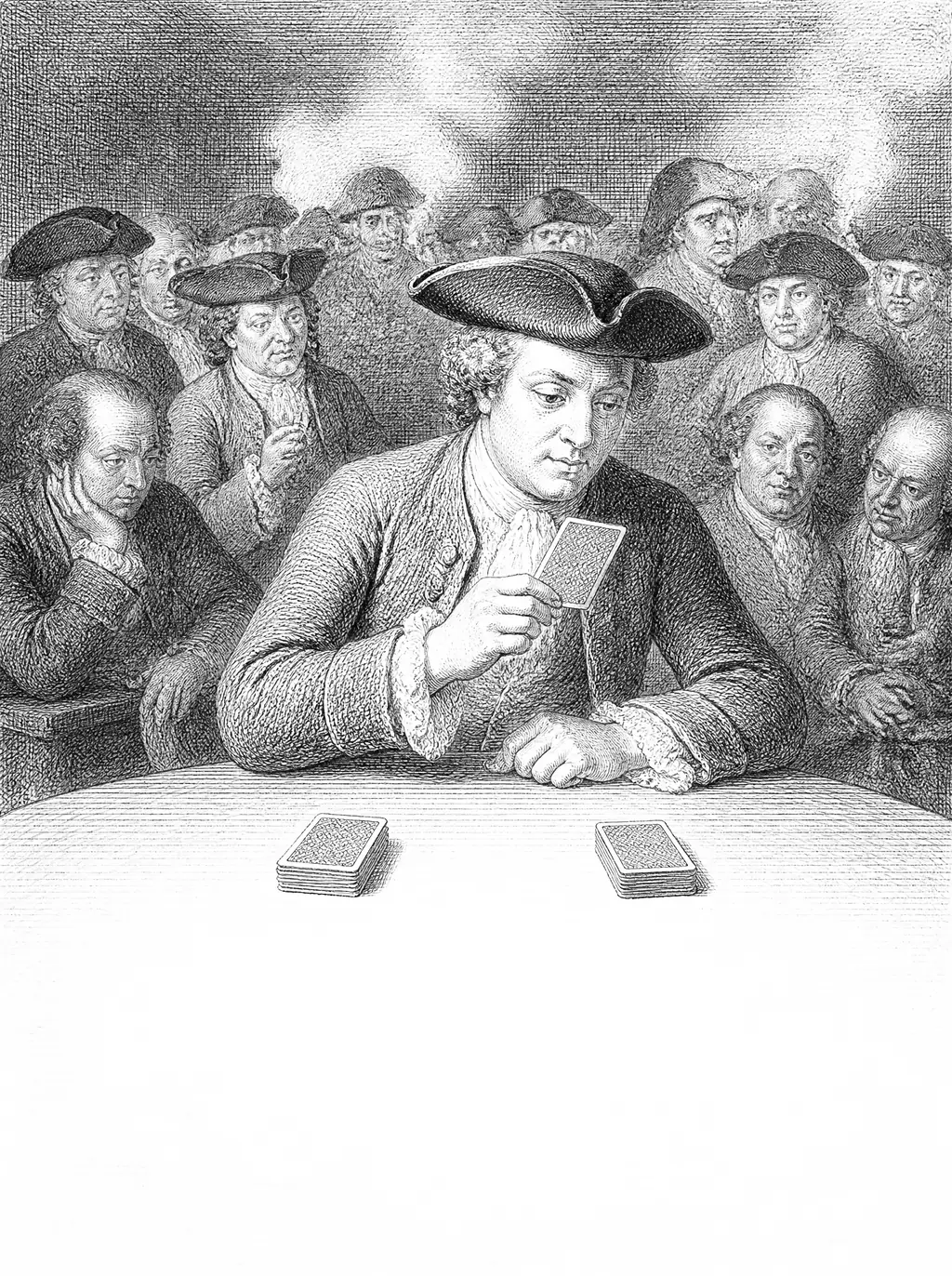
Reasoning from probability only pays off reliably across a large number of trials, yet any one person faces a finite, mortal number of chances to reason at all. If logic is supposed to serve your own individual interest, Peirce notices, this mismatch between infinite theory and finite life becomes a genuine problem. He dramatizes it with a wager. You must draw one card from one of two packs. One pack gives you a twenty-five in twenty-six chance of a good card; the other, one in twenty-six. Everyone picks the first. But if you only draw once, the long run never arrives, so why is that choice rational?
The world it came from
The Doctrine of Chances appeared in Popular Science Monthly in March 1878, the third of the six Illustrations of the Logic of Science. Peirce was writing as a practicing scientist at the United States Coast Survey, where measurement meant error, and error meant probability. He had read Laplace and the English logicians on chance, and he rejected the idea that probability measures a degree of private belief. For him it measures a ratio of outcomes in the long run. That commitment produced the problem the essay attacks. A frequency only exists across many cases, yet the man at the card table gets one draw. Peirce was also thinking about what makes a person rational at all, and he wanted an answer that did not rest on religion.
The idea
Logicality inexorably requires that our interests shall not be limited. They must not stop at our own fate, but must embrace the whole community. Since probabilistic reasoning only makes sense assuming an indefinitely large number of cases, Peirce argues, being genuinely logical requires caring about outcomes stretching beyond any single person's own limited stake in them. The community he means is not your town or your nation. It stretches to all reasoners, past and future, whose inferences together make up the long run that probability refers to. To reason well is to identify your interest with theirs. Peirce says this identification cannot be coerced; it has to be a real, if unspoken, hope.
How the reasoning runs
Step one: a probability is a ratio in the long run. A valid inference is one that leads to truth most of the time. Step two: a single person faces only a finite number of inferences, and the important ones may come once. Step three: so for a single person the long run is a fiction, and the argument from probability gives no reason to prefer the better pack. Step four: yet the preference is plainly rational. Step five: so the reasoner must be taking an interest in something larger than one draw, all the draws that reasoners like her will ever make. Step six: therefore logic presupposes an interest that extends beyond the self. That is what Peirce means by the social principle.
Seen in life
You run a small clinic and a patient asks about a treatment that helps four in five people and harms one. She will take it once. Her long run is a single case. If reason were only about her draw, the odds would carry no more authority than a coin she has already flipped. What makes the four-in-five a reason is that you are treating her as one of the many patients the evidence was gathered from and will be applied to. Peirce would say you can only advise her rationally by caring about all of them at once, and she can only accept the advice by seeing herself as one case in a series she will never watch complete.
Why it matters
This gave logic an unexpectedly social and even ethical foundation, tying the validity of inference itself to a willingness to care about a community's fate rather than merely one's own. It anticipated later pragmatist arguments that inquiry is inherently a communal enterprise, never something a single isolated mind can fully complete alone. It also answers a private question. When you defer to the evidence against your own hope, and you lose anyway, why is that not simply a loss? Peirce's answer is that in doing so you are being logical, and that logic was never a tool for winning single hands. Its point was always the whole run, played by everyone.
“Logicality inexorably requires that our interests shall not be limited. They must not stop at our own fate, but must embrace the whole community...Logic is rooted in the social principle.”
From the source
Peirce draws the conclusion directly from his analysis of probability: “Logicality inexorably requires that our interests shall not be limited. They must not stop at our own fate, but must embrace the whole community...Logic is rooted in the social principle.” Pure self-interest, on this view, cannot fully ground rational inference. The passage follows the two-pack wager and its troubling conclusion that a single draw leaves probability without a foothold. Peirce then names three sentiments that logic requires: an interest in an indefinite community, a recognition that this interest can be made supreme, and a hope in the unlimited continuance of intellectual activity. He notes, without irony, that these resemble the Christian virtues of charity, faith, and hope.
The pushback
Isn't it a stretch to move from a technical point about the mathematics of long-run probability to a sweeping claim about ethics and community, when reasoners might simply accept that their individual inferences carry real but limited, non-infinite reliability? Peirce's defenders reply that he is diagnosing what full logical consistency actually demands, not merely describing ordinary practice. A harder objection comes from decision theory. Since the 1920s, Frank Ramsey and others have treated probability as a measure of a single agent's degree of belief, checked by the bets she would accept. On that reading the one-draw case has an easy answer: pick the pack you believe is better, and no long run is needed. If that account is right, Peirce's whole problem dissolves.
The reply
Peirce would grant that a person can assign degrees of belief, and deny that this explains why the degrees should track frequencies. Why should you believe the good pack is better? Because most draws from it come out well, and that is a fact about the run, not about your feelings. The subjective account, he would say, borrows its authority from the frequency it claims to replace. That reply is strong on validity and weaker on scope. Peirce needs the community to be indefinite in extent, and a critic can ask why caring about the next hundred reasoners is not enough. The essay does not settle that. What it establishes is narrower and still surprising: if you take probability seriously, the self is the wrong unit of logic.
Where it went next
The idea that inquiry belongs to a community, not a mind, runs through everything that followed. Peirce's later definition of truth as the opinion inquiry would converge on in the long run depends on it. Josiah Royce, his Harvard ally, turned the community of interpretation into the center of his late philosophy. Dewey built a politics on it in The Public and Its Problems. In the twentieth century, Karl-Otto Apel and Jürgen Habermas took the unlimited community of communication from Peirce explicitly and made it the basis of discourse ethics. Cheryl Misak's reading of pragmatism starts here. And the tension the essay opened, between frequentist and subjective accounts of probability, is still live in statistics.
Where this leads
Hypothesis is where we find shows Peirce turning from probability to a different mode of inference entirely in a related essay from the same series, describing the distinctive act of guessing at an explanatory rule to account for some curious, unexplained fact, a form of reasoning later thinkers would call abduction. The irritation of doubt comes earlier in the same series and shows what the community is for. There, the method of science wins because it fixes belief by something outside any single mind. Here you learn why a single mind was never the right unit to begin with. Read the two together and Peirce's realism and his social principle turn out to be one thought.