Symposium · Philosophy of Mind · Pl. 11Plato · c. 428–348 BC
The Three-Part Soul
Three voices, one head
Socrates notices something odd about internal conflict: a thirsty man can want to drink and, at the same time, refuse to, as though two separate forces inside him were pulling in opposite directions. Since the same thing cannot do opposite things to itself at once, he reasons, there must be more than one part of the soul doing the pulling. He then tells a story about a man named Leontius, who saw corpses by the city wall, wanted to look, hated himself for wanting to, and finally ran up to them shouting at his own eyes to take their fill. That is not one desire. It is three, and one of them is angry.
The world it came from
Plato wrote the Republic in Athens around 375 BC, a generation after the city had lost a long war to Sparta and put his teacher Socrates to death. He had founded the Academy a decade earlier. The dialogue's main question is what justice is, and Plato answers it twice, once for a city and once for a soul, insisting the two have the same structure. The tripartite soul is the second answer. It also corrects Socrates. The Socrates of the earlier dialogues had held that nobody does wrong knowingly, so that weakness of will is impossible. Plato had watched people know better and act worse, and he needed a picture of the soul in which that could happen.
The idea
The soul has three principles: reason, which calculates and seeks truth; spirit, which feels anger, pride, and indignation; and appetite, which wants food, drink, and pleasure. A just, well-ordered person is one who has bound these three together, reason ruling with spirit's help, appetite kept in its proper place, the way a musician tunes the high, low, and middle notes of a single instrument into one harmony. Each part has its own object and its own pleasure. Reason loves truth, spirit loves honor, and appetite loves gain. The three match the three classes of Plato's ideal city: rulers, soldiers, and producers. Justice in both cases is each part doing its own work and none of them usurping the others.
How the reasoning runs
Step one: state a principle. The same thing cannot do or undergo opposites in the same respect, toward the same object, at the same time. Step two: find a case. A thirsty man wants to drink and holds back. Wanting and refusing are opposites toward one object, so two different things are at work: appetite and reason. Step three: Leontius. He wants to look at the corpses and is angry at himself for wanting to. The anger is not reason calculating; it is a third thing, spirit, that sides with reason. Step four: spirit is not reason, because children and animals have spirit before they have reason, and Homer's Odysseus rebukes his own heart. Conclusion: three parts, and justice is their right order.
Seen in life
You set the alarm for six with every intention of running. At six a different person is negotiating with the phone. That person has arguments, and they are good ones: the knee, the rain, the meeting. You lie there and watch two voices bargain. Then a third one arrives, and it is not arguing. It is contempt. You are disgusted with the person under the duvet, and the disgust is what finally moves your legs. Plato would say you have just met all three parts in order. Appetite wanted the warmth. Reason had the plan. Spirit, the part that cannot stand to be shamed, is what a plan needs on its side to win. Training spirit to back reason is, for Plato, most of what education is.
Why it matters
This gives inner conflict a structure instead of treating it as a single confused will. Craving a cigarette while wanting to quit, feeling brave and terrified in the same breath: Plato's model explains these not as contradictions in one simple thing, but as the ordinary friction between three genuinely different parts that a well-lived life has to learn to balance. It also changes what self-control is. On a one-part picture, weakness of will is a failure of knowledge, and the cure is more information. On Plato's picture the cure is alliance: get spirit, the part that cares about pride and shame, to side with reason against appetite. That is why he thought music, gymnastics, and stories mattered as much as argument.
“He sets in order his own inner life, and is his own master and his own law, and at peace with himself; and when he has bound together the three principles within him, which may be compared to the higher, lower, and middle notes of the scale.”
From the source
Plato describes the well-ordered soul directly: “He sets in order his own inner life, and is his own master and his own law, and at peace with himself; and when he has bound together the three principles within him, which may be compared to the higher, lower, and middle notes of the scale.” The passage closes Book IV of the Republic, in Benjamin Jowett's translation. It follows the argument from the principle of opposites and the story of Leontius. The musical image is exact: three notes do not become one note, but they can be tuned to sound as one chord. Plato returns to the picture in the Phaedrus, where reason is a charioteer driving two horses, one noble and one unruly.
The pushback
Isn't dividing the soul into three separate parts just a convenient story, a metaphor mistaken for an actual internal structure, when a single unified mind could produce exactly the same felt experience of conflicting desires without literally splitting into pieces? Later philosophers largely treated the division as psychologically useful without endorsing it as literal anatomy of the soul. Two sharper objections follow. Each part, on Plato's telling, wants, judges, and feels, so each part looks like a small soul of its own, and the question of how a soul is unified has been pushed down a level, not answered. And the principle of opposites yields as many parts as there are conflicts. Nothing in the argument stops at three.
The reply
Plato half concedes the second objection himself. He has Socrates say that a full account would need a longer road, and that the present division is what the argument needs, not the last word. Three parts are the minimum the cases demand, and a defender can say that further conflicts fall within a part rather than between parts, as two appetites can compete. The small-souls worry is harder. Plato does give each part beliefs and desires of its own, and critics from Aristotle onward have pressed him on it. The best reply is that the parts are sources of motivation with characteristic objects, not persons, and that Plato's point survives the metaphor: when you fight yourself, something in you really is on each side.
Where it went next
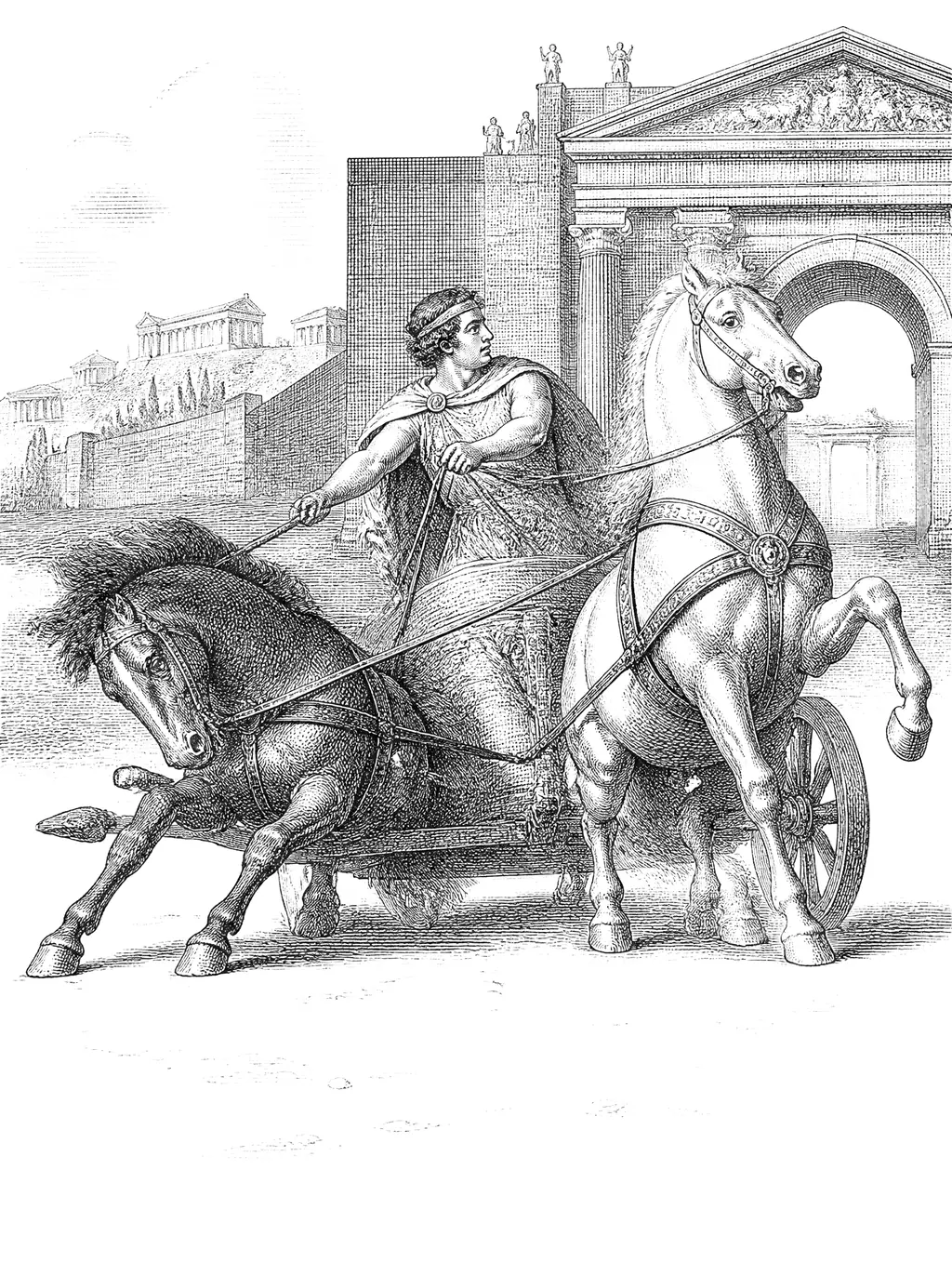
Aristotle kept the split between a rational and a non-rational part and built his account of weakness of will on it. The Stoics rejected the parts entirely: for Chrysippus a passion is a judgment, and inner conflict is the soul changing its mind quickly. The physician Galen defended Plato against the Stoics in the second century AD, locating the three parts in the brain, heart, and liver. Freud's id, ego, and superego are often compared to Plato's three, though Freud's parts do different work. The modern echo that fits best is Jonathan Haidt's image of a rider on an elephant, where reason steers only if it wins the elephant over. Plato said that first, with a charioteer and two horses.
Where this leads
The golden mean picks up the same picture of a soul with competing pulls, from Aristotle himself, translating Plato's three warring parts into a single practical daily discipline: finding, and steadily holding, the exact balanced point between excess and deficiency. Plato's cave is the other side of the same book. The tripartite soul explains what is wrong with the prisoners: appetite and spirit are satisfied by shadows, and only reason wants to turn around. The ascent out of the cave is the story of reason taking command. Read the two together and Plato's education program comes into focus: the point of philosophy is not to add knowledge to a soul, but to change which part of it rules.