Symposium · Pragmatism · Pl. 12W. V. O. Quine · 1908–2000
No Statement Is Immune to Revision
A wall between two kinds of truth
Philosophers had long distinguished analytic truths, true purely by the meanings of their words, from synthetic truths, true by matching the facts of the world. Quine attacked this distinction directly, arguing no one had ever managed to explain analyticity itself without secretly assuming the very distinction under dispute. The stakes were high because the distinction was load-bearing. The logical positivists had used it to explain how mathematics and logic could be certain without being about the world: they were true by meaning alone. Take that away and you have to say what mathematics is about, and how anything could be known for sure.
The world it came from
Quine read Two Dogmas of Empiricism to the American Philosophical Association in December 1950 and published it in the Philosophical Review in January 1951. He was forty-two, a Harvard professor, and had spent 1932 and 1933 in Europe with the logical positivists, above all Rudolf Carnap, whom he called his greatest teacher. Carnap's system rested on the analytic-synthetic distinction and on the idea that each meaningful statement could be reduced to reports of experience. Those are the two dogmas. Quine had pressed Carnap on the first since the 1930s; the paper made the argument public. Behind it stands Pierre Duhem, who had argued in 1906 that physical hypotheses are never tested one at a time, and the pragmatism of Peirce and James, acknowledged in the paper's final pages.
The idea
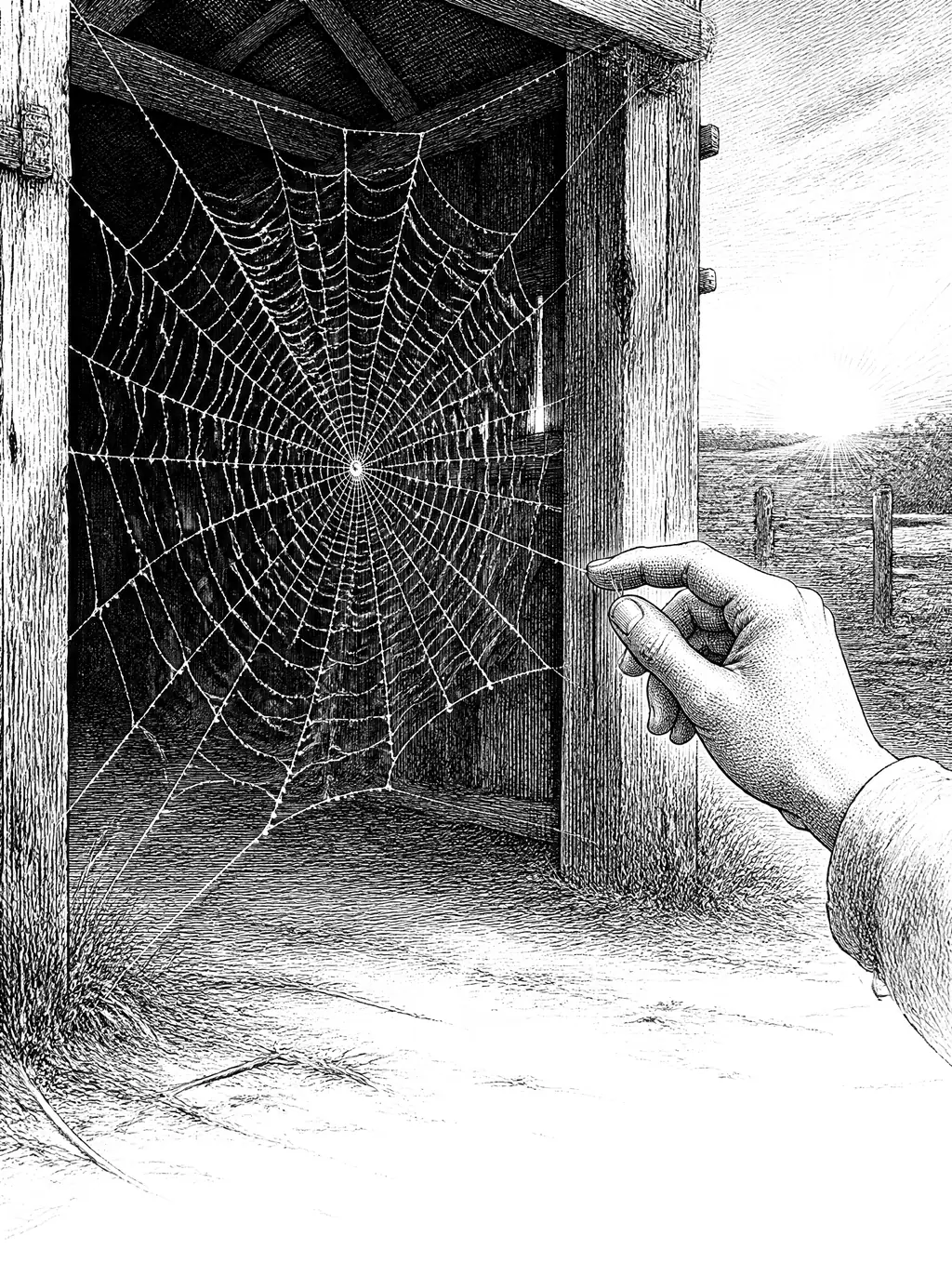
No statement is immune to revision. Even a claim that looks purely logical or definitional, Quine argues, could in principle be given up if enough pressure came from elsewhere in the interconnected web of belief, while a claim that looks purely factual can sometimes be protected from revision by adjusting other beliefs around it instead. Picture knowledge as a fabric. Experience touches it only at the edges, in observation. Logic and mathematics sit near the center, far from any single experience, which is why they seem immune. But the distance is a matter of how much else you would have to change, not of a different kind of truth. A conflict at the edge can, in principle, propagate all the way in.
How the reasoning runs
Step one: to define analytic, you must appeal to synonymy, to definition, or to necessity. Step two: each of those, when examined, either presupposes analyticity or explains nothing; definition records synonymy, and necessity is analyticity under another name. Step three: so no non-circular account of the distinction exists. Step four: the second dogma, that each statement has its own set of confirming experiences, fails too, because statements are tested in groups; an experiment refutes a bundle of assumptions, not one claim. Step five: put the two results together and you get holism. Beliefs face experience as a whole, and when experience conflicts with the whole, we choose what to revise. Conclusion: no statement is immune, and none is confirmed alone.
Seen in life
Your team's dashboard shows a metric that cannot be right: revenue up, orders down, refunds flat. Something in the web has to give, and notice how many candidates there are. The query could be wrong. The definition of an order could have changed. The currency conversion could be stale. A logging service could be double-counting. Even the arithmetic, if you are paranoid enough, could be a floating-point artifact. Nothing tells you in advance which one. You revise the belief that is cheapest to change and does the least damage elsewhere, and only experience, the next week's numbers, tells you if you chose well. Quine's point is that this is not a special feature of dashboards. It is what all knowledge looks like when a fact arrives that does not fit.
Why it matters
This dissolved a boundary that had organized huge stretches of twentieth-century philosophy, replacing it with a holistic picture in which beliefs face experience together as an interconnected web rather than as separate, individually testable claims. It pushed epistemology in a distinctly pragmatist direction, judging beliefs by their overall usefulness in the whole system rather than by isolated verification. For you the lesson is about what certainty costs. A belief that feels beyond question is one you would have to change a great deal to give up, and that is a fact about your web, not about the world. Keep the center stable, since you cannot function otherwise, but do not mistake stability for immunity. The next fact might reach it.
“No statement is immune to revision.”
From the source
Quine states the conclusion his holistic picture of belief leads to: “No statement is immune to revision.” Any single claim, he argues, can in principle be preserved against contrary evidence by making compensating adjustments elsewhere in the web, and any claim can in principle be abandoned if enough of the surrounding web shifts instead. The line comes in the paper's sixth and final section, Empiricism without the Dogmas. There Quine compares science to a field touching experience only at its edges, and suggests that even logic could be revised to simplify quantum mechanics, as Kepler superseded Ptolemy. He calls his own position a more thorough pragmatism than Carnap's, and compares physical objects, as posits, to the gods of Homer, different in degree, not in kind.
The pushback
Doesn't treating literally every statement as revisable, even basic logical laws, risk collapsing all meaningful distinctions between kinds of knowledge into one undifferentiated mass, no different in principle from mere convenience? Quine's defenders reply that some beliefs are simply far more central and costly to revise than others, even while none is formally exempt. The sharpest reply came from Paul Grice and Peter Strawson in 1956. They argued that a distinction philosophers had used for two centuries with broad agreement about which cases fell on which side could not be meaningless just because it lacked a reductive definition. Carnap's own response was that analyticity is relative to a chosen language, and that Quine had asked for something no useful concept can supply.
The reply
Quine granted that people agree about cases, and replied that agreement about cases does not show there is a sharp line; people agree about which men are bald without there being a number of hairs that decides it. Analyticity, on his view, survives as a matter of degree, a measure of how central a sentence sits in the web. To Carnap he answered that relativizing analyticity to a language only pushes the question back to how a language is chosen. The reply is strong against the demand for a sharp line and weaker on logic. Quine never quite explained how to revise logic without using it, and in later work he became more cautious, treating logic as revisable in principle and fixed in practice. The concession is real.
Where it went next
Two Dogmas is among the most cited papers in twentieth-century philosophy and marked the end of logical positivism as a program. Its holism became a standard position in philosophy of science, where it is now called the Duhem-Quine thesis. Thomas Kuhn's account of paradigm shifts, in 1962, drew on the same picture of theory change. Donald Davidson, Quine's student, extended holism to meaning and mind. Hilary Putnam and Richard Rorty both took the paper as licence for their versions of pragmatism, though Rorty's was looser than Quine, a lifelong physicalist, would have accepted. Saul Kripke's work in the 1970s separated necessity from analyticity, reviving one of the notions Quine had bundled together. The analytic-synthetic distinction has never regained its old authority.
Where this leads
Logic is rooted in the social principle shows Charles Peirce, working nearly a century earlier, already treating logic and inquiry as fundamentally communal and revisable processes rather than fixed, individually certain foundations, an early ancestor of the same holistic, pragmatist instinct Quine would later formalize far more rigorously. Falsifiability is the rival picture. Popper wanted a single observation to be able to kill a theory; Quine's holism says the observation kills only a bundle, and you choose which member dies. Read the two side by side and you can see why scientists in practice do a bit of each: they let anomalies pile up, then decide, all at once, what to give up.