Symposium · Epistemology · Pl. 9Thomas Kuhn · 1922–1996
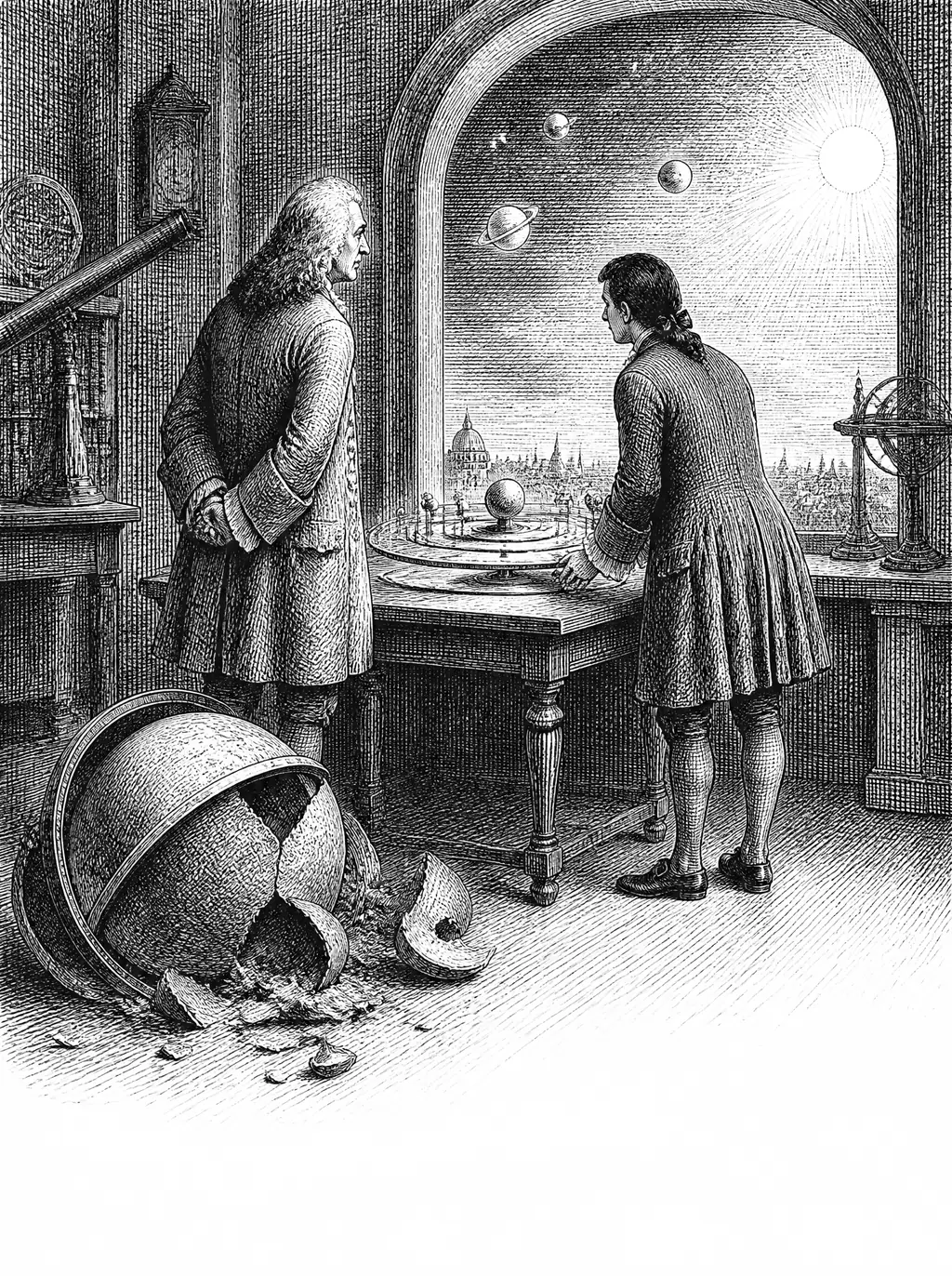
The Paradigm Shift
Not a straight line upward
The standard story of science pictures a steady accumulation of facts, one discovery quietly stacked on the last. Kuhn, trained as a physicist before turning to history, found the actual record messier and stranger: long stretches of routine puzzle-solving inside a shared framework, interrupted by rare, disorienting upheavals in which the framework itself gets replaced, not just refined. The book that said so, The Structure of Scientific Revolutions, sold over a million copies and put the phrase paradigm shift into boardrooms, where it now means almost anything. Kuhn spent the rest of his life trying to take the phrase back and explain what he had actually meant.
The world it came from
While finishing a physics doctorate at Harvard, Kuhn was asked in 1947 to teach a general science course for humanities students. Preparing it, he read Aristotle's Physics and found it absurd: how could so brilliant a man be so wrong about motion? Then one summer afternoon, by his own account, the text rearranged itself and he saw that Aristotle was not doing bad Newtonian physics but a different physics, coherent on its own terms. That experience became the book. Structure appeared in 1962, oddly enough as a volume in the logical positivists' own International Encyclopedia of Unified Science. Its opponents were the positivists and Karl Popper, who both pictured science as a single rational method applied without interruption.
The idea
A paradigm is the shared set of assumptions, methods, and exemplary problems that lets a scientific community agree on what counts as a solved puzzle. Most of the time, science operates inside one paradigm, extending and applying it. A paradigm shift happens when accumulated anomalies finally break the old framework, and the field adopts a genuinely new one, incommensurable with the old, not just an upgrade of it. Incommensurable is the word that does the damage. It means the two frameworks share no neutral measure: they disagree about which problems matter, what a good answer looks like, and sometimes what the words mean. Mass in Newton and mass in Einstein are not the same quantity refined. They are different concepts that happen to share a name.
How the reasoning runs
First, look at how scientists actually spend their days: solving puzzles the paradigm defines, using methods the paradigm supplies. Kuhn calls this normal science, and it is most of science. Second, puzzles that refuse to be solved are anomalies, and most are shelved, since abandoning a paradigm over one failure would abandon the work. Third, when anomalies pile up in a place the paradigm cannot ignore, the field enters crisis, and rival frameworks appear. Fourth, the rivals cannot be judged by neutral observation, because what counts as an observation, and as a good answer, is set by the paradigm. Fifth, so the shift is partly persuasion and partly a change of generation. Therefore science progresses within paradigms but does not accumulate across them.
Seen in life
You are a gastroenterologist in 1983. Every textbook you own says stomach ulcers come from stress and acid, and the drugs that lower acid work well enough to prove it. Two Australians, Barry Marshall and Robin Warren, claim a bacterium is the cause. You know bacteria cannot survive in stomach acid; that is not a finding, it is a background fact that every finding assumes. Their paper looks like a mistake. It takes a decade, a course of antibiotics, and Marshall drinking a culture of the organism before the field turns. Notice what turned. Not just a fact, but what counted as a possible fact. That is the shift, and you would have resisted it for excellent reasons.
Why it matters
This reframes scientific revolutions, the move from Newtonian to relativistic physics, for instance, as something closer to a shift in worldview than a simple correction of past error. Kuhn's most provocative claim was that scientists working in different paradigms are not just disagreeing about facts; they are, in an important sense, looking at different worlds shaped by different basic assumptions. The lesson reaches beyond laboratories. Any community that shares a framework, a company, a profession, a political movement, does its best work inside that framework and cannot see its edges from within. The anomalies it dismisses as noise are the only early warning it will get, and the people who insist on them will look, for a while, like cranks.
“The proponents of competing paradigms practice their trades in different worlds.”
From the source
Kuhn puts the whole claim as starkly as the book ever gets, right after patiently tracing several historical scientific revolutions in careful, exhaustive detail, chapter after chapter after chapter: “The proponents of competing paradigms practice their trades in different worlds.” The sentence sits in the chapter on the resolution of revolutions. One group sees a pendulum where the other saw a falling body slowed by a string, he says; one sees oxygen where the other saw dephlogisticated air. Kuhn compares the change to a gestalt switch, the duck that becomes a rabbit, and then admits the comparison is too easy, because the scientist cannot switch back. He quotes Max Planck: a new truth triumphs when its opponents die and a new generation grows up familiar with it.
The pushback
Critics worried this makes science sound less rational than advertised, closer to fashion or persuasion than to steady, evidence-driven progress toward truth, since paradigms on this account cannot be neutrally compared against each other. Kuhn maintained that paradigm shifts are still constrained by evidence and problem-solving power, just not by the simple cumulative logic the standard story assumed. A second objection is about the word itself. Margaret Masterman counted twenty-one different senses of paradigm in the first edition, ranging from a worldview to a single textbook example. If one term does that much work, the argument may be trading on ambiguity: true in the narrow sense, exciting only in the broad one, and never both at once.
The reply
Kuhn answered both in a postscript added in 1969. To the charge of irrationalism, he listed the values that guide theory choice across paradigms, accuracy, consistency, scope, simplicity, fruitfulness, and said the shift is rational without being algorithmic: good scientists weigh the same values differently, which is why the transition takes argument rather than proof. To Masterman, he conceded the muddle and split the word in two, a disciplinary matrix for the shared commitments and an exemplar for the model problems. The concessions cost him. The tamer Kuhn of the postscript is harder to distinguish from the rational picture he set out to replace, and readers still argue about whether the first edition or the second is the real book.
Where it went next
The 1965 confrontation with Popper's circle in London, published as Criticism and the Growth of Knowledge, set the terms for a generation. Imre Lakatos tried to save rationality with research programmes that could be judged progressive or degenerating; Paul Feyerabend took Kuhn further and declared that in method anything goes. Sociologists of science, from David Bloor's strong programme onward, treated paradigm choice as a social fact to be studied like any other, which Kuhn disowned. Richard Rorty borrowed incommensurability for philosophy at large. Meanwhile the phrase escaped entirely: consultants sell paradigm shifts by the hour. Kuhn's last decades went to a theory of scientific language he never finished, still trying to say precisely what a different world means.
Where this leads
Falsifiability was Popper's earlier attempt to draw a clean, permanent line around genuine science, a line Kuhn's account of paradigm shifts complicates by showing how much of actual scientific practice depends on assumptions that are not, in the moment, being tested at all. Popper thought a good scientist hunts for the refuting case; Kuhn showed that a working scientist usually files it under later. The problem of induction lies under both. Hume proved that no run of observations guarantees the next one, and Kuhn added that what counts as an observation is itself decided by a framework that the observations were supposed to test. The ground moves twice: once under the inference, once under the evidence.