Symposium · Philosophy of Mind · Pl. 12Bertrand Russell · 1872–1970
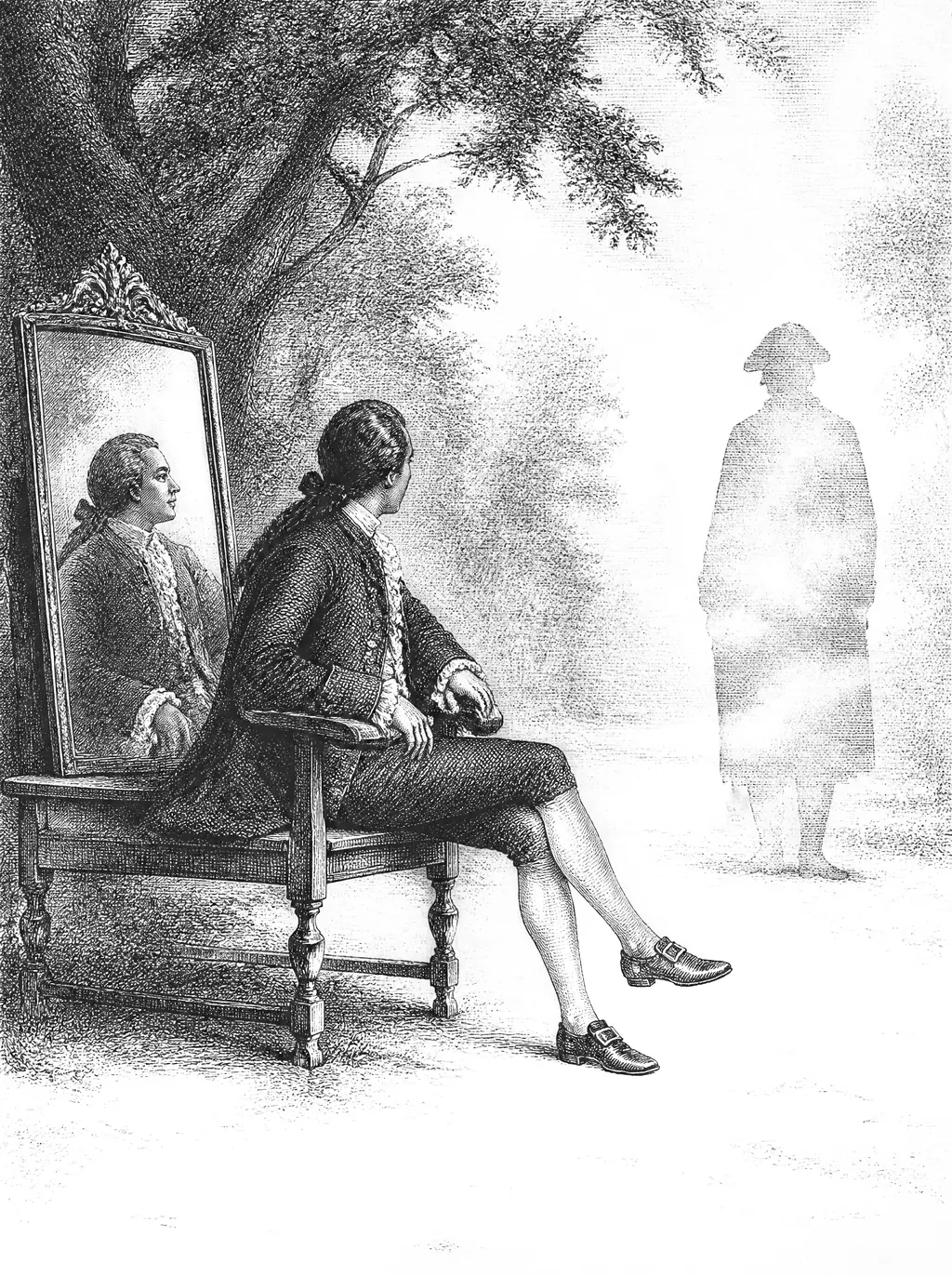
The Problem of Other Minds
Watching bodies, guessing minds
You know your own thoughts directly, from the inside, with no inference required. Everyone else's thoughts you know only indirectly, by watching their body: their words, their expressions, their behavior, and reasoning from there to a mind you can never observe. Russell asked how solid that inference actually is, once you look at it closely. The uncomfortable answer is that it rests on a single case. You have observed the link between behavior and inner life exactly once, in yourself, and you generalize from that one sample to everybody. No scientist would accept an induction from one instance. Yet every friendship you have depends on it, and Russell wanted to know what, if anything, entitles you to make it.
The world it came from
Russell wrote The Problems of Philosophy in 1911, for a series of cheap introductions called the Home University Library, in the months after finishing the first volume of Principia Mathematica with Whitehead. He was at Cambridge, under the influence of G. E. Moore, and had adopted the theory that what you are directly acquainted with is sense-data: patches of color, sounds, pressures. Everything else is inferred. Chapter II asks whether matter exists at all, given that starting point, and answers that it is the simplest hypothesis to explain why sense-data behave as they do. Other people's minds come up as a corollary, and a worrying one, because they sit at the end of not one inference but two.
The idea
We have no grounds for believing in other people's minds except such as are derived from observing their bodies. If the independent existence of physical objects is ever in doubt, belief in other minds is even shakier still, since it depends on that same doubtful inference, plus a second, further leap from a body's behavior to an inner experience you can never directly check. Russell does not conclude that other minds do not exist. He concludes that belief in them is an instinctive belief, held before any argument, which philosophy can show to be reasonable but never certain. The gap between reasonable and certain is the problem. Nothing you could ever observe would close it, because every observation is of a body.
How the reasoning runs
Step one: what you know without inference is your own sense-data and your own mental states. Step two: physical objects, including a table and a cat, are inferred as the simplest explanation of why sense-data recur and cohere, as when the cat reappears hungry after being out of sight. Step three: other people's bodies are physical objects, so they are already inferred. Step four: their minds are a further inference from their behavior. In your own case, certain behavior goes with certain thoughts, so when you see that behavior elsewhere you suppose the thoughts are there too. That is an argument from analogy, from one case. Conclusion: belief in other minds rests on two inferences stacked, neither of which is certain, and the second is weaker than the first.
Seen in life
You type a complaint into a support chat and the reply says it understands how frustrating this must be. You assume nothing on the other end is frustrated on your behalf. Ten minutes later you phone a friend, she says the same words, and you do not doubt her for a second. Now put the two side by side. In both cases you received a pattern of words from a source you cannot see inside. Your confidence differs enormously, and Russell's question is what the difference is made of. The friend has a body like yours and a history you share. That is a good reason. It is still an inference, and a machine that behaved exactly like her would offer the same evidence and get less belief.
Why it matters
This exposes an assumption almost nobody questions in daily life: that the people around you have genuine inner experience like your own, rather than simply behaving as if they do. Nothing in ordinary experience could ever fully rule out the alternative, which makes the everyday confidence people place in other minds a real philosophical commitment, not a proven fact. The problem has become practical. Whether an animal suffers, whether a patient who cannot respond is aware, whether a machine that reports feelings has any: each is the problem of other minds with the analogy weakened. Russell's framing tells you what such disputes are about. They are about how far from your own case an inference can travel before it stops being reasonable.
“For if we cannot be sure of the independent existence of objects, we cannot be sure of the independent existence of other people's bodies, and therefore still less of other people's minds, since we have no grounds for believing in their minds except such as are derived from observing their bodies.”
From the source
Russell states the problem directly: “For if we cannot be sure of the independent existence of objects, we cannot be sure of the independent existence of other people's bodies, and therefore still less of other people's minds, since we have no grounds for believing in their minds except such as are derived from observing their bodies.” The sentence comes from the second chapter of The Problems of Philosophy, called The Existence of Matter. Russell follows it with the remark that if we cannot be sure of other people, we are left alone in a desert, and that the whole outer world may be a dream. He then argues that the dream hypothesis, though it cannot be strictly refuted, is less simple than the common-sense one, and that simplicity is a reason.
The pushback
Doesn't this skepticism prove too much, since no one actually lives as though other minds might not exist, and refusing to trust the inference would make ordinary life, friendship, conversation, love, impossible to conduct at all? Russell's own answer treats the belief as reasonable and probably true, while insisting it remains, strictly, an inference rather than a certainty. Wittgenstein and his followers pressed a deeper objection. If you learned the word pain only from your own case, you could never know that anyone else's pain was the same thing, and the word would have no public meaning. Since it plainly does, the picture of a private inner life known first from the inside, and then guessed at in others, must be wrong from the start.
The reply
Russell never pretended the analogy was strong. In Human Knowledge, in 1948, he wrote it out as a postulate: when you observe behavior that in your own case follows from a thought, you may infer the thought, with a probability, not a proof. He accepted that this is an induction from one instance and said the belief comes before the argument and survives it. To the Wittgensteinian reply he would answer that showing pain is a public word does not show that pain is a public thing; it shows how the word is taught. Whether something is felt behind the behavior remains a separate question. That answer holds, but the tradition has never found a way to make the inference from one case stronger than it is.
Where it went next
Turing used the problem in 1950 against the objection that a machine cannot really think: demand inner feeling as evidence, he said, and you cannot credit thought to anyone but yourself. Wittgenstein's Philosophical Investigations in 1953 and Norman Malcolm's 1958 paper turned the problem into a question about the meaning of mental words. P. F. Strawson argued in 1959 that the concept of a person, with both body and mind, must come before either. Psychology made the inference an object of study: the false-belief tasks of the 1980s traced when children begin to attribute minds, and the phrase theory of mind entered common use. The question of whether an AI system has experience is Russell's problem, with the analogy at its weakest.
Where this leads
The Turing test proposes one practical way around this exact uncertainty, replacing the impossible demand to verify another mind directly with the more modest, testable question of whether its behavior can be told apart from a real mind's at all. The Gettier problem sits on the other side of Russell's worry. Suppose your belief in your friend's mind is true and you have a reason for it. Gettier asked whether a true, justified belief can still fail to be knowledge, because the reason and the truth are only luckily connected. If the argument from one case is as weak as Russell admits, then even your correct beliefs about other people may be true for reasons that do not quite reach them.