Symposium · Epistemology · Pl. 13Thomas Nagel · b. 1937
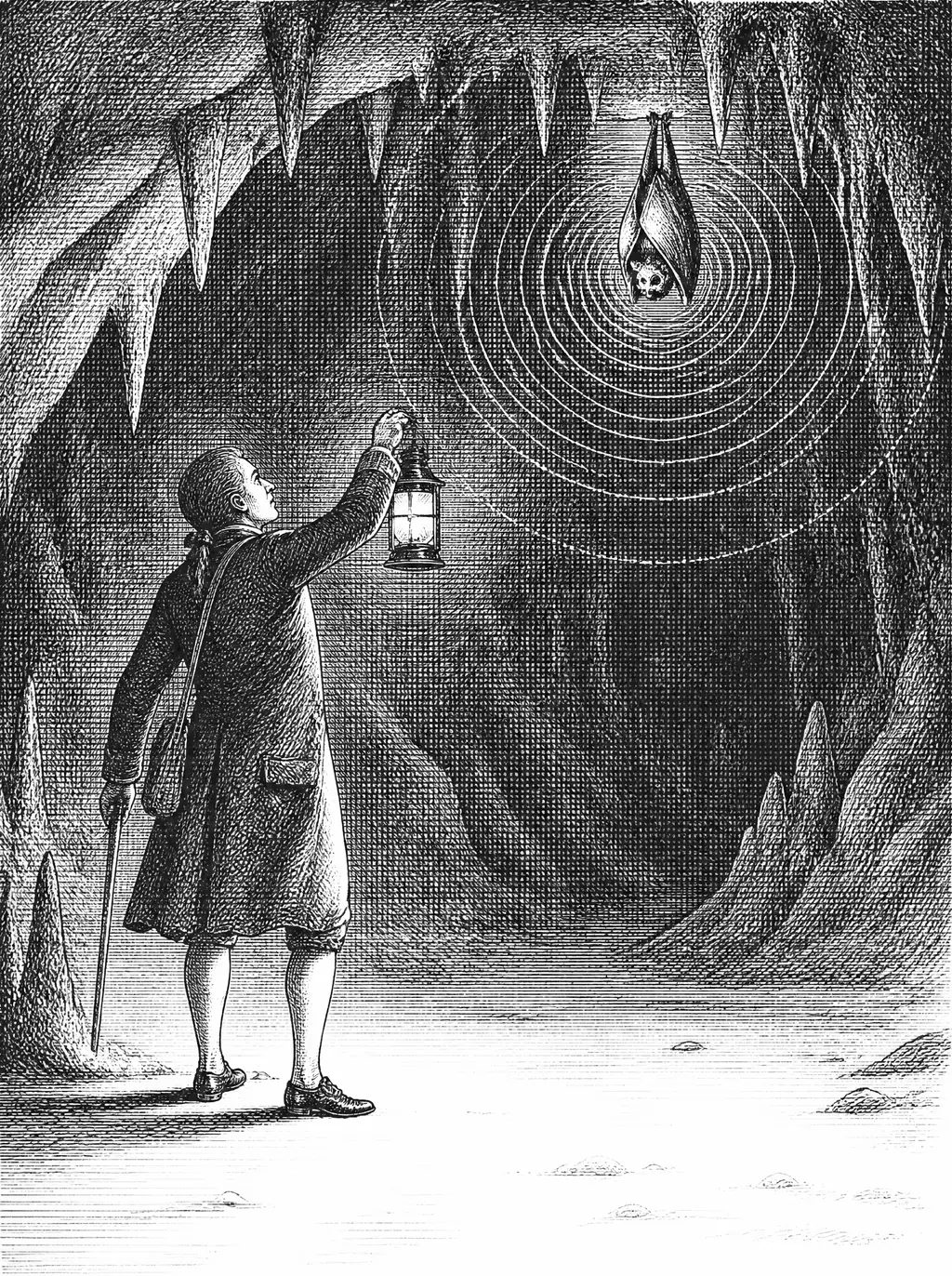
What Is It Like to Be a Bat?
An echo you'll never hear from inside
Bats navigate by sonar, bouncing sound off the world and reading the echoes back, a sense with no real human equivalent. Nagel picked bats deliberately: close enough that we're confident something is going on inside their experience, alien enough that imagining our way into it, rather than just imagining a human crouched in a cave, is obviously impossible. You can hang upside down, close your eyes, and click your tongue all afternoon. What you get is a human pretending. The bat's own experience, whatever it is, stays exactly where it was, on the far side of a wall no description has yet crossed.
The world it came from
Nagel was born in Belgrade in 1937, grew up in the United States, and wrote the essay as a young professor at Princeton; it appeared in The Philosophical Review in 1974. The philosophy of mind around him was confident. Identity theorists said a sensation simply is a brain state, the way water is H2O. Functionalists said a mental state is whatever plays the right causal role, so a computer could have one. Both programs promised to reduce the mind to something objective. Nagel's target was that promise, and he chose the mildest possible way to attack it: not by defending souls, but by asking a question the reductions had skipped. He said the mind-body problem was hard because nobody had faced consciousness itself.
The idea
There is something it is like to be a conscious creature, a subjective character to its experience, and that subjective character cannot be fully captured by any amount of objective, third-person physical description. You can learn everything physics and neuroscience can tell you about bat brains and echolocation and still not know what the echo actually feels like from the bat's own point of view. Nagel is careful about what he is not saying. He does not claim physicalism is false. He claims we do not currently understand how it could be true, because every objective account works by leaving out the point of view, and the point of view is the very thing to be explained.
How the reasoning runs
Start with a test for consciousness: an organism is conscious if there is something it is like to be that organism. Second, that something is tied to a point of view; it is experience for the creature that has it. Third, objective description works by stripping away any particular point of view: the more objective an account, the less it depends on who is looking. Fourth, a complete objective account of a bat leaves out the one thing that makes the bat conscious, its point of view. Fifth, we cannot fill the gap by imagination, because our imagination only extends our own experience. Conclusion: there is a fact about the bat that no physical description delivers, and we have no method for reaching it.
Seen in life
You lie in a scanner with a migraine, and afterward the neurologist walks you through the images. Here is the wave of activity crossing your visual cortex; here is the blood flow; this is why the zigzag lights appeared before the pain. It is all true, and all of it is your headache described from outside. Then she asks what it was like, and you reach for words: a drill, a hot wire, a light behind the eyes. She nods, because she has had one too. Now imagine she has not. Every picture on the screen is still available to her. The one thing she wanted, what the pain is like for you, is on no picture.
Why it matters
This poses a direct challenge to the idea that consciousness will eventually be fully explained by physical science alone, since physical facts are, by their nature, describable from no particular point of view, while conscious experience seems to essentially require one. If Nagel is right, something about subjective experience may resist translation into objective description no matter how complete the science gets. The practical edge is real. Debates about animal welfare, about whether a machine can suffer, and about how much a doctor can know of a patient's pain all turn on the same gap. Nagel does not close it. He shows why closing it will take a kind of concept nobody yet has.
“What is it like to be a bat?”
From the source
Nagel opens his 1974 essay with the question that gives it both its title and its entire driving argument, stated as plainly as it can be stated, before any of the surrounding philosophical machinery arrives: “What is it like to be a bat?” He then explains why the question resists every answer we can give. Bat sonar is not similar to any sense we possess, so we cannot extrapolate from our own case. Imagining webbed arms and a diet of insects tells us only what it would be like for us to behave as a bat behaves. The essay ends by proposing an objective phenomenology, a way of describing experience to someone who cannot have it, and admits it does not exist yet.
The pushback
Some philosophers argue this only shows a limit on human imagination, not a genuine limit on physical explanation itself; failing to picture bat experience vividly is a psychological shortfall, not proof that no complete physical account of it could exist. Nagel's reply is that the problem is not a failure of imagination, but a structural feature of what subjective and objective descriptions can each capture. A harder objection comes from Daniel Dennett. He argues that the intuition of a leftover something is itself a product of how brains model themselves, and that once you explain every judgment a creature makes about its experience, there is nothing further to explain. On that view, Nagel has mistaken a feature of our self-description for a feature of the world.
The reply
To the imagination objection, Nagel answers that the point never depended on imagining. Even a bat scientist who felt no urge to picture anything would still lack a fact: what sonar is like for the bat. The gap is in the kind of description, not in the describer's mind. To Dennett, the reply is blunter: explaining every judgment about pain is not the same as explaining pain, because the judgments are about something, and that something is what hurts. Here the argument stalls, honestly. Each side accuses the other of begging the question, and Nagel himself says the correct theory may need concepts we cannot yet form. He offers the problem, not the solution, and says so.
Where it went next
The phrase something it is like became the standard way to name consciousness, and the essay is among the most cited in philosophy. Frank Jackson sharpened it in 1982 with Mary, the color scientist who knows every physical fact about seeing red but has never seen it. Joseph Levine named the explanatory gap in 1983. David Chalmers built the hard problem of consciousness on the same foundation in 1995, and Colin McGinn concluded the problem is real but beyond human minds. Dennett spent decades arguing all of them wrong. Nagel himself went on to The View from Nowhere in 1986, on the tension between subjective and objective standpoints, and the bat still turns up in every debate about whether an AI can feel.
Where this leads
Cogito ergo sum located the one fact Descartes thought no external doubt could touch, his own thinking; Nagel's bat asks whether that same first-person interior, however certain it feels from inside, can ever be handed over completely to anyone standing outside it. The bundle theory of self pushes from the other direction. Hume looked inward and found no self, only perceptions passing. Nagel would answer that even a bundle has a point of view, and that this, not a hidden owner, is what the objective sciences keep failing to describe. Read the three together and you have the whole shape of the problem: something is certainly here, nobody can say what it is, and nobody else can look.