Symposium · Philosophy of Mind · Pl. 13Gilbert Ryle · 1900–1976
The Ghost in the Machine
A mistake with a name
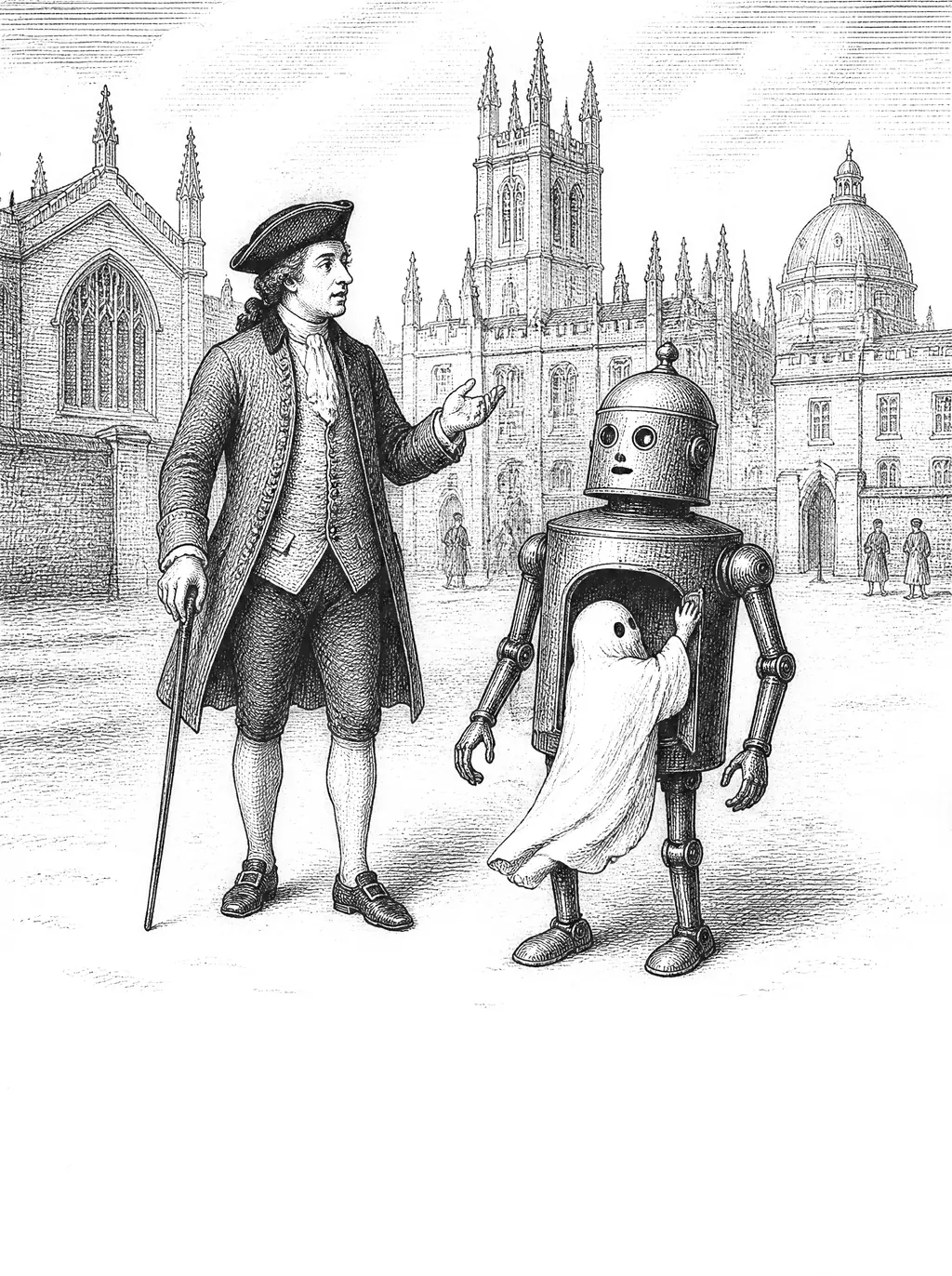
For three centuries, philosophy had mostly argued about where the mind was and how it connected to the body, treating both sides of the question as settled. Ryle went after the question itself, arguing that picturing a person as a machine, the body, secretly steered by a ghost, the mind, was not a subtle theory but a basic mistake in how to talk about a person at all. His favorite illustration was a visitor to Oxford. Shown the colleges, the libraries, and the playing fields, the visitor asks where the university is. He has not missed a building. He has misfiled a word, and Ryle thought Descartes had done the same with mind.
The world it came from
Ryle published The Concept of Mind in 1949, four years after becoming Waynflete Professor of Metaphysical Philosophy at Oxford and two years after taking over the journal Mind. He had spent the war in intelligence. Oxford in those years was the center of ordinary-language philosophy, which held that many philosophical problems come from misusing everyday words, and Ryle was its senior figure. His targets were two. One was the Cartesian picture of an inner, private mind that he found underneath most philosophy and most psychology. The other was the crude behaviorism that had replaced it in some laboratories. He wanted a third way: to map what he called the logical geography of mental concepts, and show that most of them never referred to hidden episodes at all.
The idea
The official doctrine, which hails chiefly from Descartes, is something like this: a person has both a body and a mind, generally harnessed together, the mind private, the body public, each substance following its own laws. Ryle calls this picture a category mistake, treating the mind as a hidden thing inside the machine, when talk of mind is really talk about a whole person's intelligent behavior. A category mistake is not a false belief. It is putting a word in the wrong logical box, like asking whether the average taxpayer has a wife. When you call someone clever, careful, or vain, Ryle says, you are not reporting a ghostly event. You are saying how they act and how they would act.
How the reasoning runs
Step one: the Cartesian places mind and body in the same category, as two things that exist and interact. Step two: show by example that mind-words do not behave like thing-words. A foreigner watching cricket asks who does the team spirit, having seen the batting and bowling. Team spirit is not a further player. Step three: show that most mental predicates are dispositional. To know French is not to be undergoing anything; it is to be able to answer when addressed. Step four: the regress. If every intelligent act had to be preceded by a private act of considering a rule, that considering would itself need to be done intelligently, and so on forever. Conclusion: intelligence is in the doing, and the ghost has no work left.
Seen in life
You watch a colleague handle a hostile meeting. She lets the loudest person finish, asks one question that exposes the gap in his numbers, and moves on before he can recover. Afterward you say she was sharp. Ask yourself what you were reporting. Not a hidden episode behind her eyes that you somehow observed. You were describing the meeting: the timing, the question, the restraint. Now take the same word and apply it to an AI assistant that handles your question well. The temptation is to ask whether there is really anything going on inside. Ryle would say you have just made the visitor's mistake. You saw the colleges and asked for the university. The sharpness was the performance.
Why it matters
This reframes the mind-body problem as partly a grammatical illusion: asking where the ghost sits inside the machine already assumes the mind is a kind of thing, located somewhere, interacting causally with the body, when a great deal of ordinary talk about minds is really shorthand for dispositions and abilities, not references to an inner, separate object at all. The practical effect was to give psychology permission to study behavior and capacity without apology, and to give philosophy a new job: policing its own grammar. It also changed how the problem of other minds looks. If cleverness is a way of acting, then you see it in other people directly. There is no inference to a hidden cause, because there was never a hidden cause to infer.
“The official doctrine, which hails chiefly from Descartes, is something like this.”
From the source
Ryle opens his attack with a description of the view he is targeting: “The official doctrine, which hails chiefly from Descartes, is something like this.” He goes on to name the resulting picture, mind hidden inside body, its famous label: the dogma of the ghost in the machine. The chapter is called Descartes' Myth. Ryle says he will call the doctrine that, with deliberate abusiveness, because it is not one mistake among many but a family of mistakes with a single source. He then introduces the category mistake through the Oxford visitor, the cricket spectator, and a child at a parade who asks to see the division as well as the battalions. The rest of the book works through knowing, will, emotion, and imagination in turn.
The pushback
Doesn't reducing mind entirely to observable behavior and dispositions leave out exactly the private, felt quality of experience that made the mind-body problem interesting in the first place, the redness of red, the ache of pain, none of which seem fully captured by a list of behaviors alone? A second objection came from the sciences. Within a decade U. T. Place and J. J. C. Smart argued that there are inner states after all, and that they are brain states, so Ryle had dissolved a problem that turned out to have an answer. Cognitive science then reinstated inner representations wholesale. And Ryle's own distinction cut against him: knowing how to ride a bicycle seems to rest on a great deal of knowing that, stored somewhere, however inarticulate.
The reply
Ryle never denied that people have sensations, images, or silent conversations with themselves. He wrote a chapter on sensation and admitted it was the hardest case. His claim was narrower: these episodes are not what most mental words refer to, and they do not take place in a second, ghostly medium. Against the identity theorists a Rylean can say that finding the brain states of cleverness does not make cleverness a brain state, any more than finding the bricks makes the university a building. Against cognitive science the reply is weaker. If the mind does store rules and consult them, Ryle's regress fails, since the consulting need not itself be intelligent. Most readers conclude that Ryle exorcised the substance and left the experience standing.
Where it went next
Wittgenstein's Philosophical Investigations, published in 1953, attacked the private inner theater from a different angle, and the two books are often read together. Place in 1956 and Smart in 1959 launched the identity theory as a direct answer, arguing that sensations are brain processes. Daniel Dennett, who wrote his doctoral thesis under Ryle, carried the dispositional approach into the age of cognitive science with the intentional stance. Arthur Koestler borrowed the phrase for a 1967 book title, and it has since named an album and a manga. The knowing-how question came back in 2001 when Jason Stanley and Timothy Williamson argued that knowing how is a kind of knowing that after all. The category mistake is now standard vocabulary.
Where this leads
The heart is just a spring anticipates a strikingly similar deflationary move three whole centuries earlier still, Hobbes reducing life and thought to plain matter in motion rather than to a separate ghostly substance steering the body from somewhere within. The real distinction is the doctrine Ryle set out to destroy. Descartes argued in the Sixth Meditation that mind and body are separate substances because each can be clearly conceived without the other. Ryle's reply is that the argument never gets started, because mind was never the kind of word that names a substance. Read the two together and you see a disagreement not about facts but about what sort of question is being asked.