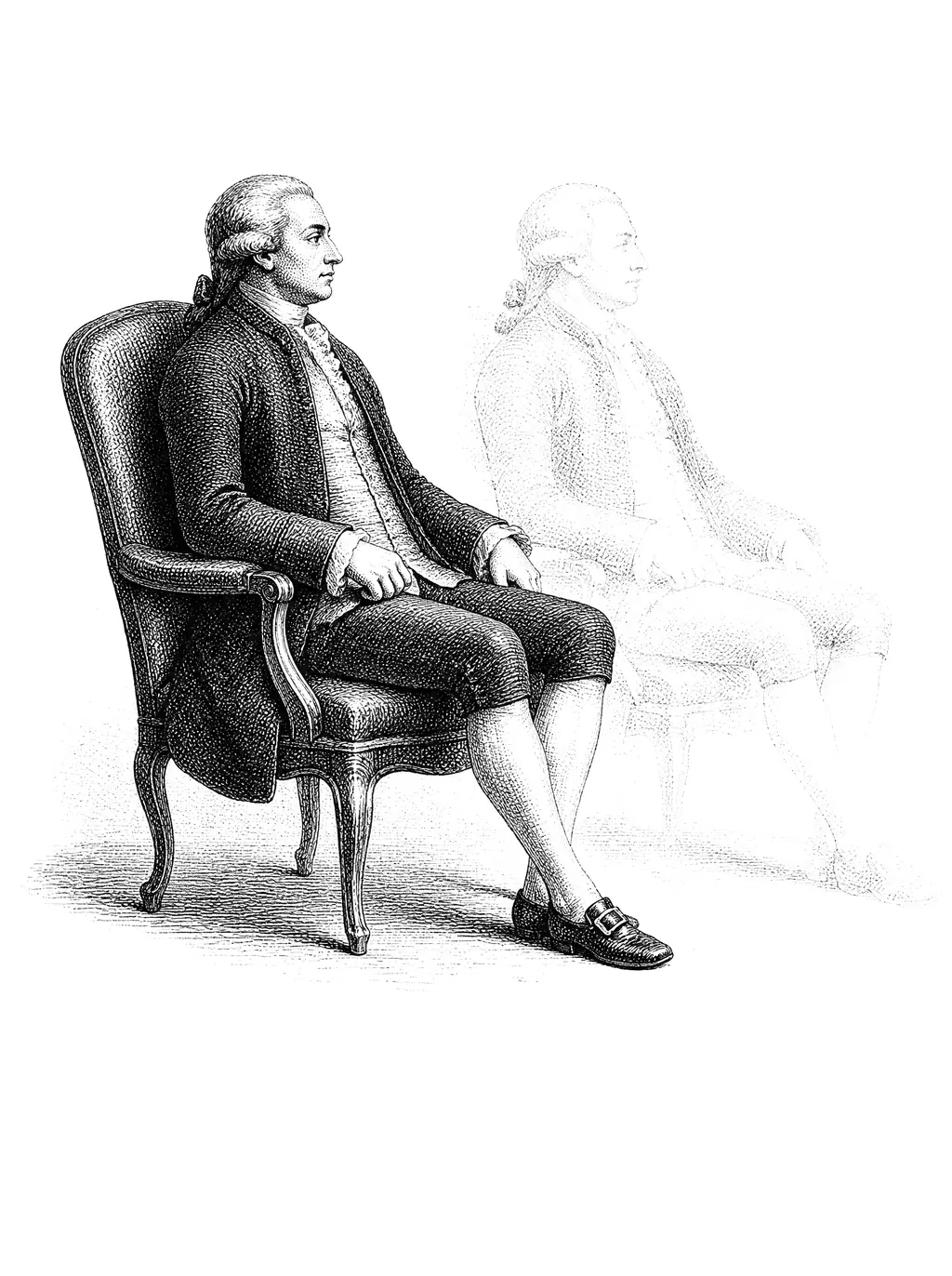
Symposium · Philosophy of Mind · Pl. 3René Descartes · 1596–1650
The Real Distinction
Two ideas that will not merge
Having survived the demon's assault with the cogito intact, Descartes turns to a new question: what exactly is this thinking thing that survived? He examines his idea of himself as a mind and his idea of body side by side, and finds they refuse to blend into one another no matter how he tries to combine them. Everything he can say about a body is about extension: length, breadth, depth, shape, motion. Nothing he can say about his mind is. And everything he can say about his mind, doubting, willing, imagining, feeling, applies to nothing extended. Two ideas with no overlap, he concludes, are ideas of two things. The rest of the Sixth Meditation turns that thought into a proof.
The world it came from
Descartes published the Meditations in Latin in Paris in 1641, from his home in the Dutch Republic, and had his friend Mersenne circulate the manuscript to critics first. Their objections, from Hobbes, Arnauld, Gassendi, and others, were printed with the book alongside his replies. The universities still taught Aristotle's doctrine that the soul is the form of the body, not a separate thing. Descartes wanted two results that doctrine could not give him. He wanted a physics in which bodies are pure extension governed by mechanical law, with no souls or purposes inside them. And he wanted, as his dedication to the theologians of the Sorbonne says, a proof that the soul is distinct from the body and so can survive it. The real distinction delivers both.
The idea
I have a clear and distinct idea of myself as only a thinking thing, not extended in space, and a separate, distinct idea of body as only an extended thing, not thinking. Because these two ideas are genuinely separable in clear thought, mind and body must be really distinct substances, capable, at least in principle, of existing apart from one another. Descartes does not say they are apart. He insists, in the same Meditation, that he is not lodged in his body like a pilot in a ship, but so mixed with it that hunger and pain are felt, not merely observed. The distinction is about what could be. The union is about what is. Holding both at once is the whole difficulty.
How the reasoning runs
Premise one: whatever I clearly and distinctly conceive, God can bring about exactly as I conceive it. Premise two: I clearly and distinctly conceive myself as a thing that thinks and is not extended. Premise three: I clearly and distinctly conceive body as a thing that is extended and does not think. Step four: so God could create my mind without any body, and a body without any mind. Step five: two things that can each exist without the other are really distinct, not one thing under two aspects. Conclusion: I am really distinct from my body and could exist without it. Descartes adds a second argument. Body is divisible, since every extended thing has parts. The mind is not, since he finds no parts in himself.
Seen in life
Imagine waking tomorrow in a different body. Taller, older, a different face in the mirror. You can picture it in a second, and the picture is of you, in there, looking out. Every story about swapped bodies, uploaded minds, and ghosts trades on the same ease. Now try the reverse: imagine your body going about its day with nobody home. That is also easy. Descartes's argument begins exactly here. The ease with which you separate yourself from your body in thought is, for him, evidence that they are separable in fact, because a clear conception cannot be of the impossible. Whether a brain scan changes your mind about that is the question the next four centuries argued over, and the intuition has not gone anywhere.
Why it matters
This gave Western philosophy its clearest, most influential statement of dualism: two fundamentally different kinds of stuff, mental and physical, rather than one substance wearing different descriptions. It also opened a problem Descartes spent the rest of his life fielding objections to: how could two utterly different substances ever causally interact at all? The argument also fixed the method later dualists would use. Descartes reasons from what can be conceived to what can be. Every later argument for dualism, from Kripke's pain and brain states to Chalmers's zombies, runs the same route from conceivability to possibility, and every physicalist reply attacks the same bridge. Whether you can get from a clear idea to a real distinction is still the question.
“Because on this side I have a clear and distinct idea of my self, as I am only a thinking thing, not extended; and on the other side because I have a distinct idea of my body, as it is only an extended thing, not thinking, it is from hence certain, that I am really distinct from my body.”
From the source
Descartes concludes in the Sixth Meditation: “Because on this side I have a clear and distinct idea of my self, as I am only a thinking thing, not extended; and on the other side because I have a distinct idea of my body, as it is only an extended thing, not thinking, it is from hence certain, that I am really distinct from my body.” The translation is from an English edition of 1680. Descartes prefaces the argument with the premise that carries it: whatever he clearly and distinctly understands, God can make just as he understands it. The same Meditation then turns immediately to the union, arguing from pain, hunger, and thirst that mind and body are intermingled and not merely adjacent.
The pushback
If mind and body are truly separate substances with nothing in common, how does a decision to raise your arm, a purely mental event, actually move purely physical muscle at all? Princess Elisabeth of Bohemia pressed Descartes on exactly this interaction problem in their correspondence, and he never gave an answer his own critics, or later philosophers, found satisfying. Arnauld raised a harder objection before the book was printed. Someone can clearly conceive a right triangle without conceiving that the square on its hypotenuse equals the other two, yet the property cannot be separated from the triangle. Conceiving one thing without another may show only what you have not noticed, not what could exist apart. Clear ideas can be incomplete.
The reply
To Arnauld, Descartes replied that the cases differ. The idea of a triangle without its property is incomplete, since the property follows from the triangle's nature. His idea of himself as a thinking thing is complete: it is the idea of a whole substance, lacking nothing it needs to exist. That is where the argument's weight rests, and Arnauld's worry stays there, because whether the idea is complete is exactly what a physicalist denies. To Elisabeth, Descartes conceded more than his critics expected. The union of mind and body, he wrote in 1643, is a primitive notion, known through the senses and ordinary life rather than by the intellect, and he admitted he had said almost nothing about it. He advised her not to think about it too much.
Where it went next
Malebranche answered the interaction problem by having God do the moving on every occasion; Leibniz by pre-established harmony; Spinoza by denying there were two things at all. The Meditations set the agenda for all three. Ryle named the doctrine the ghost in the machine in 1949 and tried to kill it by ridicule. It survived. Saul Kripke argued in 1970 that pain cannot be identical to a brain state, on grounds close to Descartes's, and David Chalmers's zombie argument of 1996 is the real distinction run on conceivability alone. The neuroscientist Antonio Damasio titled a 1994 book Descartes' Error. Property dualism, the view that one substance has two kinds of property, is the position most of Descartes's heirs have retreated to.
Where this leads
The pre-established harmony offers Leibniz's own solution to the very problem Descartes left open, proposing that mind and body never actually interact at all, but were set running in perfect correspondence with each other from the very beginning by God. The cogito is the ground the real distinction stands on. In the Second Meditation Descartes finds that he cannot doubt he exists as a thinking thing while he can doubt he has a body. The Sixth Meditation asks what that asymmetry proves. Read the two together and you see the ambition: from the one certainty that survived doubt, Descartes tries to draw a complete map of what he is, and the map has two continents that never touch.