Symposium · Philosophy of Mind · Pl. 9John Locke · 1632–1704
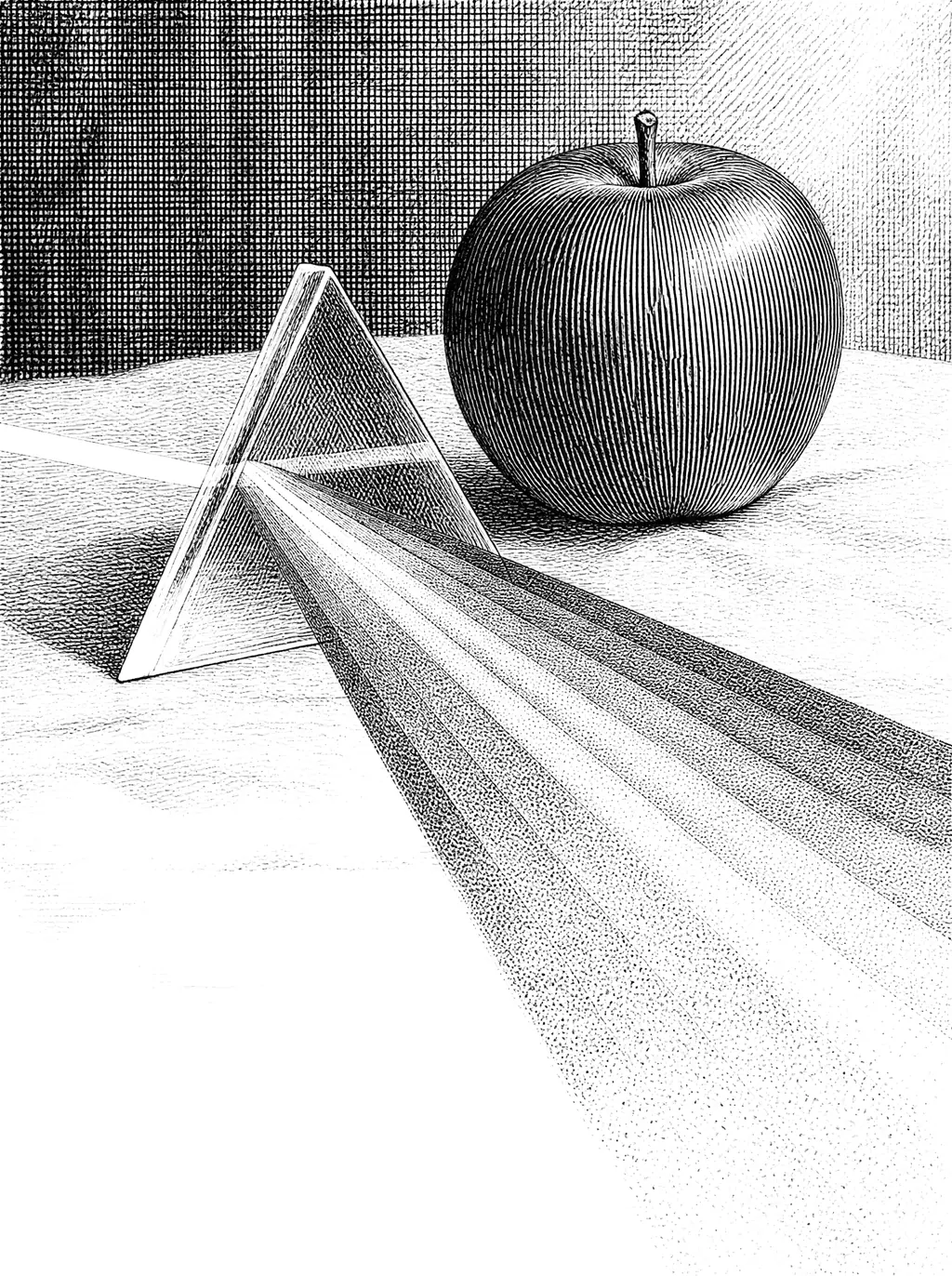
The Color Is Not in the Apple
Two very different kinds of quality
Bite into an apple and you experience its shape, its sweetness, its red skin, its crunch, all seemingly delivered by the same object in the same simple way. Locke separated these experiences into two categories most people never think to distinguish, and argued that only one of them actually resembles anything real in the apple itself. The other, he said, is a reaction your senses manufacture. The apple has the power to cause it, but the apple contains nothing that looks like it. Once you see the split, you cannot unsee it: half of what you call the world is a report about you.
The world it came from
Locke wrote the Essay Concerning Human Understanding over nearly twenty years and published it in 1689, the year he returned to England from exile in Holland. He was a physician by training, a friend of Robert Boyle, and a member of the Royal Society, and he watched the new corpuscular science take shape at close range. Boyle had already argued that a body's sensible qualities arise from the size, shape, and motion of its invisible particles. Locke's problem was to fit that picture to ordinary experience: if the world is really particles in motion, what is the red you see, and where is it? The Essay's answer is Book II, Chapter VIII.
The idea
Primary qualities, shape, size, motion, number, are inseparable from a body and resemble it exactly; the idea you have of a round apple really does match something round in the apple. Secondary qualities, color, taste, smell, sound, produce sensations in you that have no resemblance to anything in the object. What is red in your experience is, in the apple itself, only a particular arrangement of insensible particles. Locke's test for a primary quality is simple. Grind the apple to powder and every grain still has a shape, a size, and a position. Keep grinding and that never changes. But the red goes as the light goes, and the sweetness goes if your tongue is numb.
How the reasoning runs
Step one: divide a grain of wheat, then divide it again. Each part keeps solidity, extension, figure, and mobility. These never leave a body, so they belong to it. Step two: notice that the same fire that warms you at one distance burns you at another. Warmth and pain are both in you, and nobody says the pain is in the fire. So why say the warmth is? Step three: porphyry looks red and white in daylight and has no color in the dark, yet nothing in the stone changed. Conclusion: color, heat, and taste are powers in objects to cause sensations, through the bulk and motion of their particles, and the sensations resemble nothing in the object.
Seen in life
Open a photo on your phone and drag the white balance slider. The wall in the picture turns from cream to blue to grey, and every version looks like a plain fact about the wall. Now hand the phone to a friend with red-green color blindness and ask what the apple in the corner looks like. The two of you agree completely about the apple's outline, its position, and how many there are. You disagree about the color, and no measurement of the apple settles the dispute, because the disagreement is between two nervous systems. Locke would say the shape belongs to the fruit. The red belongs to whoever is looking.
Why it matters
This splits the world you directly experience from the world as it actually is in a precise, technical way: some of what you perceive is really out there, unaltered, and some of it is manufactured entirely by your own senses in response to a cause that does not itself resemble the experience it produces at all. The distinction underwrites the whole modern scientific picture. Physics describes mass, position, and motion, and says nothing about redness or sweetness, because on Locke's view those were never in the object to begin with. It also sets the price of that picture: the world science describes is colorless, silent, and tasteless, and everything you love about a sunset is happening in you.
“The ideas of primary qualities of bodies are resemblances of them, and their patterns do really exist in the bodies themselves, but the ideas produced in us by these secondary qualities have no resemblance of them at all.”
From the source
Locke states the distinction directly: “The ideas of primary qualities of bodies are resemblances of them, and their patterns do really exist in the bodies themselves, but the ideas produced in us by these secondary qualities have no resemblance of them at all. There is nothing like our ideas, existing in the bodies themselves.” The passage sits in Book II, Chapter VIII, of the Essay, where Locke sets out his account of simple ideas of sensation. He is careful about the word quality: a quality is a power in an object to produce an idea in you. Primary qualities produce ideas that copy them. Secondary qualities produce ideas that copy nothing, the way a knife produces pain without the knife containing any pain.
The pushback
How can shape count as a real, resembling primary quality while color does not, when both are delivered to you by the exact same kind of sensory process, light striking an eye or a surface striking a hand? Later philosophers, including Berkeley, pushed this objection hard, arguing the same doubts that undermine color apply just as forcefully to shape. Berkeley's version is sharp. You never see a shape without a color, so strip away every secondary quality and nothing is left to carry the shape. And apparent shape changes with distance exactly as color changes with light. If variation proves color is in the mind, it proves shape is too. Deeper still: if ideas of color resemble nothing, how does Locke know that ideas of shape resemble anything?
The reply
Locke's defenders point to the grinding test. Variation is not his criterion for a secondary quality; inseparability is. A body seen from far away has a smaller apparent shape, but it never has no shape, while a body in the dark has no color at all. Shape survives every operation you can perform on matter, and color does not. The stronger reply comes from science rather than from Locke. The primary qualities are the ones that figure in mechanical explanation, and the theory that uses them works. Nobody predicts anything with redness. That is a good argument, but it is not the resemblance argument Locke gave, and the last worry, how any idea is known to copy its cause, stays open.
Where it went next
Berkeley attacked the distinction in 1710 and built idealism on its ruins. Hume and Kant inherited the problem of what, if anything, our ideas copy. The distinction came back in twentieth-century philosophy of mind as the problem of qualia: color, taste, and felt warmth are exactly the qualities that resist physical description, which is why Mary's Room is about seeing red and not about measuring a wavelength. Color science took Locke's side in the details. A surface reflects a spectrum; the red is built by three cone types and a visual cortex, and a color-blind viewer builds a different red from the same light. Physics still works with a version of Locke's primary list.
Where this leads
To be is to be perceived is Berkeley's own answer to that exact challenge, denying outright that any quality at all, primary or secondary, ever exists independently of a mind perceiving it, collapsing Locke's careful distinction entirely from underneath it. Tabula rasa is the other half of Locke's account. If nothing is in the mind that was not first in the senses, then the question of what the senses actually deliver, a copy or a manufactured sign, decides what you can know about the world at all. Read the two together and the empiricist bargain becomes clear: everything you know comes from experience, and some of what experience gives you was never out there.