Symposium · Aesthetics · Pl. 15Oscar Wilde · 1854–1900
Life Imitates Art
London's fog, before and after
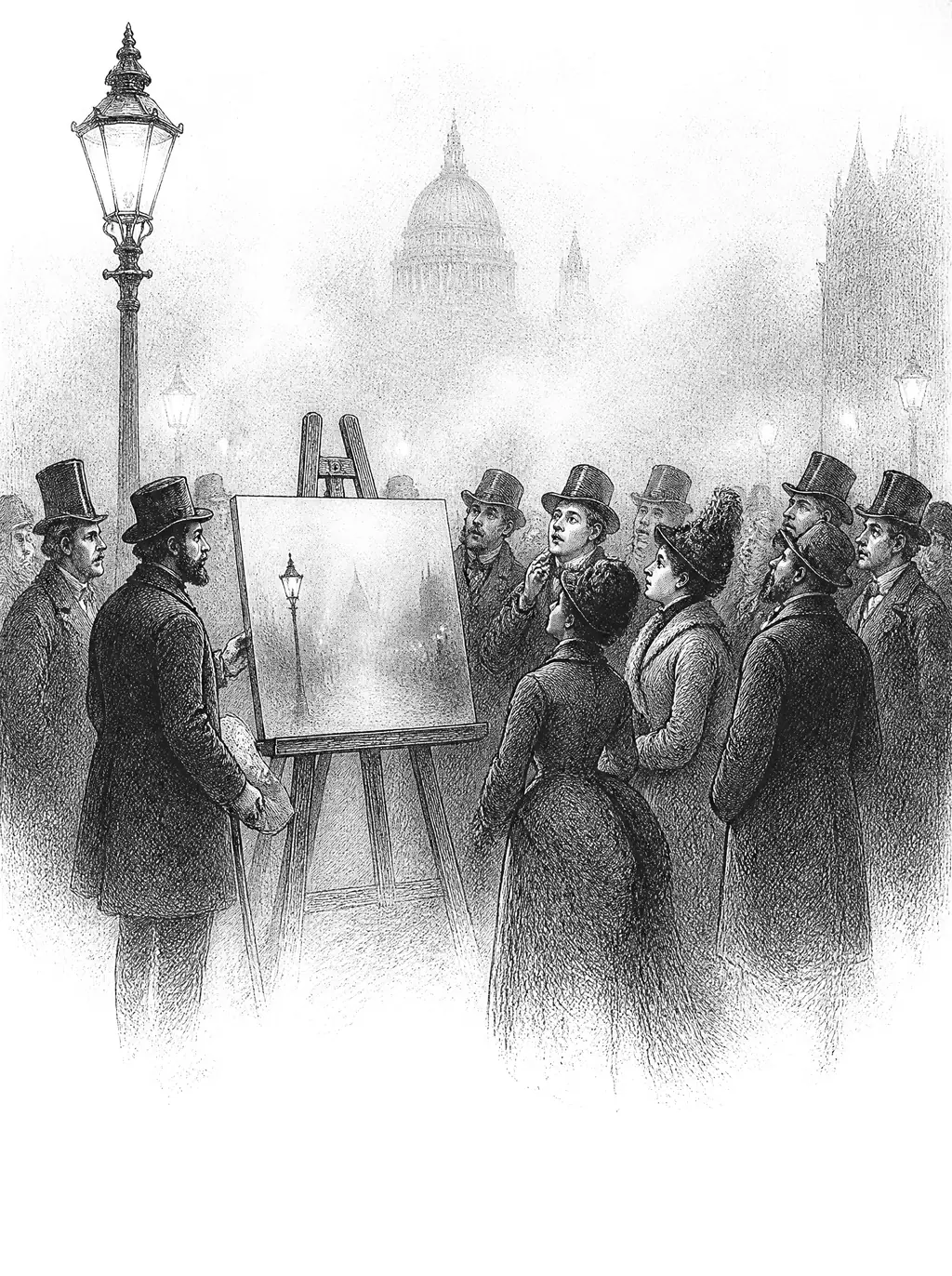
Wilde's mouthpiece Vivian points to fog: London had fog for centuries before poets and painters taught people to notice and describe it. Only after that description existed, he argues, did fog become something Londoners consciously experienced as beautiful, mysterious, and worth remarking on, rather than just an unpleasant obstacle to getting home. Vivian goes further. The brown fogs that creep down streets and blur the gas lamps, he says, are the work of the Impressionists; the silver mists on the river come from them and their master. Whether or not you buy the credit, the trick has already worked on you: you have seen a London fog through a painting before you ever stood in one.
The world it came from
Wilde wrote 'The Decay of Lying' in 1889, at thirty-four, before the plays that made him rich and the trial that destroyed him. It appeared first in the magazine The Nineteenth Century and then, revised, in Intentions in 1891. The setting is a library in a country house, where Vivian reads Cyril an article in progress. Around Wilde, realism was the reigning creed: Zola's naturalist novels catalogued slums and factories, and English critics praised fiction for its documentary truth. Wilde had absorbed Walter Pater at Oxford and Whistler's quarrel with Ruskin in London, and he took the aesthetic side. The essay answers a specific charge, that art which does not copy life is dishonest, by turning the charge around.
The idea
Life imitates Art far more than Art imitates Life. Trained perception, Wilde argues, genuinely changes what a person is able to notice and feel in the world around them, so art does not merely record reality afterward; it actively teaches audiences new ways of seeing that reality before they ever encounter it directly. Vivian's claim has two halves. The first is about perception: nature, he says, is our creation, and things exist because we see them, with what we see shaped by the arts that influenced us. The second is about conduct. People model their lives on the characters they have read; a boy who pillages an apple stall is copying Jack Sheppard. Art sets the pattern, and life falls into it.
How the reasoning runs
Start with a fact Wilde thinks you cannot deny: you do not see raw fog. You see fog as mysterious, or dreary, or picturesque, and each of those is a way of seeing that somebody taught you. Second, ask where the teaching came from. Not from fog itself, which sat in London for centuries unremarked. It came from the paintings and poems that made fog a subject. Third, generalise. Every quality you find in nature, the sunsets, the moods of the sea, arrived through some artist's eye first. Fourth, extend the point from perception to action: people copy characters and gestures they met in fiction. Therefore life follows art, and the mirror theory has the direction of influence backwards.
Seen in life
You are standing at a viewpoint at seven in the evening, and you already know the shot. Warm light from the left, a lone figure small against the ridge, a little haze softening the far hills. You did not work that out from the hills. You learned it from ten thousand photographs in your feed, which learned it from landscape painting, which learned it from Claude Lorrain. When the light finally does what the pictures promised, you feel that nature has delivered, and you raise the phone. Wilde would say the ridge has not changed in a million years. What changed is that a picture got there before you, and now the evening is imitating it.
Why it matters
This reverses the ancient assumption that art's job is faithful copying, proposing instead that art actively shapes what people are able to perceive and feel in the first place. It anticipated later ideas about how culture and representation construct experience, long before those ideas had the technical vocabulary Wilde's paradox already implied. It also changes what you owe to art. If pictures teach you how to see, then the pictures you consume are not entertainment; they are training. A feed full of one kind of face, one kind of body, one kind of city will narrow what you are able to find beautiful. Wilde's paradox is a warning: choose your art the way you would choose your teachers, because it is one.
“Life imitates Art far more than Art imitates Life.”
From the source
Vivian, Wilde's mouthpiece in the dialogue, states the doctrine as a general principle: “Life imitates Art far more than Art imitates Life.” He argues this is not mere paradox for its own sake, but a claim anyone willing to think seriously about it, and actually observe the world, will eventually be forced to accept. The line comes near the end of 'The Decay of Lying', in Intentions (1891), when Vivian sums up the doctrines of his new aesthetics. He has just argued that the nineteenth century, as we know it, is largely an invention of Balzac, and that the Russian nihilist walked out of Turgenev's novels before he walked into the street. The paradox is the conclusion of a case, not a stray epigram.
The pushback
Isn't this simply a clever inversion for its own sake, style triumphing over substance in classic Wilde fashion, rather than a claim that survives serious philosophical scrutiny once the wit wears off? Even granting exaggeration, the core observation, that trained perception genuinely changes what we notice, holds up better than the paradox's provocative phrasing first suggests. A harder objection follows. Where did the first painter of fog get the idea? Not from an earlier painting; there was none. At some point an artist looked at the weather and found something there. Art cannot be the origin of every way of seeing; the chain must start with somebody attending to life. If that is true once, the mirror theory Wilde mocks is back, at the start of every tradition.
The reply
Wilde's answer to the first charge is in the essay: Vivian insists the paradox is literally true, and the fog example is an empirical claim you can test on your perception. Wit is the delivery, not the content. The origin objection he handles less well. He would grant that the first painter of fog looked at fog, but add that the painter saw it through a temperament, and a temperament is already a work of art. That is a real reply, but it shifts the claim. If any organised way of looking counts as 'art', then 'life imitates art' becomes close to 'perception is shaped by prior perception', which is true and less shocking. The strong version stays a provocation; the weak version is the one that survives.
Where it went next
The paradox outlived its author. Marcel Proust built the Recherche on the discovery that Elstir's paintings teach the narrator to see the sea. Ernst Gombrich's Art and Illusion (1960) turned the claim into a research programme: artists work from inherited schemata and correct them against nature, so every picture descends from earlier pictures. Nelson Goodman argued in Languages of Art (1968) that representation is a matter of learned symbol systems, not resemblance. Sociologists of media speak of the way films script proposals, funerals, and first kisses. Susan Sontag's On Photography (1977) noted that people now travel to see what the postcard promised. Not all of them mention Wilde; all of them work his side of the street.
Where this leads
The test of art is infection shows Tolstoy, writing only a few years later, building an entirely different theory of art's power over its audience, one measured not by how it reshapes perception but by whether genuine feeling actually transmits from the artist's soul into the audience's own. Music copies the will itself pulls the other way. Schopenhauer agrees that art reaches something under ordinary perception, but he thinks music does it by copying a reality deeper than appearances, not by inventing appearances for life to copy. Read the three together: Tolstoy asks whether art moves you, Schopenhauer asks what it reveals, and Wilde asks what it has already done to your eyes.