Symposium · Stoicism · Pl. 8Marcus Aurelius · 121–180 AD
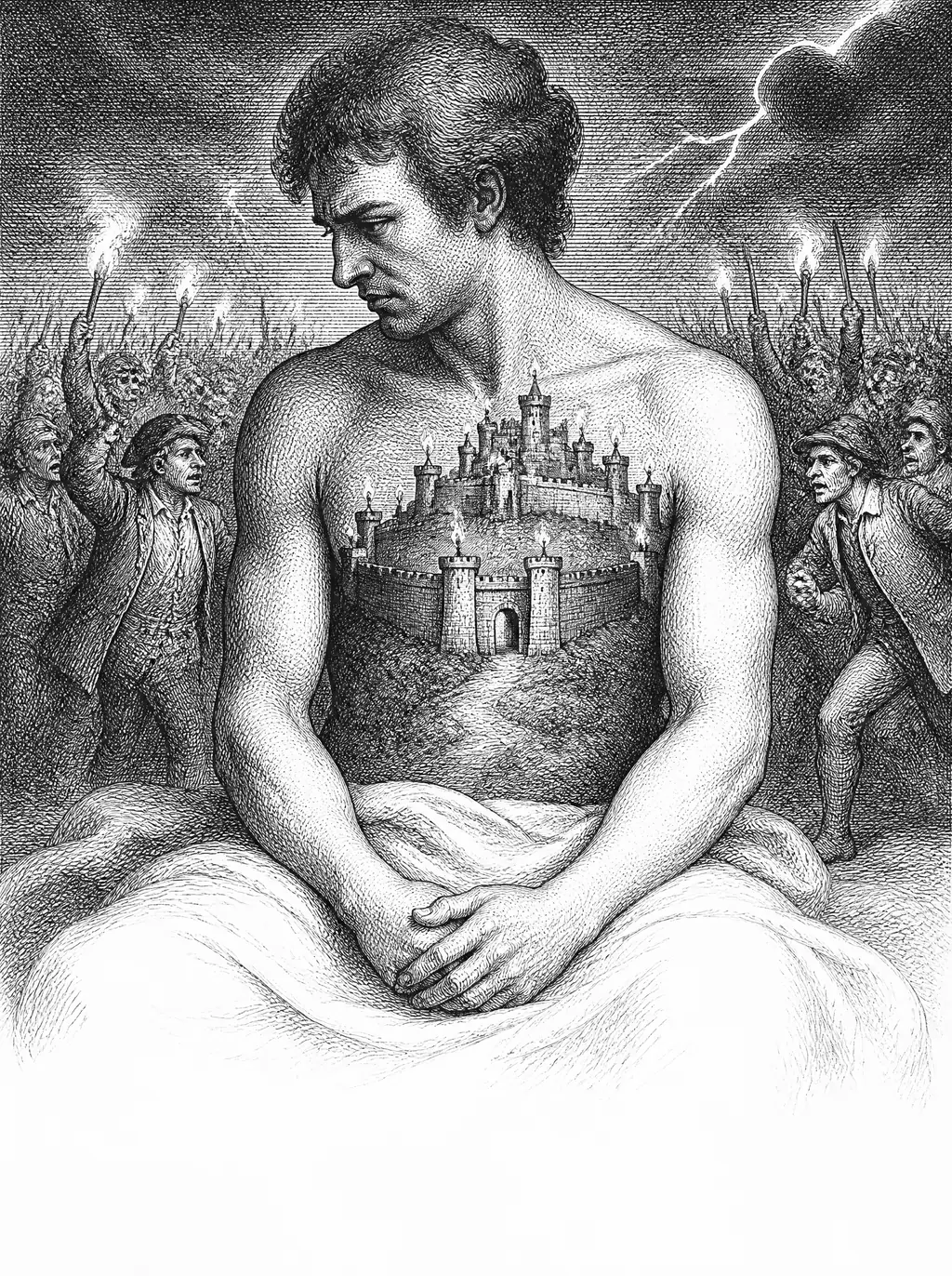
The Inner Citadel
A retreat you already own
Rich Romans fled to country villas and quiet shorelines whenever life in the city grew unbearable, and Marcus Aurelius, an emperor who could have gone anywhere, noticed himself longing for the same escapes. Then he noticed something more useful: the retreat he actually needed was never a place. It was always available, inside his own mind. The passage he wrote about it reads like a man arguing with his own restlessness, and winning, and then telling himself to get back to work.
The world it came from
Marcus wrote this passage during the Danube wars, some time after 170 AD, far from the country houses and seashores that wealthy Romans escaped to. He knew those escapes; his family owned villas, and his letters to his tutor Fronto are full of longing for rest. The Meditations were his substitute. The image of the mind as a fortress was already Stoic: Marcus elsewhere calls the mind free from passions a citadel, and Epictetus had taught that a person's ruling faculty is the one place no tyrant can enter. But the emperor gave it a new urgency. He could not leave the camp. He had to find the retreat where he stood, or not at all.
The idea
You carry a private fortress with you at all times, a place no army, crowd, or crisis can occupy without your permission. Withdraw into it, and the noise outside does not follow you in. This is not denial of the noise. It is the standing fact that your judgments, your attention, and your composure remain entirely under your own command. The retreat is not silence or emptiness. Marcus fills it with short, plain principles, and says that a few of them, revisited, are enough to wash away every vexation and send you back out to the world without resentment.
How the reasoning runs
The reasoning moves from what disturbs you to where the disturbance lives. First, ask what actually unsettles you: the noise of others, the state of the world, your own reputation. Second, notice that none of those is in your mind. They are events. What is in your mind is the judgment that they are unbearable, and that judgment is yours. Third, since the judgment is yours, you can withdraw from it at any moment, wherever you are, without a carriage or a coast. Fourth, a retreat that requires travel fails exactly when you need it, because the crisis is where you are. A retreat inside the mind never fails on that count. So the only reliable retreat is the one you carry.
Seen in life
The train is delayed, the meeting is in twenty minutes, and the person beside you is on speakerphone. You feel your jaw tighten. Marcus would not tell you to enjoy this. He would tell you to retire, for the length of a breath, into the few principles you actually hold: that the delay is not up to you, that the meeting will start when you arrive, that the man on the phone is a person and not an insult aimed at you. Then come back. Nothing on the platform has changed. The thing that had changed, your own state, has changed back, and you can now decide what to do with the twenty minutes.
Why it matters
Most people wait for their surroundings to calm down before they feel calm themselves, which hands their peace of mind to whoever happens to be shouting nearby. The inner citadel reverses the order. Calm comes first, generated from inside, and it survives the trip out into whatever chaos is waiting, because it was never dependent on the chaos being absent. The retreat is also portable in a way no spa is. You can use it in a hospital corridor, a courtroom, or a meeting, which are exactly the places where calm is worth most and where nobody is going to offer it to you.
“It is in thy power to retire into thyself, and to be at rest, and free from all businesses. A man cannot any whither retire better than to his own soul.”
From the source
In Book IV of the Meditations, Marcus Aurelius wrote: “It is in thy power to retire into thyself, and to be at rest, and free from all businesses. A man cannot any whither retire better than to his own soul.” He urges himself to use this retreat continually, not only in emergencies. The passage is one of the longest in the Meditations. He lists the escapes people seek, country houses, seashores, mountains, and calls the longing for them a mark of an untrained mind, since the retreat you actually need is available whenever you choose. Then he sets out the short principles he means to keep there, and finishes by telling himself to go back.
The pushback
A fair worry: doesn't retreating inward risk becoming a polite way to disengage from real problems that need real action out in the world? Marcus Aurelius answers by example, not argument: he wrote this to himself while commanding armies and hearing court cases, not instead of doing either. The citadel is where you steady yourself, then leave it to act. There is a second objection from the other side. A citadel is a defensive structure. A person who lives inside one may be safe from the crowd but is also walled off from it, and Stoicism's own doctrine says that human beings are made for one another.
The reply
Marcus's example does most of the work against the disengagement charge, and the text reinforces it: the passage ends by sending him back to his duties. The citadel is a place you visit, not a place you live. The walls objection deserves a fuller answer. In the same passage Marcus reminds himself that rational beings exist for one another, and that tolerating them is part of justice; the retreat is where he restores the patience the crowd will need from him. That is a reply, but only partly, since the image still pictures other people as what you retreat from. Pierre Hadot argued the citadel was always meant as a base, not a hideout. The text supports him more often than not.
Where it went next
The image gave its name to the most influential modern study of Marcus Aurelius: Pierre Hadot's The Inner Citadel, published in French in 1992, which read the Meditations as a record of spiritual exercises rather than a collection of maxims. Viktor Frankl, writing in 1946 about the concentration camps, described the last human freedom as the choice of one's attitude in any circumstances, which is the citadel without the Roman name. Cognitive therapy borrowed the mechanism. The mindfulness movement borrowed the practice of stepping back from a judgment for the length of a breath. And the phrase itself has passed into ordinary English as a name for the part of a person that hard events do not reach.
Where this leads
The dichotomy of control gives the citadel its walls: knowing exactly which parts of your situation are yours to command is what makes retreating inward more than an escape fantasy, and turns it into somewhere real to stand, day after day, not just in a crisis. The obstacle is the way describes what you do after you leave the citadel: the same mind that steadied itself inside now turns the outer blockage into its next task. Read the two together and you have the full cycle Marcus lived by in the camp. Withdraw, recover the principles, return, and convert whatever is waiting outside into work.