Symposium · Philosophy of Mind · Pl. 14Baruch Spinoza · 1632–1677
One Thing, Described Two Ways
No gap left to bridge
Descartes needed to explain how two utterly different substances could touch. Leibniz needed God to synchronize them like matched clocks. Spinoza looked at the whole problem and rejected its starting assumption: that mind and body were ever two separate things needing to be reconciled, rather than one thing, wearing two different descriptions at once. He had read Descartes closely enough to write a textbook on him, and he had no patience with the pineal gland, the tiny organ where Descartes had the soul push on the brain. A man who could doubt everything, Spinoza remarked, had ended by accepting something more obscure than any occult quality. There was a cleaner answer, and it needed no gland.
The world it came from
Spinoza was born in Amsterdam in 1632 to a family of Portuguese Jews who had fled the Inquisition. In 1656 his own community expelled him for opinions the decree does not name. He ground lenses for a living, moved between small Dutch towns, and refused a professorship at Heidelberg to keep his freedom to write. The Ethics was finished by 1675 and published by friends after his death in 1677, because he judged it too dangerous to print. It is written in the form of Euclid, with definitions, axioms, and proofs. Descartes had been dead since 1650, but his followers dominated the Dutch universities, and the mind-body problem he left behind was the live question. Part II of the Ethics is Spinoza's answer.
The idea
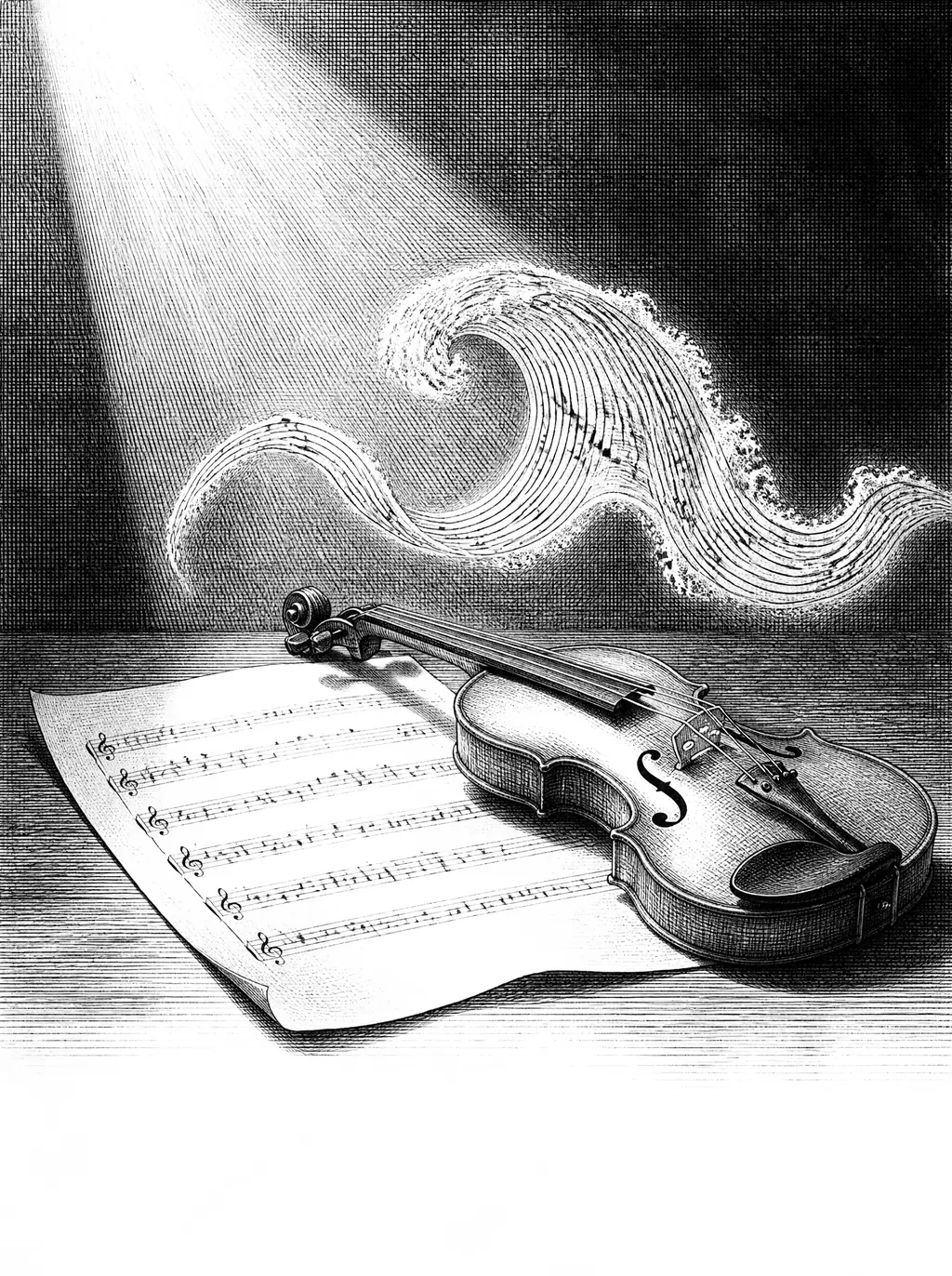
The order and connection of ideas is the same as the order and connection of things. Mind and body are not two substances but two attributes, two complete ways of describing the identical underlying reality, the way a melody and the sheet music representing it describe the same thing in two different vocabularies, neither one causing the other. For Spinoza there is only one substance, which he calls God or Nature, and thought and extension are two of the infinitely many attributes under which it can be conceived. A human being is a small part of that substance. Considered under extension, you are a body. Considered under thought, you are the idea of that body. Nothing passes between the two, because there is no between.
How the reasoning runs
Step one: there is only one substance, since a substance is what exists through itself, and two such things could share nothing that would let one limit the other. Step two: thought and extension are attributes of it, and each attribute must be understood through itself, so no explanation runs from one to the other. A thought is explained by thoughts; a motion by motions. Step three: since the substance is one, the causal order under each attribute is the same order seen twice. That is Proposition 7 of Part II. Step four: the human mind is the idea of the human body. Conclusion: whatever happens in your body has a counterpart in your mind, not because one causes the other, but because they are one event under two names.
Seen in life
You lie in the scanner and think about the argument you had this morning. On the screen next door a region of your brain brightens. The technician says your amygdala is active; you say you are angry. Now ask the question everyone asks: did the brain activity cause the anger, or did the anger cause the activity? Spinoza's answer is that the question is badly formed. There is one event. The scanner describes it under extension, in the language of blood flow and voltage. You describe it under thought, in the language of grievance. Neither description is the cause of the other, any more than a word in French is the cause of the same word in Dutch. That is what parallelism claims, and modern neuroscience keeps running into it.
Why it matters
This dissolves the interaction problem without requiring Leibniz's elaborate pre-synchronized clockwork: if mental and physical events are simply the same events under two descriptions, there is no gap between them to bridge, and no causal traffic that needs explaining, only one reality, described physically or described mentally, in perfect lockstep by definition. It also changes what self-knowledge is. If your mind is the idea of your body, then understanding your emotions means understanding what is happening to your body and why. Spinoza's therapy for the passions, in the later parts of the Ethics, rests on exactly this: a feeling clearly understood stops being a passion and becomes something you do. Nobody yet knows, he adds, what a body can do.
“The order and connection of ideas is the same as the order and connection of things.”
From the source
Spinoza states the principle in the Ethics: “The order and connection of ideas is the same as the order and connection of things.” Elsewhere he draws the conclusion directly: mind and body are one and the same thing, conceived now under the attribute of thought, and now under that of extension. The first sentence is Proposition 7 of Part II. The second comes from the note to Proposition 2 of Part III, where Spinoza also proves that the body cannot make the mind think and the mind cannot make the body move. That note contains his most quoted aside: that nobody has yet determined what the body can do from the laws of its own nature alone, so nobody is entitled to say the mind must be moving it.
The pushback
If mind and body are truly the same thing under two descriptions, why does one description, the physical, seem to fully determine outcomes through ordinary causation, while the other, the mental, seems to add nothing extra, raising the suspicion that the mental description is doing no real work at all? Two further objections have followed Spinoza for three centuries. First, the sameness of order is asserted, not explained: given two self-contained series, why should they match at all? Second, if every body has a mind, since every body has its idea in God, then a stone thinks, in its way. Spinoza accepts this, and says all individuals are animate in different degrees. Most readers find that a high price for a tidy solution.
The reply
To the idleness worry Spinoza answers that the mental description cannot be idle because it is not a second thing that could fail to act. Asking whether the mind does anything is asking whether the event does anything under one of its names, and the answer is the same under both. The matching order is not a coincidence for the same reason: there is one order, not two that happen to agree. Those replies dissolve the objections rather than answering them, and whether dissolving counts depends on whether you accept the one substance to begin with. The panpsychism is the honest gap. Spinoza does not explain why some ideas in God are conscious minds and most are not, and later parallelists have not either.
Where it went next
Leibniz visited Spinoza in 1676, read the Ethics in manuscript, and spent much of his career building an alternative he could defend in public. For a century Spinozism was a term of abuse; then Lessing, Herder, and Goethe adopted it, and Hegel said that to begin philosophizing one must first be a Spinozist. Gustav Fechner's psychophysical parallelism in the 1860s put the doctrine into experimental psychology. Donald Davidson's anomalous monism of 1970, on which every mental event is a physical event but no law connects the two vocabularies, is a recognizable descendant, and Davidson said so. The neuroscientist Antonio Damasio wrote a 2003 book, Looking for Spinoza, arguing that the account of emotion was ahead of its time. Dual-aspect theories of consciousness still cite Part II.
Where this leads
Two clocks set to the same time offers Leibniz's own rival solution to the identical interaction problem, keeping mind and body as genuinely separate things synchronized from outside, rather than collapsing them, as Spinoza does, into a single underlying reality. One substance, infinite names is the foundation the parallelism stands on. Part I of the Ethics proves that there can be only one substance and that everything else is a mode of it. Part II applies that result to a human being. If you find the mind-body parallelism strange, the place to look is not Part II but the argument for a single substance, because once that is granted, the parallelism is close to forced. Reject it, and the parallelism has nothing to rest on.