Symposium · Philosophy of Mind · Pl. 8Gottfried Wilhelm Leibniz · 1646–1716
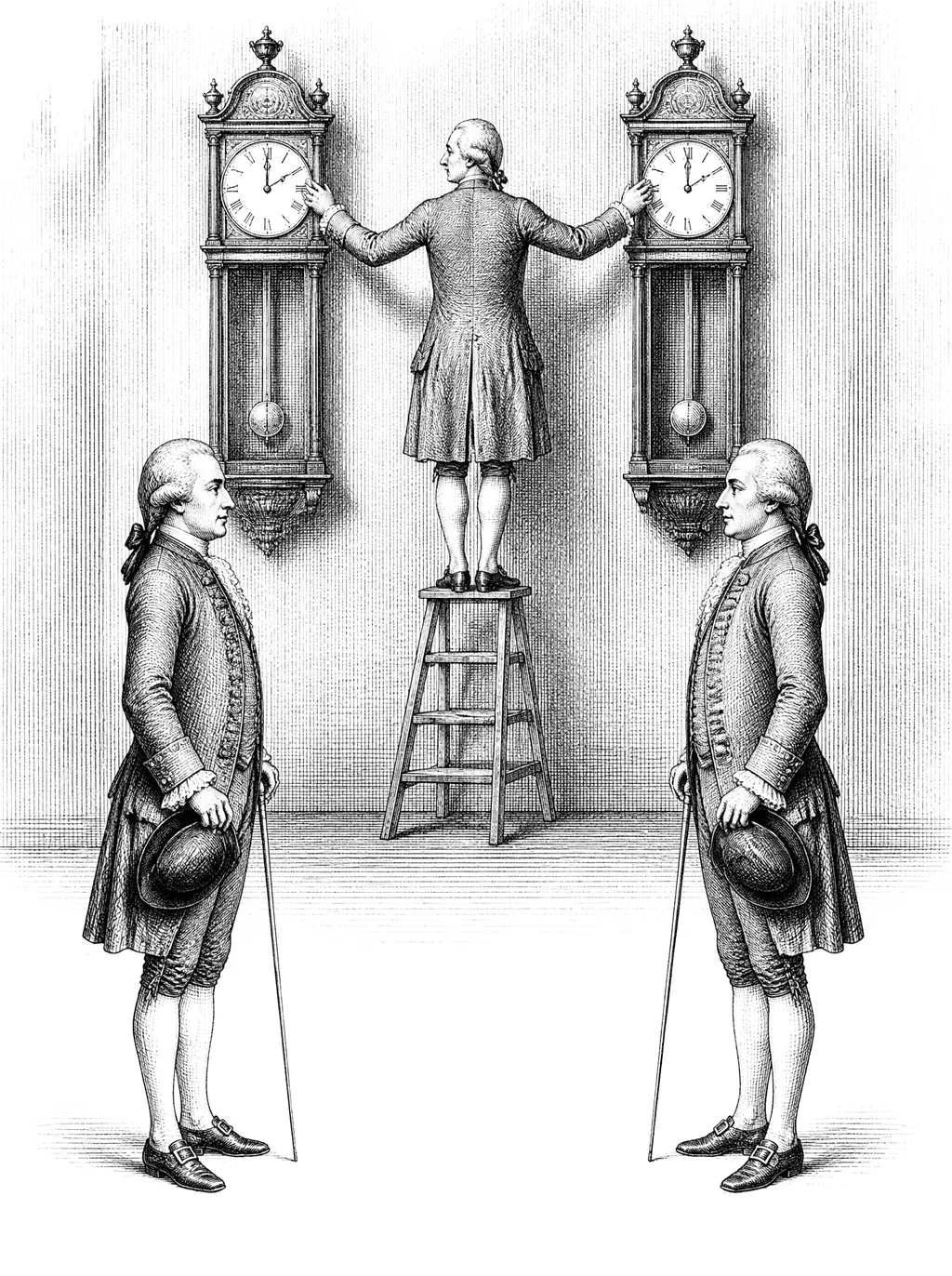
Two Clocks Set to the Same Time
A problem Descartes left open
Descartes split mind and body into two genuinely different substances and then struggled to explain how a decision made of pure thought could ever move an arm made of pure matter. Leibniz proposed a way out that kept the split but removed the interaction entirely: what if mind and body never actually causally affect each other at all? Picture two clocks on a wall that always show the same time. Either one drives the other, or a clockmaker keeps adjusting them, or they were built so well that they agree on their own. Leibniz thought the first was impossible, the second beneath God, and the third the truth about you.
The world it came from
Leibniz spent most of his adult life as librarian, historian, and adviser to the dukes of Hanover, writing philosophy in letters and journal articles between diplomatic errands. He first published the harmony in 1695, in a French journal, after working it out in a long correspondence with the theologian Antoine Arnauld. The Theodicy of 1710, the only large book he printed in his lifetime, defended it against Pierre Bayle, whose Dictionary had mocked the idea as a fable. Two rivals framed his problem. Descartes's followers still had the soul nudging the brain, which Leibniz thought violated the laws of motion. Malebranche's occasionalists had God move the body each time the soul willed, which made every gesture a miracle. Leibniz wanted a world that ran without miracles.
The idea
The body is prompted by its original constitution to carry out with the help of external things all that it does in accordance with the will of the soul. Mind and body run on two separate, self-contained tracks that never causally intersect, tracks God synchronized perfectly at creation, the way two accurate clocks set to the same time will always agree without either one causing the other to move. Each substance, for Leibniz, unfolds its whole history from its own nature, like a melody that already contains its next note. Your soul produces its perceptions from within. Your body moves by the laws of mechanics alone. They match because God, choosing which world to create, chose the one in which they would.
How the reasoning runs
Step one: a true substance is simple and self-contained. Nothing gets in or out of it, so its states arise from its own nature. Leibniz says such substances have no windows. Step two: it follows that no created substance can act on another. The soul cannot push the body and the body cannot push the soul. Step three: rule out the alternative that God does the pushing at every moment, because a God who must intervene constantly has built a machine that needs constant repair. Step four: the only way left for agreement is that it was built in. God surveyed all possible substances and created a set whose separate histories fit. Conclusion: mind and body correspond perfectly and never touch.
Seen in life
You are in a cinema. A door slams on screen and you hear the slam. Nothing on the screen made the sound. The picture is a stream of frames, the audio is a separate stream of samples, and they were lined up in an editing suite months ago. Each runs by itself, and the match is so exact that you experience one event. Now put a person in the same picture. A brain scan shows a signal a moment before you report deciding to press the button. Did the brain cause the decision? Leibniz would say you are watching two tracks, each complete in its own terms, that were never going to disagree. The correspondence is perfect precisely because neither stream is listening to the other.
Why it matters
This dissolves the interaction problem by denying its premise: if mind and body never interact, there is nothing left to explain about how they manage it. The cost is a strange kind of determinism, since your body's every motion was already fixed at creation to match your soul's choices, without your choices actually causing anything physical to happen at all. The harmony also draws a line that has outlasted it. Leibniz insisted that everything in the body be explained mechanically, with no appeal to the soul, while everything in the soul be explained by perceptions and appetites, with no appeal to the body. Two vocabularies, each complete, neither borrowing from the other: that division of labor is roughly how neuroscience and psychology still divide the work.
“The body is prompted by its original constitution to carry out with the help of external things all that it does in accordance with the will of the soul.”
From the source
Leibniz describes his system in the Theodicy: “The body is prompted by its original constitution to carry out with the help of external things all that it does in accordance with the will of the soul. So the seeds by their original constitution carry out naturally the intentions of God.” The passage is from E. M. Huggard's translation. The comparison to seeds is deliberate. A seed does not receive instructions as it grows; it unfolds what was in it. Leibniz says the body is like that, and the soul too. Elsewhere in the Theodicy he answers Bayle's jibe that this makes the body a ship steering itself to port without a pilot. Yes, Leibniz replies, and that is exactly what an infinitely wise shipwright would build.
The pushback
Doesn't this trade one mystery for an even larger one, asking readers to accept that God pre-programmed two entirely separate, non-interacting sequences of events to match perfectly for an entire lifetime, down to every last thought and motion, rather than simply allowing the two to interact directly? Critics found the cure harder to swallow than the original disease. Bayle pressed a second objection that has never gone away. If Caesar's body was built at creation to cross the Rubicon whatever his soul did, and his soul was built to will it, then his choice was written before he existed. Freedom on this picture is a feeling of choosing that accompanies a script. And if the body would have crossed anyway, the soul is a passenger.
The reply
Leibniz answered Bayle at length. Freedom, he said, needs three things: spontaneity, intelligence, and contingency. The soul's acts are spontaneous because they spring from its own nature and nothing else, they are intelligent because it deliberates, and they are contingent because God could have created a different world. God's choice inclines without necessitating. As for the passenger worry, Leibniz denies there is anything for the soul to be a passenger in: the body's story is complete under efficient causes and the soul's under final causes, and each is the whole event told in its own language. The reply is coherent, and almost nobody has found it comforting. A choice that was certain before you existed does not feel open from the inside.
Where it went next
Christian Wolff turned the harmony into the textbook philosophy of German universities, and Voltaire's Candide in 1759 made the Theodicy's best of all possible worlds a joke that outlived the argument. The young Kant rejected the harmony in 1755 and defended real interaction; the mature Kant put the whole question beyond what we can know. Bertrand Russell's 1900 book on Leibniz revived him for English readers. The doctrine's descendants are the theories that deny the mind moves the body: T. H. Huxley's epiphenomenalism in 1874 kept causation in one direction only, and psychophysical parallelism in nineteenth-century psychology kept neither. Leibniz's other image, the mill you could walk through and find only parts pushing parts, is still cited as the first statement of the explanatory gap.
Where this leads
One substance, infinite names answers the identical interaction problem with the opposite strategy entirely, denying that mind and body were ever two separate things requiring synchronization at all, since both are simply two ways of describing a single underlying substance. The real distinction is the problem Leibniz inherited. Descartes proved, to his own satisfaction, that mind and body are distinct substances, and then spent his last years failing to say how they touch. Leibniz accepted the proof and rejected the touching. Read the three together and you have the full set of answers to one question: Descartes says the two interact, Leibniz says they only agree, and Spinoza says they were never two.