Symposium · Logic & Paradoxes · Pl. 14Alfred Tarski · 1901–1983
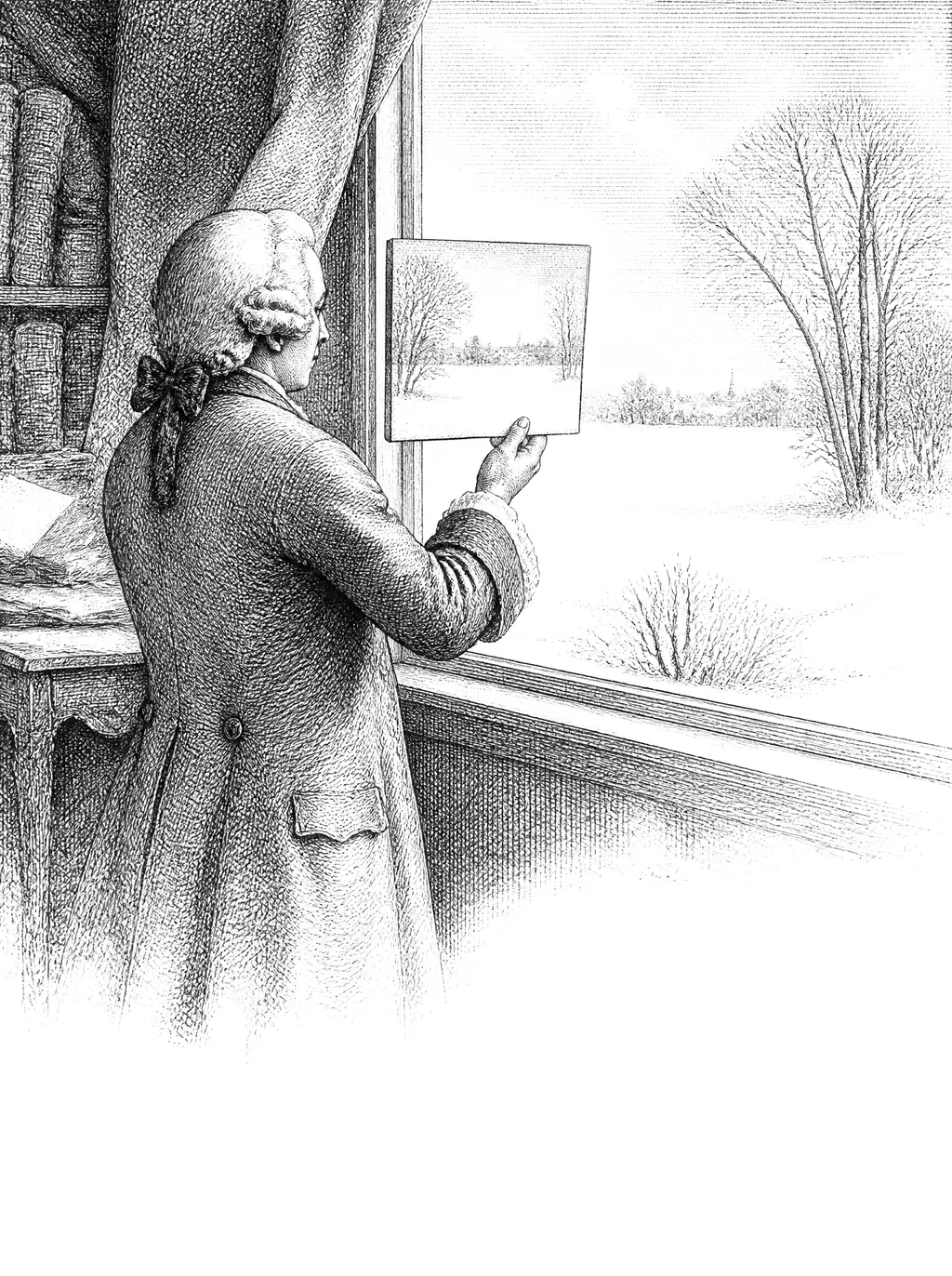
Snow Is White
A definition that risks sounding empty
After centuries of grand, contested theories of what truth ultimately is, correspondence with reality, coherence within a system, usefulness in practice, Tarski built his formal theory around something that looks almost too plain to count as philosophy at all: a simple biconditional linking a sentence about snow to the actual color of actual snow. The plainness is deliberate. Tarski wanted a definition that anyone would accept as correct before he showed how much work it took to state it without contradiction.
The world it came from
Alfred Tarski was born in Warsaw in 1901 and trained in the Lwów-Warsaw school of logic under Leśniewski and Łukasiewicz. His long paper on the concept of truth appeared in Polish in 1933 and in German in 1935; the 1944 essay quoted here was written for an American audience. The problem was the Liar. Any language that can name its own sentences and apply true to them can build a sentence that says of itself that it is false, so a naive definition of truth is inconsistent. Meanwhile the Vienna Circle suspected that truth was a metaphysical word to be avoided. Tarski sailed to a congress at Harvard in August 1939, weeks before Germany invaded Poland, and never went home. He spent the rest of his career at Berkeley.
The idea
The sentence 'snow is white' is true if, and only if, snow is white. This schema, applied to any sentence, is meant to capture the core of the classical notion of truth without smuggling in a paradox, carefully separating the language being talked about from the richer language used to talk about it, so a language cannot trap itself the way the Liar sentence does. The sentence about snow is a sample of the target, not the theory. The theory is the machinery that produces every such sentence for a whole language without ever producing a contradiction.
How the reasoning runs
Step one: set the test. Any definition of true must imply, for each sentence, X is true if and only if p, where X names the sentence p. Tarski called this Convention T. Step two: separate the language you are defining truth for, the object language, from the language you use to do it, the metalanguage, which alone contains the word true. Step three: define truth by recursion on structure. A conjunction is true when both parts are; a negation is true when its part is not; a universal sentence is true when every object satisfies it. Instance: snow is white and grass is green is true because both halves are. The Liar cannot be written, since no object-language sentence can call itself true.
Seen in life
You are setting up an audit for a financial system. The obvious shortcut is to let each report include a line certifying itself as accurate. You reject it, and the reason is Tarski's. A document that vouches for its own truth adds nothing, and a document that could deny its own truth would be a Liar on letterhead. So you build a second layer: an auditor who reads the reports in a vocabulary the reports do not have, with access to the bank statements the reports summarize. The auditor's language is the metalanguage. Its statements about the reports can be checked in turn, but only by a third layer. Every serious verification system, from a test suite to a court, has that shape, and Tarski explained why it must.
Why it matters
This gave logic a formally precise, paradox-resistant definition of truth for the first time, one that could be stated with mathematical rigor rather than left as an intuitive but slippery philosophical notion. It became foundational for logic, linguistics, and computer science, anywhere a system needs to reason carefully about its own claims to truth. It also changed the philosophical mood. Carnap and Popper, who had avoided the word true as unscientific, took it up again once Tarski showed it could be defined with the same rigor as any mathematical notion.
“The sentence 'snow is white' is true if, and only if, snow is white.”
From the source
Tarski states the schema, deceptively simple on its plain surface, that his whole careful formal theory of truth for an entire language is ultimately built around: “The sentence 'snow is white' is true if, and only if, snow is white.” Tarski calls sentences of this form equivalences of the form T, and the requirement that a definition imply all of them Convention T. He insists that the schema is not itself a definition of truth, still less a theory of it: it is the condition any acceptable definition must meet. The essay then explains why natural language fails the condition, because it contains its own truth predicate and its own names for its own sentences, and why a formalized language with a separate metalanguage can pass it.
The pushback
Doesn't this look suspiciously circular or trivial, merely restating the sentence rather than genuinely explaining what truth is? Tarski's actual technical achievement lies elsewhere, in how the full formal apparatus behind this simple example manages to define truth for an entire language without allowing that language to generate a Liar-style contradiction about itself. A second objection is that Tarski defined truth only for artificial languages, and said outright that natural languages, which can talk about themselves, are inconsistent. A theory of truth that does not apply to English seems to have changed the subject.
The reply
On triviality, two camps. Deflationists such as Quine and Paul Horwich embrace it: the equivalences are all there is to truth, and Tarski showed how to have them without paradox. Others, following Hartry Field's 1972 critique, argue that Tarski gave a definition for each language but no account of what truth is across languages, and that the recursion on satisfaction is bookkeeping rather than explanation. On natural language, Tarski held his ground, and the field split. Kripke's 1975 theory keeps a single language and allows sentences to be ungrounded rather than climbing a hierarchy. Davidson turned the machinery round and used Tarski-style truth conditions as a theory of meaning for natural language. The formal result is uncontested; what it tells you about truth is not.
Where it went next
Tarski's definition founded model theory, the branch of logic that studies what sentences are true in which structures, and his Berkeley school dominated it for decades. His undefinability theorem of 1936 showed that arithmetic truth cannot be defined within arithmetic, a companion to Gödel's incompleteness. Donald Davidson made truth conditions the centre of semantics in the 1960s, and Richard Montague's grammars carried the method into linguistics. Computer science inherited the object-language and metalanguage split directly: the formal semantics of a programming language is written in a metalanguage, model checkers ask whether a system satisfies a specification, and a database query is evaluated by the same recursion Tarski wrote for satisfaction.
Where this leads
The liar paradox names the exact ancient problem this whole careful apparatus was built to finally defuse, a self-referential sentence flipping between true and false that any adequate theory of truth eventually has to find some principled way to handle. Whereof one cannot speak, Wittgenstein's closing line, marks the other border. Tarski showed what a language cannot say about its own truth; Wittgenstein drew a line around what language can say about anything, and both left something important on the far side.