Symposium · Metaphysics · Pl. 15Zeno of Elea · c. 490 – c. 430 BC
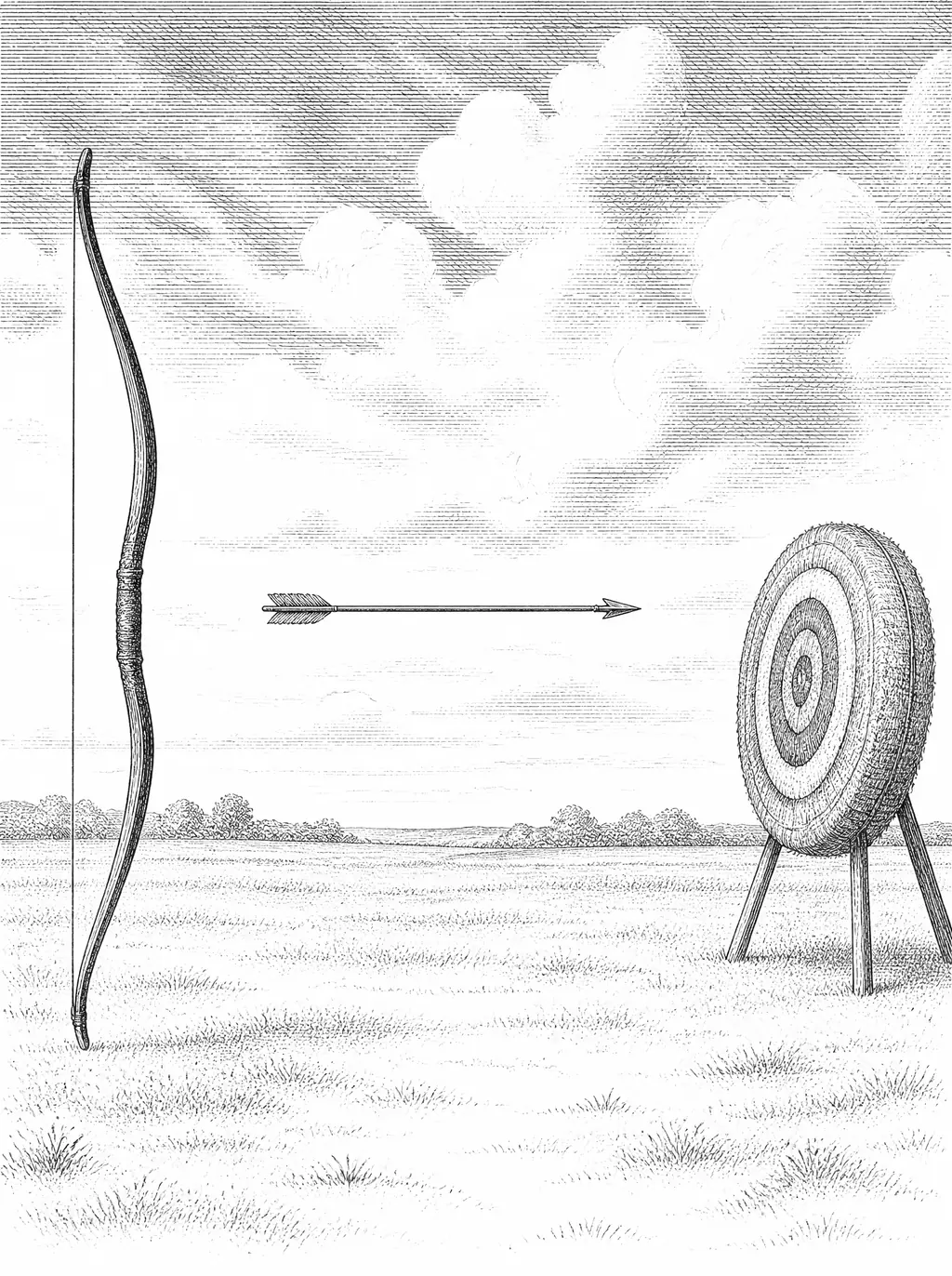
The Arrow Paradox
A single frozen moment
Picture an arrow shot from a bow, caught in a single instant of time, like a frame plucked out of a film. At that exact instant, the arrow occupies one specific space equal to its own length, no more and no less, exactly the way it would if it were simply resting on a table, not moving anywhere at all. Now ask what the difference is between this frame and a frame of an arrow lying on the table. There is none. Nothing in the single instant tells you the arrow is going anywhere. Zeno's move is to point out that the flight is made of nothing but such instants. If motion is not in any of them, where is it?
The world it came from
Zeno was born in Elea, in southern Italy, around 490 BC, and was the pupil and, Plato says, the favourite of Parmenides. Parmenides had argued that reality is one and unmoving, and that the world of many things in motion is an illusion. He was laughed at. Zeno's book, according to Plato's dialogue Parmenides, was written to return the laugh: to show that the belief in many moving things leads to absurdities worse than anything in his teacher's poem. The book is lost. What survives are reports, chiefly Aristotle's in the Physics, which lists four arguments against motion. The arrow is the third. Aristotle reports it in order to refute it, so the version we have is a hostile summary of a lost original.
The idea
The arrow in flight is at rest. If everything is at rest when it occupies a space equal to itself, and a moving arrow, at any given instant, always occupies a space equal to itself, then the arrow is at rest at every instant of its flight. And if it is at rest at every instant, motion itself starts to look like an illusion built entirely out of stillness. The argument targets a different assumption from Zeno's other paradoxes. Achilles and the dichotomy attack the idea that space can be divided without limit. The arrow attacks the idea that time is made of instants. If a stretch of time is a series of durationless nows, and nothing moves in a now, then nothing moves in the series either.
How the reasoning runs
Premise one: anything that occupies a space exactly equal to itself is at rest. Premise two: at any single instant, a flying arrow occupies a space exactly equal to itself; it is not spread over two places at once. Conclusion one: at any single instant, the flying arrow is at rest. Premise three: the time of the arrow's flight is composed of instants, and nothing else. Conclusion two: throughout its flight, the arrow is at rest. That contradicts its flying. The contradiction can be escaped only by rejecting a premise. Aristotle rejected the third: time is not made of instants any more than a line is made of points. Modern mathematics rejects the first: rest and motion are not properties of an instant at all.
Seen in life
You are watching a replay of a sprint final, paused on the finish line. On the frozen frame, the two runners are motionless, and the dispute is about which chest crossed first. You press play, and someone won. Nothing in the paused frame said who was moving faster, or that either was moving. Zeno's arrow lives in that pause. The whole race, on his reading, is a stack of paused frames, and no frame contains speed. The modern answer is in the replay itself: velocity is a comparison of frames, a rate, and a rate is not visible in one frame because a rate is not the kind of thing that fits in one. That is not a trick but a discovery about what motion is, and Zeno forced it.
Why it matters
This targets the assumption that motion is simply a sequence of static positions in a sequence of instants, an assumption most people never examine because it matches how a film strip or a stop-motion sequence actually works. Zeno's paradox asks where, in a chain of frozen instants, the actual moving is supposed to happen at all. The question turned out to be about the nature of time and the continuum, and it took two millennia to answer. The answer, that velocity is a limit of ratios over shrinking intervals, is the derivative, and the derivative is the foundation of the physics that describes every moving thing. Zeno did not know that. He wanted to show motion impossible, and instead he showed what it would take to describe it.
“The arrow in flight is at rest. For, if everything is at rest when it occupies a space equal to itself, and what is in flight at any given moment always occupies a space equal to itself, it cannot move.”
From the source
The argument, again reported through Aristotle, runs: “The arrow in flight is at rest. For, if everything is at rest when it occupies a space equal to itself, and what is in flight at any given moment always occupies a space equal to itself, it cannot move.” This is Burnet's rendering of Aristotle's report in Physics, Book VI, where Zeno's four arguments about motion are listed together. Aristotle adds his own diagnosis in the same breath: the conclusion follows only if time is composed of nows, and it is not. Diogenes Laertius credits Zeno with inventing dialectic, the art of refuting a position from its own premises, and the arrow is the cleanest surviving example. Its whole force is borrowed from what its opponents believe.
The pushback
Modern physics answers that motion is not adequately captured by any single frozen instant at all; velocity is properly defined only across an interval of time, however small, never at a durationless point. The paradox trades on treating time as made of instants with zero duration stacked together, an assumption calculus was eventually built specifically to handle. Bertrand Russell put it more sharply: motion simply is being at different places at different times, with no further ingredient. On that view the arrow's flight is a stack of positions, and Zeno's error is to expect something extra. A harder objection points at the first premise: occupying a space equal to yourself is true of moving and resting bodies alike, so it cannot be a test for rest.
The reply
Zeno has no surviving reply, so the tradition speaks for him. Against Aristotle, an Eleatic could say that denying time is made of instants denies that the instant is real, and then ask what the present is. Against Russell's at-at theory, the objection is that it describes motion without explaining it: a body at successive places is exactly what Zeno said motion could not be, and calling that motion is naming the problem rather than solving it. What is true is that the mathematics works: instantaneous velocity is well defined as a limit, and the arrow has one at every instant, including the direction it is heading. Whether that gives the instant a real motion or a mathematical shadow of one is a question the reply leaves open.
Where it went next
Aristotle's account of the continuum, in which a line is divisible without limit but not composed of points, was built partly to answer the arrow, and it held for two thousand years. Newton and Leibniz's calculus gave the paradox its mathematical answer with the derivative, and Cauchy and Weierstrass made the derivative rigorous in the nineteenth century by defining a limit without any appeal to instants of motion. Russell's at-at theory of motion in 1903 is the philosophical version of that answer. Henri Bergson turned Zeno around and argued that the arrow shows the intellect's habit of thinking in frozen frames, which he called the cinematographic method, and that real duration is something else. Physicists named the quantum Zeno effect after him: a system observed continuously does not change.
Where this leads
Achilles and the tortoise attacks the same underlying question about infinity and motion from the opposite direction, asking not whether motion can be found within a single instant, but whether an infinite number of instants can ever add up to a finished, completed race. Being is is the position both paradoxes were built to defend. Parmenides said motion is unthinkable; Zeno showed that the alternative, motion made of instants and distances, is unthinkable too. Read the three together as a single argument. The teacher states the thesis, and the pupil runs the opposing view into two walls: the arrow shows that instants contain no motion, and Achilles shows that distances contain no end.