Symposium · Metaphysics · Pl. 1Zeno of Elea · c. 490 – c. 430 BC
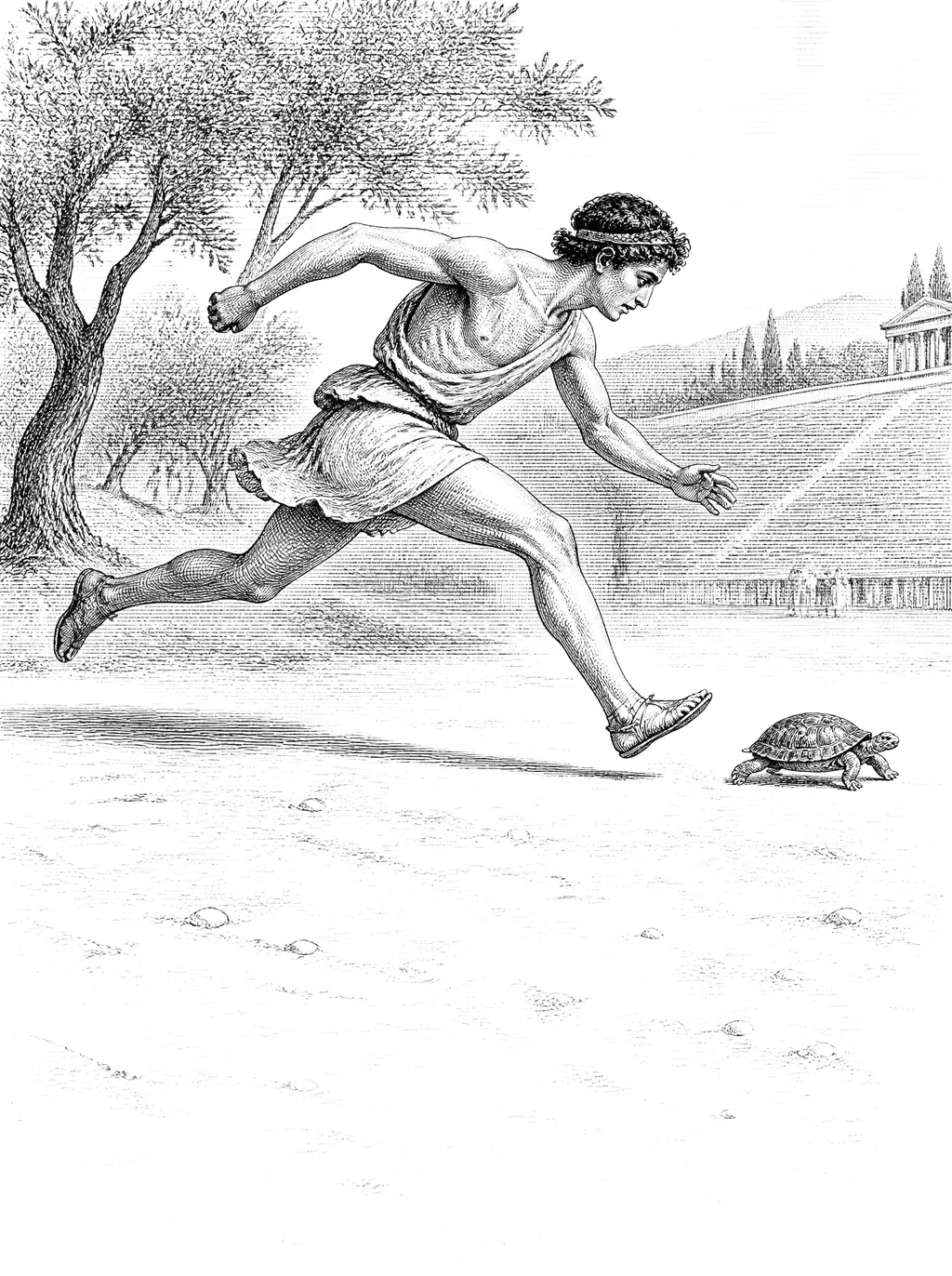
Achilles and the Tortoise
A race that cannot finish
Achilles, the fastest of the Greeks, races a tortoise that gets a modest head start. Common sense says he overtakes it within moments. Zeno's argument says otherwise: by the time Achilles reaches where the tortoise started, the tortoise has moved a little further on, and this gap, however small, keeps reopening every single time he closes it. Zeno knew perfectly well that runners overtake tortoises. That is the point. He had a proof that they cannot, and a world in which they do, and he wanted you to feel the two pull apart in your hands. Diogenes the Cynic is said to have answered by standing up and walking. Zeno would have replied that walking was never in question; explaining it was.
The world it came from
Zeno of Elea wrote in the mid fifth century BC as the pupil and defender of Parmenides, who had argued that reality is one, unmoving, and undivided. The poem had been mocked, and Zeno's book was a counterattack: assume the many and motion, and see what follows. Plato's Parmenides pictures the two of them visiting Athens around 450 BC, with Zeno reading the book aloud to a young Socrates. Aristotle preserved four of the arguments against motion in the Physics, and Achilles is the second. He remarks that it is the same as the first, the dichotomy, which says you cannot cross a room because you must first cross half of it, and that the only difference is that the remaining distance is not halved each time.
The idea
Achilles will never overtake the tortoise. He must first reach the place from which the tortoise started; by that time the tortoise will have got some way ahead. Achilles must then make up that new gap, and again the tortoise will be ahead. He is always coming nearer, but he never quite makes up to it, an infinite sequence of ever-smaller gaps that never fully closes. Give the tortoise a hundred metres and make Achilles ten times faster. When he has run a hundred metres, the tortoise has run ten. When he has run those ten, it has run one. Then a tenth. There is no stage at which the gap is zero. The stages are infinite, and Zeno asks how anyone finishes an infinite series of tasks.
How the reasoning runs
Premise one: to overtake the tortoise, Achilles must first reach the tortoise's current position. Premise two: while he does so, the tortoise moves on, so when he arrives it has a new current position. Premise three: premises one and two apply again to the new position, and to every position after that. Conclusion one: overtaking requires completing infinitely many stages. Premise four: an infinite number of stages cannot be completed, because completion means reaching the last one and an infinite series has no last member. Conclusion two: Achilles never overtakes the tortoise. Aristotle attacked premise four: the stages are infinite in division but finite in extent, and time divides the same way, so a finite time contains as many stages as the distance does.
Seen in life
You are paying off a debt, and each month you clear half of what remains. The first month is brutal, the second manageable, the third almost nothing. By the sixth you owe pennies and by the tenth a fraction of a penny. On paper you will never reach zero, because halving never produces nothing. In practice the bank rounds and the account closes. Zeno's tortoise is that debt without the rounding. The paradox feels forced because you already know the sum: half plus a quarter plus an eighth, continued forever, is one whole, and no more. That is the answer mathematics gave, two thousand years late. What it does not tell you is which month you made the last payment. There is no last payment. The debt is gone anyway.
Why it matters
The paradox exposes a real puzzle about infinity hiding inside ordinary movement: dividing any distance produces infinitely many smaller distances, and it is not obvious how traversing infinitely many steps could ever add up to a finite, completed motion. Everyday experience says Achilles wins easily; the logic of infinite division says the race should never resolve. The puzzle forced mathematics to say what a completed infinity is, and the answer took the form of limits, convergent series, and eventually Cantor's arithmetic of the infinite. It matters beyond mathematics because it shows a pattern that recurs: a description that is correct at every step and wrong about the whole. Every argument that says you can never get there because there is always one more step has a tortoise in it.
“Achilles will never overtake the tortoise. He must first reach the place from which the tortoise started. By that time the tortoise will have got some way ahead.”
From the source
The argument, preserved through Aristotle, runs: “Achilles will never overtake the tortoise. He must first reach the place from which the tortoise started. By that time the tortoise will have got some way ahead. Achilles must then make up that, and again the tortoise will be ahead. He is always coming nearer, but he never makes up to it.” This is Burnet's paraphrase of Physics, Book VI, chapter 9. Aristotle calls it the Achilles and says it is the same argument as the dichotomy in a different dress, with the sequence of gaps decreasing in a fixed ratio instead of by halves. His refutation follows in the same chapter. Not a word of Zeno's original wording survives; the runner, the tortoise, and the head start are all reported speech.
The pushback
Modern mathematics answers the paradox directly: an infinite series of shrinking distances can still sum to a finite total, the way one half plus one quarter plus one eighth, continued forever, adds up to exactly one whole. Zeno's contemporaries lacked this tool, which is part of why the paradox felt genuinely unanswerable for so long. Some philosophers think the sum misses the point. The finite total was never in dispute; the question was how infinitely many acts can be performed. A convergent series tells you where Achilles would be if he completed all the stages. It does not say how a runner completes a sequence that has no last member. Writers on supertasks, starting with James Thomson's lamp in 1954, still find that puzzling.
The reply
The reply on Zeno's behalf is that the mathematics answers a different question from the one he asked, and the reply on mathematics's behalf is that Zeno's question rested on a confusion. Achilles does not perform infinitely many acts; he performs one act, running, which can be described as infinitely many stages the way a metre can be described as infinitely many fractions. The stages are in the description, not in the running. Aristotle said the same with potential infinity: the distance is infinitely divisible but never infinitely divided. That settles the race. It does not settle Thomson's lamp, switched on and off at each halving, whose final state has no answer, and philosophers still divide over whether that shows supertasks are impossible or only that some are underdescribed.
Where it went next
Aristotle's distinction between potential and actual infinity was drawn to answer Zeno and held until the nineteenth century. The calculus of Newton and Leibniz handled the shrinking gaps with limits, and Cauchy and Weierstrass made the notion of a convergent series rigorous. Georg Cantor's set theory in the 1870s made actual infinities respectable and gave the infinite sequence of stages a completed sum without embarrassment. Bertrand Russell called Zeno's arguments immeasurably subtle and profound. Lewis Carroll borrowed the two runners for a paradox about logic in 1895, and Borges traced the tortoise's avatars through Western thought. The word supertask, coined in the 1950s, names the question Zeno left: not whether the sum is finite, but whether the running can be done.
Where this leads
The arrow paradox is Zeno's companion argument against motion, attacking the problem from the opposite direction: not whether a finite distance can ever be fully covered, but whether anything can be said to be moving at any single instant at all. Being is is the thesis both were built to protect. Parmenides had argued that motion cannot be thought; Zeno's task was to show that his critics could not think it either, and the two paradoxes divide the work. One says a distance made of infinite parts cannot be finished; the other says a time made of instants contains no movement. Read the three together as a single case, and notice that the case is still being answered.