Symposium · Existentialism · Pl. 15Friedrich Nietzsche · 1844–1900
Man Is Something to Be Surpassed
A speech in the marketplace
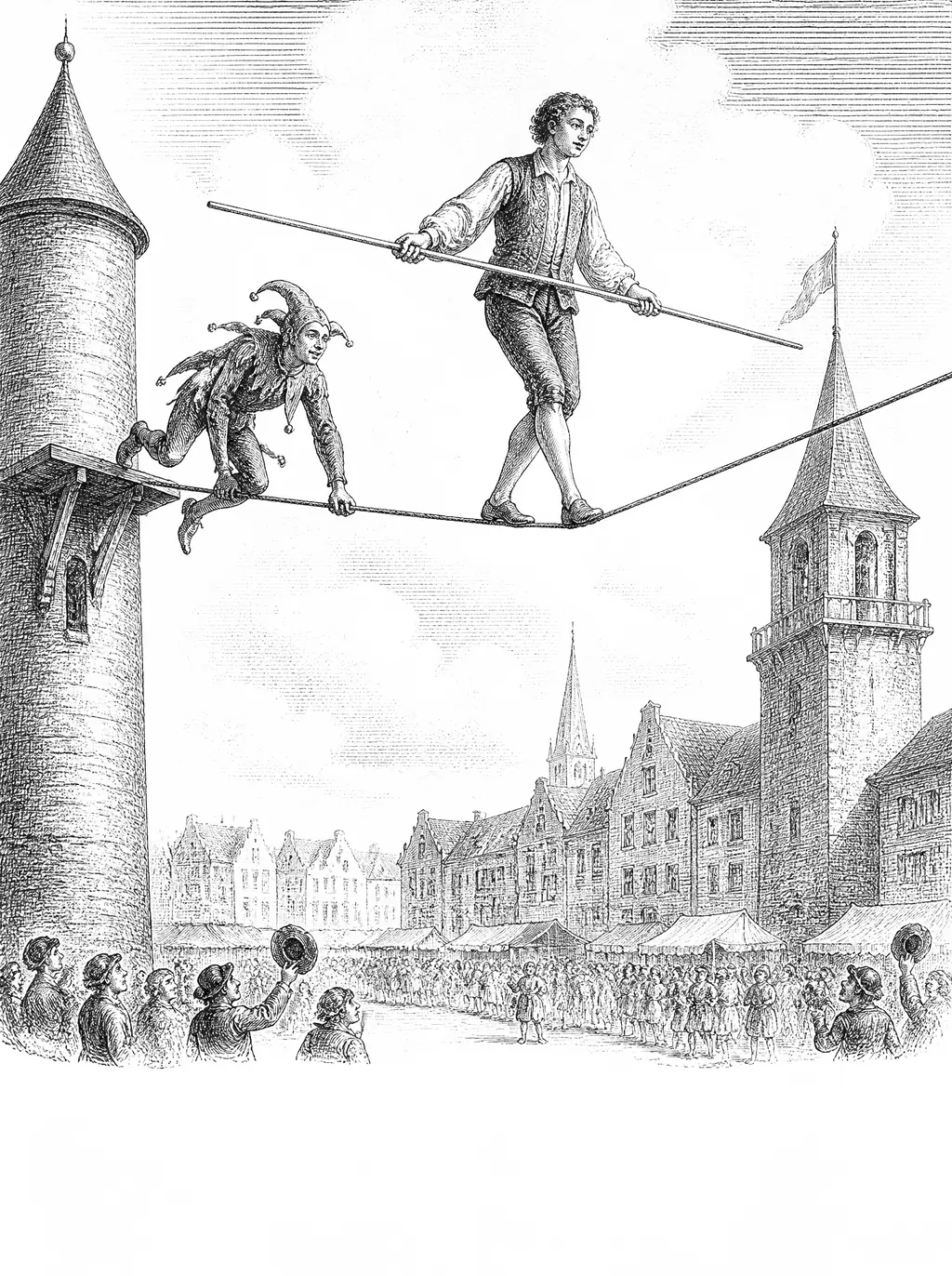
Zarathustra comes down from the mountains after ten years alone and finds a crowd gathered for a tightrope performance. He uses the occasion to deliver the central teaching of his whole book, aimed not at scholars but at an ordinary crowd waiting for entertainment: humanity itself is not a finished product, and something further is being asked of every person listening. The speech fails. The crowd laughs, the tightrope walker falls to his death, and Zarathustra leaves town carrying the corpse. Nietzsche wanted his central idea introduced as something people would first mistake for a joke.
The world it came from
Nietzsche wrote the first part of Thus Spoke Zarathustra in early 1883, on the Ligurian coast near Genoa, in about ten days. He was thirty-eight, had resigned his professorship at Basel four years earlier because of migraines and failing eyes, and lived out of suitcases in cheap rooms between the Alps and the Mediterranean. The previous year had brought the death of God passage in The Gay Science and the collapse of his hopes with Lou Salomé. He had broken with Wagner, whose art he now saw as decadent, and with Schopenhauer's counsel of renunciation. Darwin was in the air, and so was a comfortable European liberalism that Nietzsche thought had lost the appetite for anything great. The overman was his answer to both.
The idea
The overman is not a superhero or a master race. It names whatever comes after the human being manages to surpass itself, the way humanity itself once surpassed the ape. Every stage of life so far has created something beyond itself; Zarathustra asks his audience what they, specifically, have done to surpass what they currently are, rather than simply repeating it. The German word is Übermensch, and the prefix means over or beyond, not super. Nietzsche's contrast term, in the same speech, is the last man: the person who has made everything small, who blinks, and who is content.
How the reasoning runs
First premise: humanity is not a fixed kind but a stage, one that came from something and is going somewhere. Second: every creature that has ever existed, on Nietzsche's reading of evolution, has produced something beyond itself, and a being that stops producing has begun to decline. Third: the death of God removes the external goal that used to give human striving its direction, so either a new goal is set or striving lapses into comfort. Fourth: that goal cannot be handed down from outside, since there is no longer any outside to hand it. Therefore the goal must be an act of creation, and the only place it can be created is in a life that overcomes what it currently is. The overman is that goal named.
Seen in life
You are thirty-four, competent, and done. The job is fine, the flat is fine, the weekends have found a shape. Nothing hurts. You catch yourself, one evening, planning the next fifteen years as maintenance: keep this, protect that, avoid the hard conversation, avoid the move. Nietzsche's last man is not a villain. He is exactly this, a person who has decided that happiness means the absence of anything that could go wrong. The Zarathustra question is not whether you should be more successful. It is whether there is anything in you that you are still willing to be surpassed by, and what it would cost you to let it.
Why it matters
Once God is dead and the old guarantees of meaning are gone, something has to take their place, or life risks collapsing into what Nietzsche feared most, a comfortable, ambitionless contentment with things exactly as they are. The overman is his proposed answer: self-overcoming, deliberately chosen and repeated, replaces inherited purpose as the thing worth organizing a life around. The stakes are not personal only. Nietzsche believed that a culture with no goal beyond comfort would produce the last man in bulk, and that his blinking contentment was harder to escape than any tyranny, because nobody inside it wants out.
“I teach you the Superman. Man is something that is to be surpassed. What have ye done to surpass man?”
From the source
In the Prologue to Thus Spoke Zarathustra, addressing the crowd gathered in the marketplace for the tightrope walker, Zarathustra declares his central teaching plainly: “I teach you the Superman. Man is something that is to be surpassed. What have ye done to surpass man?” Thomas Common's translation, quoted here, rendered Übermensch as Superman, and the word stuck in English for half a century before Walter Kaufmann argued for overman instead. The speech continues with the image that carries the book: man is a rope stretched between animal and overman, a rope over an abyss. What is great in man, Zarathustra says, is that he is a bridge and not a goal.
The pushback
This language was infamously twisted by later movements into a doctrine of racial or national superiority, a use Nietzsche's actual writing does not support and his sister's editing of his later work helped enable. Read in context, the overman is an individual, internal standard, self-overcoming applied to one life at a time, not a group claiming superiority over other groups. A second objection stays inside the text. If there is no standard above the individual, what makes one act of self-overcoming better than another? The tyrant also surpasses himself. Nietzsche gives no rule for telling the overman from the monster.
The reply
On the first charge, the record helps. Nietzsche despised anti-Semitism, quarreled with his sister over her marriage to a leading anti-Semite, and mocked the German nationalism she later served; his notebooks were rearranged after his collapse to say what he had not said. The second charge is the one his defenders cannot fully close. He does offer criteria in scattered places: the overman gives style to his character, says yes to his whole life, and does not need to make others small to feel large. Cruelty born of weakness is the mark of the slave, not the master. But these are portraits, not tests, and a reader who wants a rule that would rule out the monster will not find one in Zarathustra.
Where it went next
The misreading came first. Nietzsche's sister Elisabeth, a committed nationalist, controlled his archive after 1889 and welcomed Hitler to it in 1934; the Nazis quoted the overman as a warrant. Walter Kaufmann's 1950 study did most of the work of rescuing the philosopher from the archive, and the English word overman is his. George Bernard Shaw had already borrowed the idea for Man and Superman in 1903. Whether the comic-book Superman of 1938 owes anything to Nietzsche beyond the name is disputed. In France, Deleuze and Foucault read the overman as a figure of endless self-transformation rather than a destination, and that reading, stripped of the abyss, survives in every self-help promise to become who you are.
Where this leads
God is dead supplies the vacancy this idea is meant to fill: once the old source of meaning collapses, self-overcoming is Nietzsche's candidate for what a person can build in its place, instead of drifting on borrowed values nobody actually still believes. Eternal recurrence is the test that goes with the goal. A person who has surpassed himself is, on Nietzsche's account, one who could hear the demon's whisper and answer yes. The overman is the direction; recurrence is the proof that the direction was taken.