Symposium · Ethics · Pl. 14Jeremy Bentham · 1748–1832
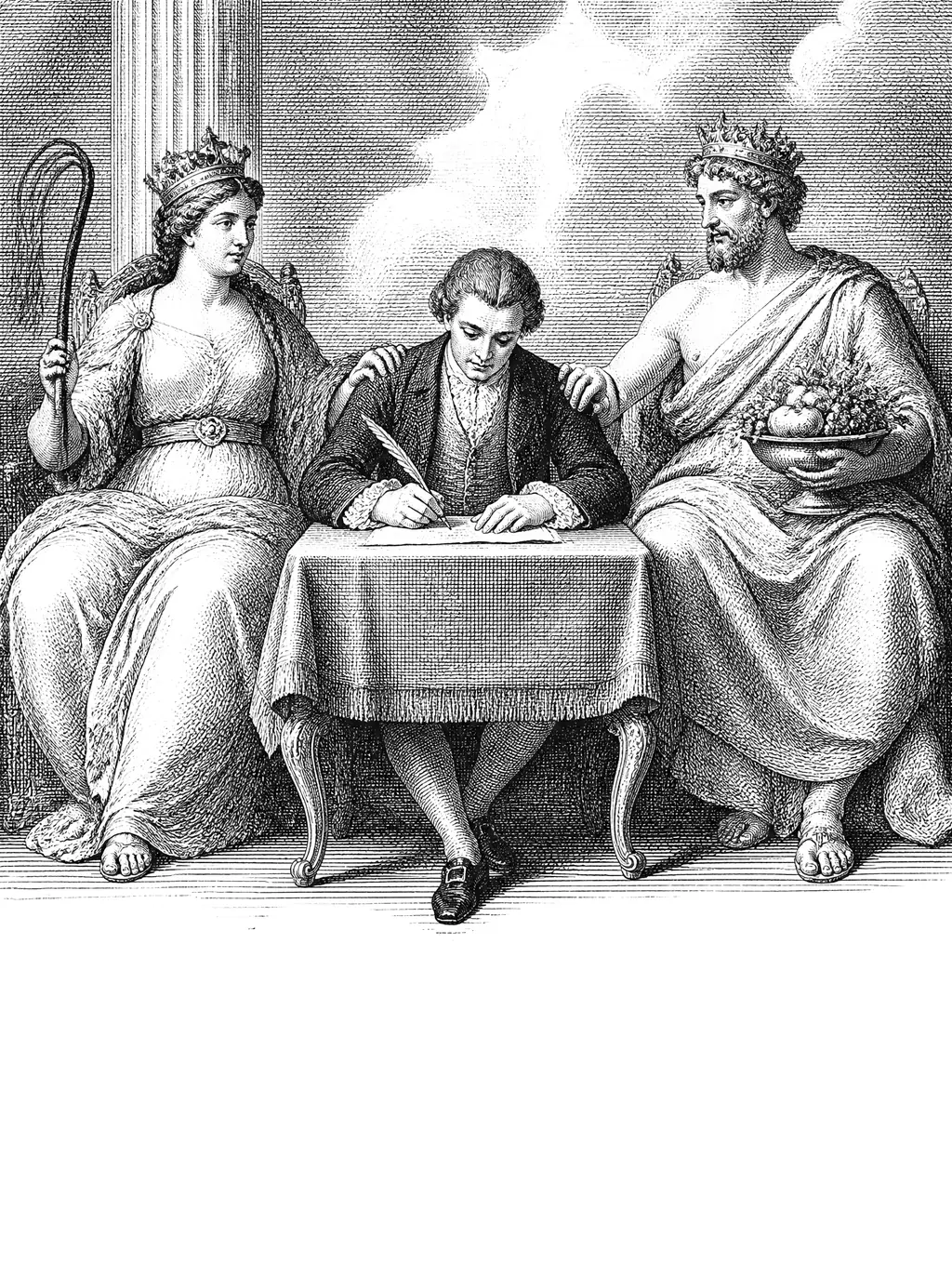
Two Sovereign Masters
A blunt opening line
Most ethical systems begin with an ideal, duty, virtue, divine command, and work outward from it. Bentham began instead with an observation about how human beings actually operate underneath all their stated ideals, treating pleasure and pain as the two forces that, whatever people claim to believe, are already quietly deciding what they do and what they think they ought to do. He wrote that sentence in 1780 and never softened it. Everything else in his system, the calculus of pleasures, the legal reforms, the model prison, follows from that one refusal to look away.
The world it came from
Bentham was born in London in 1748, a prodigy who entered Oxford at twelve and trained as a lawyer at Lincoln's Inn. He never practiced. What he found in English law disgusted him: a tangle of precedent, legal fictions, and fees that served lawyers rather than the people caught in it. His first book, in 1776, attacked William Blackstone, the great celebrator of that system. An Introduction to the Principles of Morals and Legislation was printed in 1780 and published in 1789, the year the Bastille fell. Its purpose was not abstract ethics. Bentham wanted a standard by which every law could be tested and rewritten, and he needed that standard to rest on something no lawyer or bishop could dispute.
The idea
Pain and pleasure are the sovereign masters governing everything humans do and everything they judge to be right or wrong. Any system of ethics that pretends to override these masters entirely is, on Bentham's view, only fooling itself about its own foundations. The honest move is to build morality directly on top of pleasure and pain, systematically, rather than dress up the same forces in nobler language. From this he draws the principle of utility: approve of an action in proportion as it tends to increase the happiness of those affected, and disapprove as it tends to diminish it. The interest of the community is nothing but the sum of the interests of its members.
How the reasoning runs
Step one is descriptive: watch what people do, and pleasure and pain explain it. Step two turns to language: when someone calls an act right or wrong, ask what they mean. Bentham says every answer that is not utility comes down to a private feeling dressed as a principle, what he calls the principle of sympathy and antipathy. Step three: a standard that rests on private feeling cannot settle disputes, because your feeling and mine can differ with no way to adjudicate. Step four: pleasure and pain are shared by everyone and, in principle, measurable by intensity, duration, certainty, and extent. Therefore the only standard that can do the work a standard must do is the one that counts them.
Seen in life
You sit on a committee deciding whether the town should ban skateboards from the square. One member calls it unseemly. Another says young people have a right to public space. A third quotes scripture. Bentham would stop the meeting. Unseemly is a report of your own discomfort. A right, without a law behind it, is a wish in fancy dress. Ask instead: how many people are annoyed, how badly, how often, and how many are delighted, and for how long? The answers may be hard to get. But they are at least answers, and the meeting can argue about evidence rather than trade adjectives until the loudest voice wins.
Why it matters
This grounds ethics in something measurable and universal rather than in contested claims about duty or virtue that different cultures and eras define very differently. If pleasure and pain really are the common currency underneath every moral judgment, then in principle actions could be compared and evaluated using a shared, calculable standard rather than competing, unresolvable intuitions. It also makes ethics reformable. If a law causes more pain than it prevents, the law is wrong, whoever made it and however old it is. Bentham used that lever against the criminal code, the prisons, and the treatment of animals, whom he included on the plain ground that they too can suffer.
“Nature has placed mankind under the governance of two sovereign masters, pain and pleasure. It is for them alone to point out what we ought to do, as well as to determine what we shall do.”
From the source
Bentham opens his book with the claim stated as plainly as possible: “Nature has placed mankind under the governance of two sovereign masters, pain and pleasure. It is for them alone to point out what we ought to do, as well as to determine what we shall do.” The sentence opens the first chapter of An Introduction to the Principles of Morals and Legislation. Bentham goes on to say that the two masters govern us in all we do, in all we say, in all we think, and that every effort to throw off their yoke only demonstrates and confirms it. He then names the principle of utility as the system that recognizes this subjection and builds on it.
The pushback
Critics have long objected that reducing all of morality to pleasure and pain flattens real differences in kind, treating the satisfaction of cruelty and the satisfaction of compassion as merely different amounts of the same currency. Later utilitarians, including Mill, tried to answer this by distinguishing higher, more valuable pleasures from lower ones, a distinction Bentham's original framework does not clearly provide. A harder objection comes from Bentham's own method. Pleasures cannot in fact be measured on a common scale; nobody has ever weighed an hour of music against a week of relief from toothache. If the calculus cannot be run, the standard that was supposed to replace intuition is itself a guess.
The reply
Bentham's reply to the flattening charge is to bite: pushpin is as good as poetry if the quantity of pleasure is equal, and the disgust you feel at that sentence is just the sympathy principle talking. Mill thought this cost too much and introduced higher and lower pleasures, at the price of admitting a standard other than quantity. To the measurement charge the tradition answers that rough comparison is what legislators do anyway; a stated calculus at least makes the guess explicit and correctable. That is a partial answer. It shows the calculus is no worse than the alternatives, not that it delivers the precision Bentham promised.
Where it went next
James Mill became Bentham's closest ally, and John Stuart Mill, raised inside that circle, gave utilitarianism its most famous defense in 1863 while quietly revising the master. The Philosophic Radicals carried Bentham's method into Parliament, and the reform of the prisons and the criminal code owe him a debt. Henry Sidgwick systematized the theory; welfare economics turned it into mathematics. In 1997 Daniel Kahneman revived Bentham's phrase, experienced utility, as a research program in psychology. Peter Singer's animal ethics starts from Bentham's line that the question is not whether animals can reason but whether they can suffer. Bentham's preserved body still sits in a cabinet at University College London, as he requested.
Where this leads
The greatest happiness principle is Mill's own direct refinement of exactly this same foundation, keeping Bentham's basic currency of pleasure and pain intact while working hard to fix the flattening problem his blunter, earlier version had left wide open for critics. Pleasure is the absence of pain is the older hedonism Bentham inherited and then turned inside out: Epicurus wanted to stop counting once calm was reached, whereas Bentham wanted to count everything and add it up. Read the three together as a single argument about whether pleasure is one thing, and whether it can be summed.