Symposium · Eastern Philosophy · Pl. 12Mencius · c. 372 – c. 289 BC
Righteousness Over Profit
A question refused
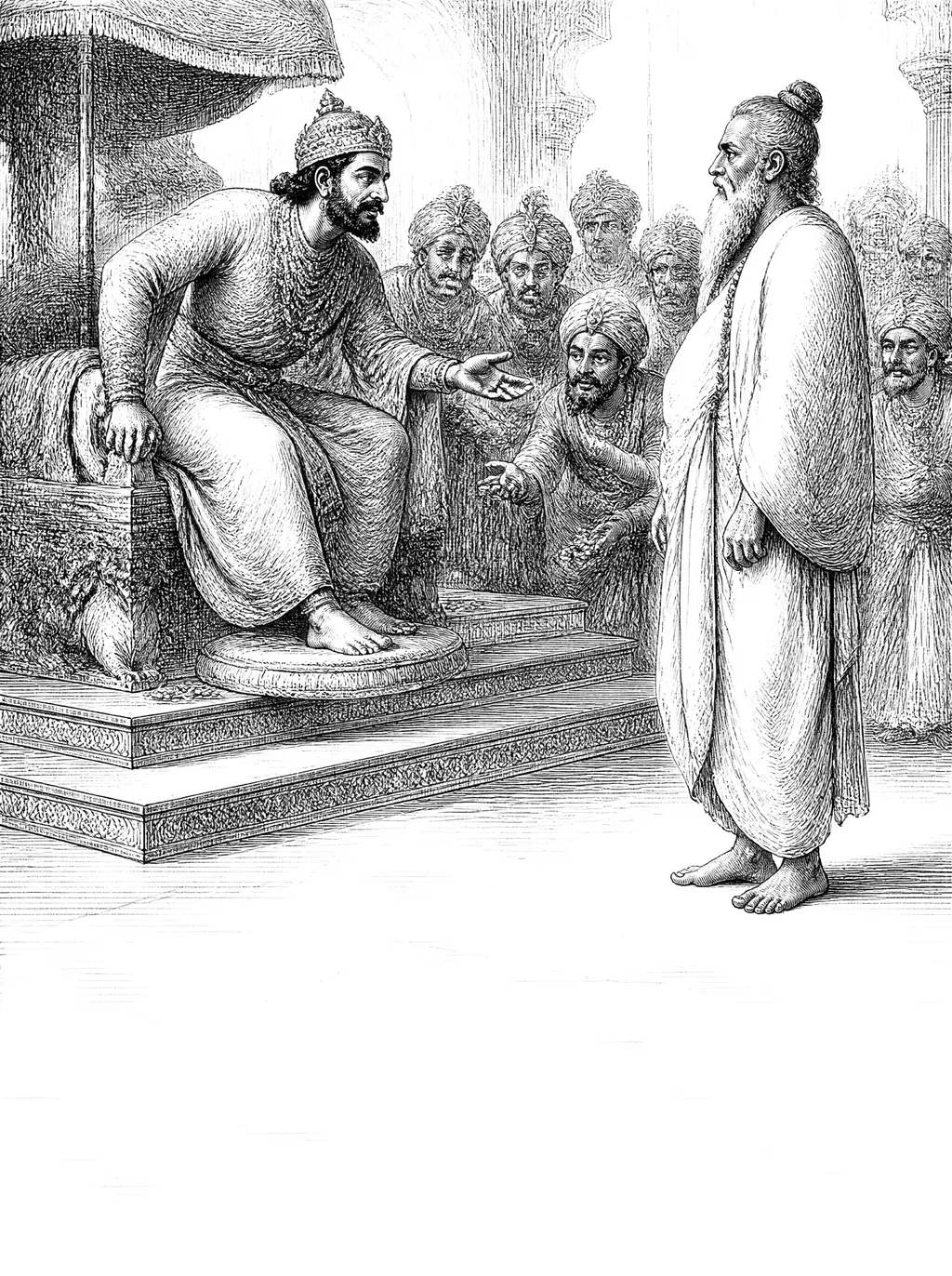
King Hui of Liang welcomes Mencius after a thousand-li journey and asks, reasonably enough, what wisdom the philosopher brings to profit his kingdom. Mencius does not answer the question as asked. He rejects the frame entirely, and spends his reply explaining why a kingdom run on the pursuit of profit is already in trouble. The exchange opens the whole book of Mencius. Whoever arranged the text wanted a reader's first encounter with the philosopher to be a refusal, and wanted the king's question to sound, by the end of the page, like a confession.
The world it came from
Mencius, or Mengzi, lived from about 372 to 289 BC, a century after Confucius, in the Warring States period, when seven major kingdoms fought for supremacy and hired wandering advisers to help them win. King Hui of Liang ruled the state of Wei, which had lost wars and territory and moved its capital east to Daliang. He wanted counsel that would restore his strength. The market for advice was crowded. Mohists argued openly for benefit, li, as the measure of every policy; Legalists such as Shang Yang were making Qin rich and terrifying; strategists sold alliances. Mencius arrived as a Confucian, and the first thing he did was refuse the vocabulary. The passage opens Book 1A, and it sets the terms for everything after.
The idea
If the ruler asks how to profit his kingdom, officers will ask how to profit their families, and commoners will ask how to profit themselves, until superiors and inferiors are all grasping the same limited profit from each other and the kingdom is endangered. Put righteousness last and profit first, and no one stops until they have taken everything. The claim is causal, not moral only. Profit-seeking at the top is a signal that changes behaviour all the way down, and a kingdom of imitators has no reason to stop short of the king himself.
How the reasoning runs
Begin with how authority works: subordinates copy the ruler's stated priorities. Second, suppose the priority is profit. Then every level asks the same question, how do I gain, and the only people to gain from are the levels beside and below, since wealth is not unlimited. Third, notice what that produces: a hierarchy in which each rank is a resource for the rank above and a threat to the rank below. Fourth, ask what holds such a structure together. Nothing but force, and force invites the strongest to seize the whole. Fifth, contrast the alternative. A ruler who leads with benevolence and righteousness teaches subordinates that their standing depends on serving, not taking. Prosperity, Mencius adds, follows from that; it cannot be aimed at directly.
Seen in life
The new CEO's first all-hands has one slide: revenue per employee, and the number it has to reach. Within a quarter the sales team is booking deals it knows will churn, because the bonus is on bookings. Middle managers hoard headcount, because headcount is leverage. Engineers stop fixing what does not show up in a metric. Nobody is doing anything the slide did not ask for. Two years later the company is a set of people extracting value from each other, and the CEO cannot understand why the culture went bad. Mencius would say it went exactly where it was pointed. The question you lead with is the question the whole organisation learns to ask.
Why it matters
This names a cascading effect that a narrower focus on any single transaction misses: once the top of a hierarchy models profit-seeking as the highest value, that same logic reproduces itself at every level below it, until the entire structure is competing for the same shrinking pool rather than cooperating toward anything larger. It also warns against a tempting shortcut. Leaders often assume they can set profit as the target and add values later. Mencius says the order of the two words is itself the policy, and that the order gets copied.
“If righteousness be put last and profit first, they will not be satisfied without snatching all.”
From the source
Mencius states the warning directly: “If righteousness be put last and profit first, they will not be satisfied without snatching all.” He offers benevolence and righteousness instead as the king's only proper themes, not as sentiment, but as the actual precondition for a kingdom's stability. James Legge translated this passage in 1861, and the Chinese contrast is between yi, rightness, and li, profit or benefit. The dialogue continues: a ruler who is benevolent will not abandon his parents, one who is righteous will not put his sovereign last. So the king should speak only of benevolence and righteousness, and leave profit unsaid.
The pushback
Isn't some pursuit of profit simply realistic, the engine that keeps a kingdom, or an economy, functioning at all, however imperfectly it is managed? Mencius is not condemning prosperity itself; his target is a ruler who leads with profit as the explicit organizing value, which he predicts corrodes the trust holding the whole hierarchy together from the top down. Push further. Mencius offers no mechanism for feeding people except the king's virtue. A ruler who ignores grain prices and tax rates on principle will lose the kingdom to one who does not, and then his righteousness feeds no one.
The reply
The second objection misreads the book. Later in the same conversation with King Hui, Mencius lays out land policy, planting schedules, fishing rules, and the age at which people should be able to eat meat. He wanted prosperity and said so. His claim is about order: secure people's livelihood first, because a hungry people cannot be righteous, but do not make gain the ruler's own announced aim, because that is what teaches the court to prey. Where the reply is only partial is in evidence. Mencius asserts the cascade; he does not show it. And his own life is a counter-example of a kind: no king took his advice, and the state that ignored him most completely, Qin, won.
Where it went next
Xunzi, a generation later, agreed about profit but trusted ritual rather than the heart to check it. Han Yu revived Mencius in the Tang; Zhu Xi made the book one of the Four Books in the twelfth century, and from 1313 to 1905 every candidate for the imperial examinations memorised this opening passage. The contrast between yi and li became the standing vocabulary for Chinese debates about commerce, and merchants in the Ming and Qing dynasties wrote defences of trade in exactly those terms. Modern echoes are easy to find: arguments that a market norm crowds out a moral one, as in Michael Sandel's work, run on Mencius's cascade without citing it. Mission statements that put purpose before profit are quoting him, knowingly or not.
Where this leads
The categorical imperative arrives at a related warning from Kant, insisting people be treated as ends rather than mere means, a distinction Mencius's whole kingdom collapses the moment profit alone becomes what everyone, at every level, is chasing from everyone else. Kant's rule is about single acts and Mencius's is about a whole hierarchy over time, but both name the same failure: a person reduced to a source of gain. Mencius adds what Kant leaves out, which is that the reduction spreads.