Symposium · Eastern Philosophy · Pl. 19Laozi · 6th century BC (traditional)
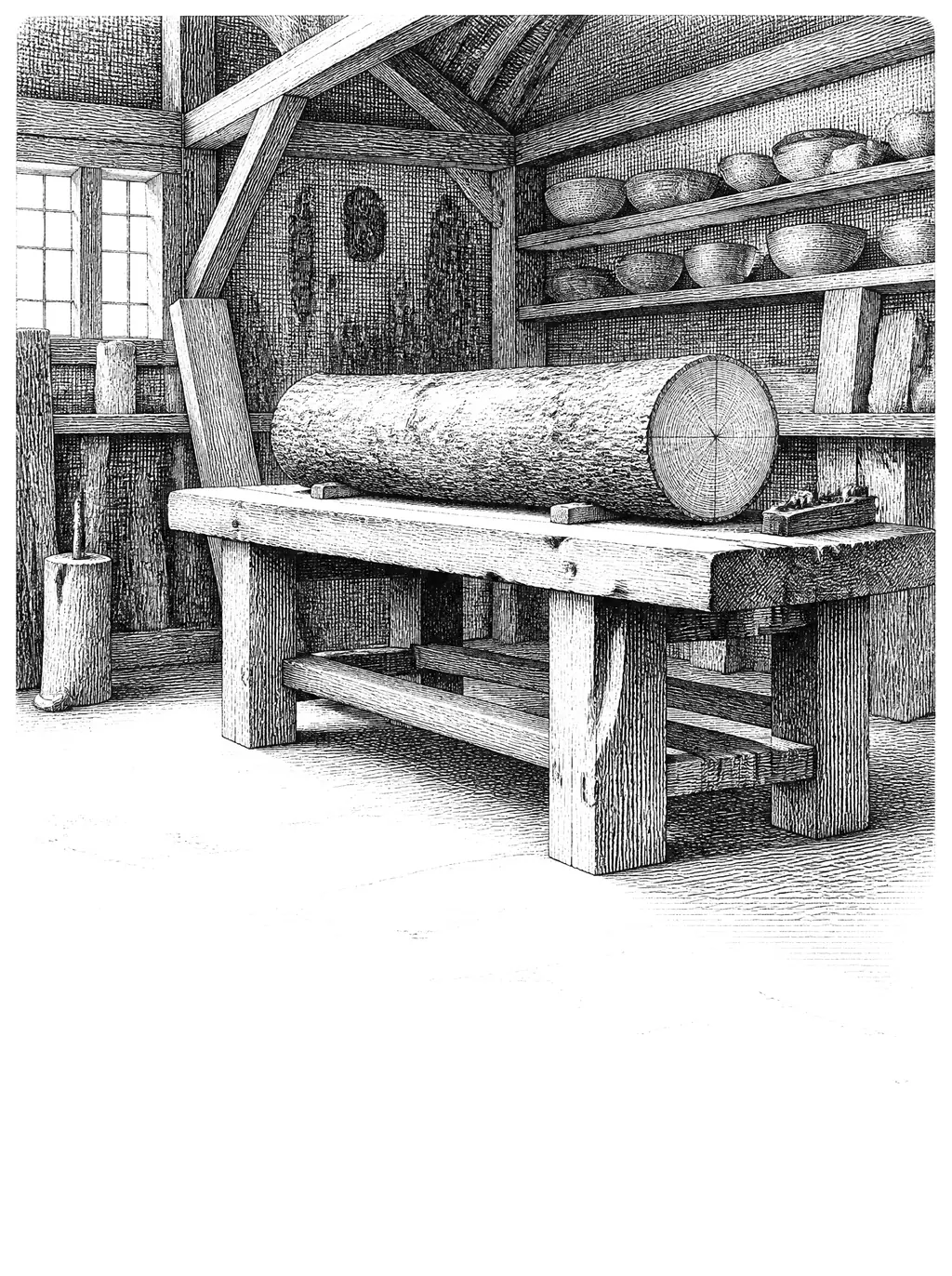
The Uncarved Block
Before the carving starts
Walk into any workshop and you will find raw material everywhere being shaped, named, and put to use: this block becomes a bowl, that one a beam. Laozi noticed that once material is carved, it can only ever be the one thing it was carved into. Before the carving, it could still become anything at all. The word is pu, and it names raw wood before the carpenter reaches it. The Tao Te Ching uses it as an image for a person, and for a state, that has not yet been cut down to a purpose.
The world it came from
The Tao Te Ching is a short text of eighty-one chapters, traditionally credited to Laozi, an archivist of the Zhou court whose historical existence was already uncertain to the historian Sima Qian around 100 BC. Most scholars treat it as a compilation of the fourth and third centuries BC, the Warring States period. Pu appears in several chapters, including 19, 28, 32, and 37, always as the plain state to be returned to. The rival image is Confucian. Confucius said a gentleman is not a vessel, meaning a cultivated person is not a tool for one use. Laozi goes further: the cultivation itself is the carving. Chapter 28, quoted here, is addressed to a ruler, and tells him what the plain state looks like in government.
The idea
The uncarved block, pu, stands for a simplicity that has not yet been narrowed down into a fixed role, title, or function. A person who stays close to this uncarved state keeps their full range of possibility intact, rather than trading it away early for the usefulness and status that comes with being carved into one specific shape. The block is also the sage's model for governing. A ruler close to pu does not carve the people into instruments either; he leaves them simple, and chapter 37 says they then transform themselves.
How the reasoning runs
Start with the workshop fact: raw wood can become any vessel, and a finished vessel can become nothing else. Carving is a gain in one use and a loss of every other. Second, apply it to a person. Each role you take, each name you accept, is a cut; useful, and irreversible in the same way. Third, ask what is lost. Not ability, but range. Fourth, ask what the Tao Te Ching values. Not use but life, and the text says elsewhere that what is stiff is dead and what is supple is alive. Fifth, conclude: stay near the block. Take on roles lightly, hold names loosely, and govern others so that they can too.
Seen in life
At twenty-two you have a degree, a job title, a LinkedIn headline, and a sense that the carving has started. Every conversation asks what you do, and the answer is getting shorter and more confident. Ten years on, you are excellent at the one thing and cannot remember why you chose it, and the people you admire most are the ones who somehow stayed strange. Laozi is not telling you to refuse the job. He is telling you to notice which cuts are permanent. Keep the parts of yourself that do not fit the title, the drawing, the odd friendships, the questions with no career value. That uncarved remainder is where the next shape will come from, if you have not already sold it for the first one.
Why it matters
Modern life pressures people to specialize early, carve themselves into a career, a brand, a role, before they have any real sense of what they actually are underneath it. The uncarved block suggests there is real value, not just inefficiency, in staying unshaped a while longer, resisting the rush to become useful in one narrow way too soon. It also names a loss that success hides. The more perfectly you fit a role, the less of you there is outside it, and the text counts that as a cost even when the role is good.
“The unwrought material, when divided and distributed, forms vessels. The sage, when employed, becomes the Head of all the Officers of government; and in his greatest regulations he employs no violent measures.”
From the source
The Tao Te Ching describes the uncarved material directly: “The unwrought material, when divided and distributed, forms vessels. The sage, when employed, becomes the Head of all the Officers of government; and in his greatest regulations he employs no violent measures.” This is chapter 28 in James Legge's 1891 translation. Legge's unwrought material is pu; other translators write uncarved block or raw wood. The chapter builds to it through a series of returns: to the infant, to the limitless, to simplicity. Chapter 19 gives the practical version, to hold to the plain and embrace the simple, and to have few desires.
The pushback
Doesn't refusing to be carved into anything just mean staying useless, avoiding the commitment that any real skill or role actually requires? Laozi is not against usefulness itself; his sage still governs. The warning is against carving so early and so completely that nothing of the original, adaptable simplicity survives the process. Harder: a block is not a person. People become themselves by choosing and committing, and a life that keeps every option open is not free but unformed. The image praises a potential that is only worth anything once it is spent.
The reply
The text has no theory of commitment and does not pretend to. Its reply is the sage, who does govern, and the line in chapter 28 that he uses no violent measures: the point is not to refuse the shape but to take it without cutting away what is not needed for it. That answers the first objection and half of the second. The other half stands. Laozi wrote for rulers who were about to be carved by their office whether they liked it or not, and his advice is about how to hold power lightly, not about how a young person should find a vocation. Zhuangzi, a century later, pushed the image harder and wrote about the potter and the carpenter maiming clay and wood.
Where it went next
Wang Bi, commenting in the third century, made pu a philosophical term for the original simplicity underlying all named things, and the Neo-Daoists took it as a warning against careerism at court. Religious Daoism, from the second century AD, adopted the return to simplicity as a practice. Zhuangzi's chapter on horses' hooves is the image at its fiercest. In the West the block became famous through Benjamin Hoff's The Tao of Pooh, in 1982, which cast Winnie-the-Pooh as the uncarved block and sold the idea to a generation in a form Laozi would not have recognised but might have enjoyed. The Confucian gentleman who is not a vessel and the Daoist block that becomes vessels are still the two classical Chinese answers to the question of what education is for.
Where this leads
Existence precedes essence reaches a related conclusion from an entirely different tradition: you are not handed a fixed nature to be carved into on arrival, and the uncarved state Laozi describes has its own echo in Sartre's insistence that you build your essence only afterward, through choice. The difference is the carver. Sartre puts the knife in your own hand and tells you to cut, and to own every cut. Laozi asks you to wonder, before you do, what the block was worth uncut.