Symposium · Eastern Philosophy · Pl. 15Laozi · 6th century BC (traditional)
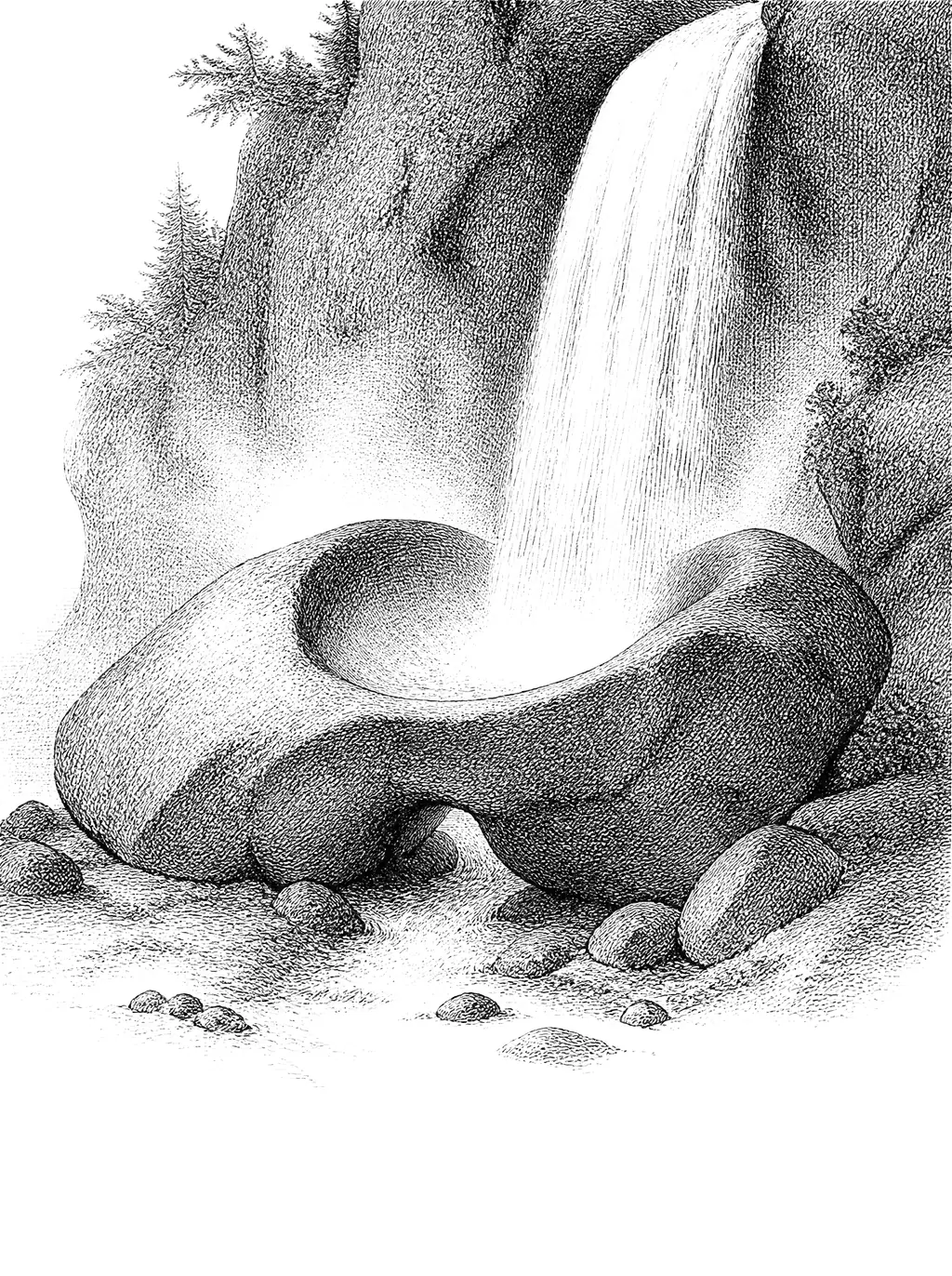
The Softest Overcomes the Hardest
A weapon with no edge
Water has no shape of its own, no cutting edge, no force it can summon by tensing a muscle. Poured into any container, it simply takes that container's form. Laozi pointed to exactly this softness as proof of something counterintuitive: given time and persistence, nothing hard can permanently resist something this yielding. The Tao Te Ching returns to water again and again. It benefits everything and competes with nothing. It settles in the low places others despise. It is the image the text reaches for whenever it wants to describe real strength.
The world it came from
The Tao Te Ching is a short text of about five thousand characters in eighty-one chapters. Tradition names Laozi, an archivist at the Zhou court, as its author, and the historian Sima Qian, writing around 100 BC, already admitted he was unsure who Laozi was. Most scholars now read it as a compilation from the fourth and third centuries BC, the Warring States period, when small kingdoms armed, taxed, and swallowed each other. Manuscripts found at Guodian and Mawangdui show the text was still shifting around 300 BC. Its audience was rulers and advisers. Against Confucians preaching ritual, Mohists preaching organised effort, and Legalists preaching force, the text argued that the ruler who yields lasts longer than the one who pushes. Chapter 78 is that argument in one image.
The idea
The softest, weakest thing in the world, water, can attack and wear down the firmest and strongest things, and nothing can take its place for that purpose. Everyone knows the soft overcomes the hard and the weak overcomes the strong, Laozi observes, yet almost no one is actually able to live by that knowledge in practice. Water wins by persistence and by shape. It does not resist the rock; it goes around, under, and through, and it never stops arriving. That combination, yielding and relentless, is what the text means by soft.
How the reasoning runs
First, observe the facts. Water is the softest common thing; it takes any shape and resists nothing. Yet canyons are cut by rivers and cliffs are eaten by tides. Second, ask how. Not by force at any moment, but by persistence across every moment: the rock has to hold out always, the water has to win only once, and it comes back every day. Third, notice what hardness costs. Chapter 76 adds the observation: living things are soft and supple, dead things are stiff and dry. Rigidity is the mark of what is already finished. Fourth, generalise. Whatever meets pressure by hardening will eventually crack; whatever meets it by yielding survives and keeps working. So the soft outlasts the hard, and outlasting is how it overcomes.
Seen in life
Your teenager has stopped talking to you. Every attempt to force the conversation, the sit-down, the ultimatum, the confiscated phone, produces a harder silence. Try water. Stop pushing. Be in the kitchen when they come in, say one ordinary thing, and let the silence be theirs. Drive them where they need to go and do not fill the car with questions. Do this for weeks, without a scoreboard. One evening they say something real, unprompted, because the pressure they were bracing against has gone and the space is still there. You did not win the argument. You outlasted the wall, which is the only way the text thinks walls come down.
Why it matters
Most people meet resistance with more force, escalating rigidity against rigidity until something breaks. This idea offers a different model of strength entirely: persistent, adaptable pressure that yields around obstacles rather than smashing through them, wearing down what rigid force alone cannot move, simply because it never stops finding a way through. It also changes how you read a stalemate. If you are grinding against something that will not move, the text does not say push harder or give up. It says stop being the thing that has to break.
“There is nothing in the world more soft and weak than water, and yet for attacking things that are firm and strong there is nothing that can take precedence of it.”
From the source
Laozi states the principle in the Tao Te Ching: “There is nothing in the world more soft and weak than water, and yet for attacking things that are firm and strong there is nothing that can take precedence of it.” This is chapter 78 in James Legge's 1891 translation. The chapter goes on to say that everyone in the world knows this and no one can practise it, and then gives the practice a political form: whoever accepts the reproach and the misfortune of the state is fit to be its lord. The soft ruler takes the blame first. Chapter 43 makes the same claim in a shorter form.
The pushback
Isn't this just a comforting story for the powerless, telling the weak to feel strong while the genuinely strong keep winning? Laozi's answer is that softness is not weakness in the ordinary sense; it is a different, slower kind of power, one that outlasts brittle strength precisely because rigid things eventually crack under pressure that adaptable things simply absorb. A harder version: water also floods. Persistence that never stops is not gentleness; it is the strategy of an occupier who simply outlasts the resistance. The image praises a kind of pressure that can be used by whoever has the most time.
The reply
The text has no real answer to the flood. Its author wrote for rulers, and a ruler who yields, absorbs, and outlasts is still a ruler using a strategy. What the text offers is a description of which strategy lasts, not a guarantee that the lasting side is the good one. The reply to the first objection is stronger. The claim is not that the weak feel strong; it is that rigid strength has a short life, which the Warring States kingdoms demonstrated by destroying each other. Softness is a bet on time. Where you have time, the bet is good. Where you do not, where the wall falls on you before you wear it down, the image gives you nothing. Laozi is honest that few can live by it.
Where it went next
Inside China the image fed the martial arts. Taijiquan's principle of yielding to redirect, and the saying that four ounces deflect a thousand pounds, are Daoist water put into the body. In Japan, Kanō Jigorō named his art judo, the gentle way, in 1882, on the related principle that giving way defeats force; the lineage is Japanese, but the idea is the same. Bruce Lee told an interviewer in 1971 to be water, and the phrase became a slogan again in Hong Kong's 2019 protests, whose tactics were fluid by design. Beyond the arts, the chapter is often read alongside nonviolent resistance, though Gandhi and King drew their ideas from other sources. Ursula K. Le Guin's 1997 rendering brought the text to a new generation of readers.
Where this leads
Wu wei is the discipline this water metaphor is actually describing, its practical twin: acting with the same yielding, unforced persistence that water shows against stone, rather than meeting every obstacle in your path with more strain and even more force. The obstacle is the way approaches the same wall from Rome and tells you to use it as fuel for effort. Laozi says the opposite: the effort is the problem. Put the two side by side and you have a real choice about what strength is.