Symposium · Eastern Philosophy · Pl. 20Laozi · 6th century BC (traditional)
Wu Wei
The paradox at the center
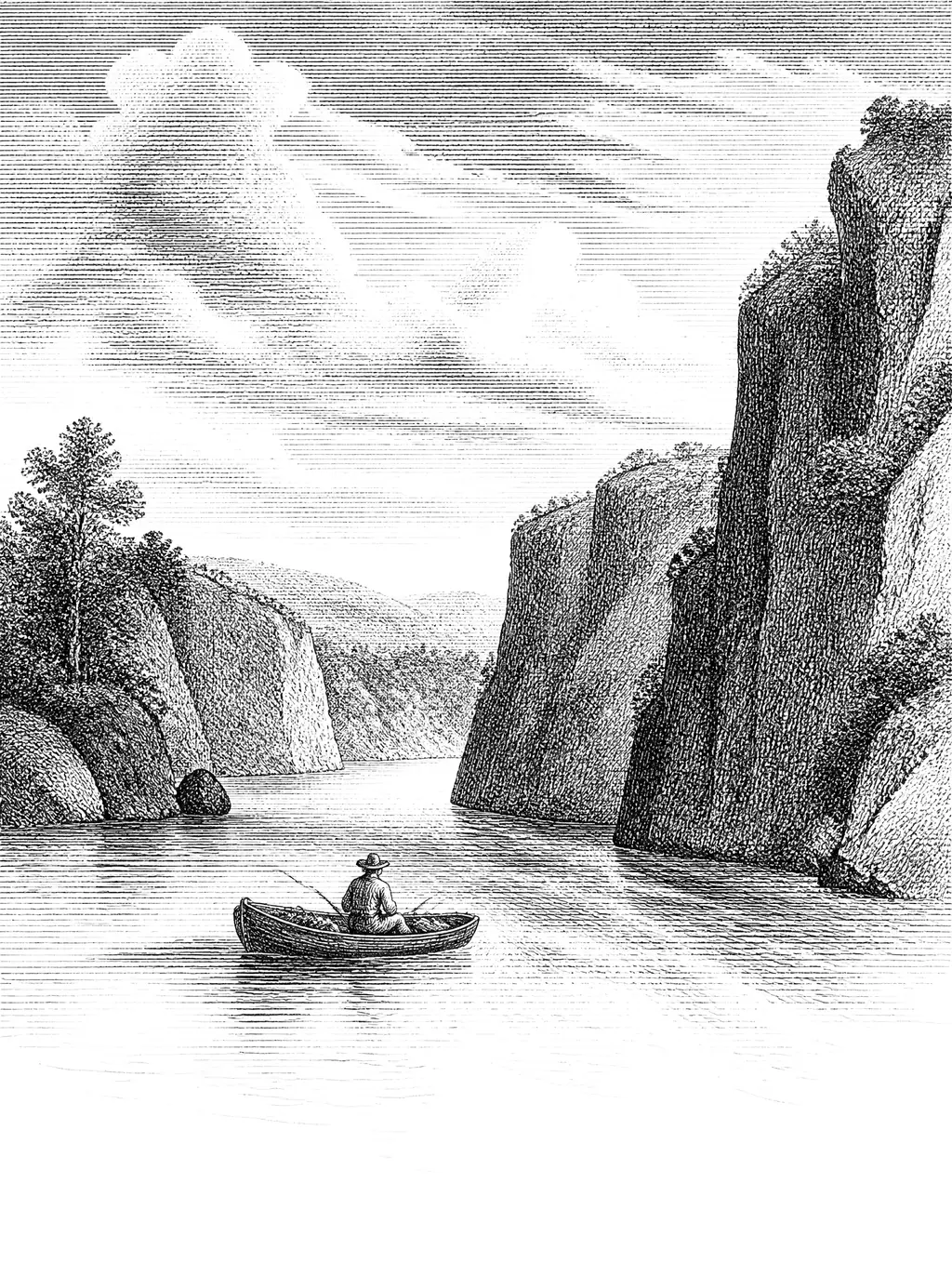
A river carves a canyon without lifting a tool. A seed becomes a forest without a plan filed anywhere. Laozi looked at how nature accomplishes enormous things without visible strain or striving, and asked why human effort so often works against itself instead of moving with the same quiet, unforced current. The phrase is two characters, wu wei, no doing, and it is one of the oldest ideas in Chinese thought. It was never a counsel to lie down. It was a description of how the best work gets done, and a warning about how most work does not.
The world it came from
The Tao Te Ching is eighty-one short chapters, about five thousand characters, traditionally credited to Laozi, an archivist of the Zhou court. Modern scholars date the text's compilation to the fourth and third centuries BC, the Warring States period. Its reader was a ruler, and the question was how to govern a state without exhausting it. Confucians answered with ritual and moral example, Mohists with organised effort, Legalists with law and force. Wu wei was the Daoist answer, and not theirs alone: the Analects use the phrase for the sage-king Shun, who ruled by sitting reverently facing south, and the Legalist Han Feizi later used it for a ruler who lets ministers act and watches. Chapter 37 is the Daoist version.
The idea
Wu wei means action without forcing, effort that does not fight the shape of the situation it is acting inside. It is not laziness or passivity. It is a way of acting so precisely aligned with how things actually work that no excess motion, no straining against the grain, is needed to get the result. The nearest English is effortless action, but effortless is misleading. The effort is real; it is spent on reading the situation, not on overpowering it. What is absent is the strain of working against the grain.
How the reasoning runs
First, observe how large natural results happen. A river reaches the sea, a seed becomes a tree, a season turns, and none of it involves forcing. Each thing follows its own tendency, and the tendencies add up. Second, observe how human effort usually fails. We decide what should happen, push toward it, and the pushing generates resistance. Third, locate the error. It is not the goal; it is the mismatch between our action and the situation's shape. Fourth, describe the alternative. Read the shape first, then act at the point and moment where a small move produces the whole result. Fifth, generalise to rule. A ruler who does this does little and the state runs. Nothing is left undone because nothing was fought.
Seen in life
You have a paragraph that will not come. You have been at it for an hour, deleting and rewriting, and each version is worse. Stop pushing. Go for a walk, and halfway round the block the sentence arrives whole, because the part of you that writes was working the whole time and only needed you to stop standing on it. That is wu wei in the smallest possible case. Now scale it up. A manager who tries to force a change through a reluctant team gets compliance and resentment. One who finds the two people who already want the change and clears their path gets the change, and it looks, from outside, as if she did nothing. Nothing was done against the grain. Everything got done.
Why it matters
Most struggle comes from pushing against a situation instead of reading its actual shape first. A river finds the sea without forcing a straight line through solid rock; it goes around. Wu wei asks you to notice where you are grinding effort against a wall that a slightly different angle would let you simply flow past. It also gives you a diagnostic. When something takes far more effort than it should, the text says the effort itself is the symptom. Stop and read the situation again before you push, because the pushing is usually what is holding the wall up.
“The Tao in its regular course does nothing (for the sake of doing it), and so there is nothing which it does not do.”
From the source
In the Tao Te Ching, Laozi writes: “The Tao in its regular course does nothing (for the sake of doing it), and so there is nothing which it does not do.” Princes and kings who could hold to this, he adds, would see all things transform themselves. This is chapter 37 in James Legge's 1891 translation. Legge's parenthesis, for the sake of doing it, is his gloss: the Chinese says only that the Tao constantly does nothing and nothing is left undone. Chapter 48 gives the practice, to lose something every day until you arrive at doing nothing, and chapter 57 gives the politics, where the ruler does nothing and the people transform themselves.
The pushback
Doesn't doing nothing sound like an excuse for never acting at all, a philosophy convenient for avoiding hard work? Wu wei is not the absence of action; it is the absence of strained, self-defeating action. A martial artist redirecting an opponent's force is not doing nothing. He is doing exactly enough, precisely aimed. The harder objection is political. A ruler who does nothing and lets things transform themselves is either a fiction or a ruler whose ministers do the ruling, which is exactly how the Legalists used the same phrase. Wu wei can be a cover for whoever actually holds the levers.
The reply
The first objection the text answers with the sage, who acts constantly and lightly, and with the martial artist's example: precision, not absence. The second is fair and the tradition split over it. Han Feizi made wu wei a technique of control, the ruler silent so that ministers reveal themselves; the Daoist text meant something else, a ruler who refuses to carve the people, but it never explained how that ruler stays a ruler. The honest reply is that wu wei describes a way of acting and says nothing about who should be acting or to what end. Later Daoists retreated from the court entirely, which is one answer, and the Han emperors who governed by wu wei kept large armies, which is another.
Where it went next
Zhuangzi turned wu wei into stories: the cook whose knife never dulls because it follows the spaces in the ox, the swimmer who goes with the water. The early Han emperors governed by it for two generations under Huang-Lao teaching. Wang Bi read it philosophically; religious Daoism made it a discipline of the body; Chan Buddhism absorbed its distrust of striving. Taijiquan is wu wei as movement. In the West, Alan Watts made it a byword in the 1950s, and the psychologist Mihaly Csikszentmihalyi's flow, described in 1990, is a modern cousin. Edward Slingerland's Trying Not to Try, in 2014, brought the classical debates to a general readership and argued that the paradox of trying to be spontaneous was the central problem of early Chinese thought.
Where this leads
The dichotomy of control reaches a similar peace from a more analytical direction, sorting what is yours to command from what is not, while wu wei asks you to also stop fighting the shape of the part that is yours. Epictetus sorts and then tells you to work hard on your pile. Laozi looks at the pile and asks whether the hard work is the problem. A reader who holds both has a complete kit: know what is yours, and then do not force even that. The two rarely disagree about what to do next. They disagree about how much strain it should take.