Symposium · Existentialism · Pl. 6Jean-Paul Sartre · 1905–1980
Existence Precedes Essence
No blueprint
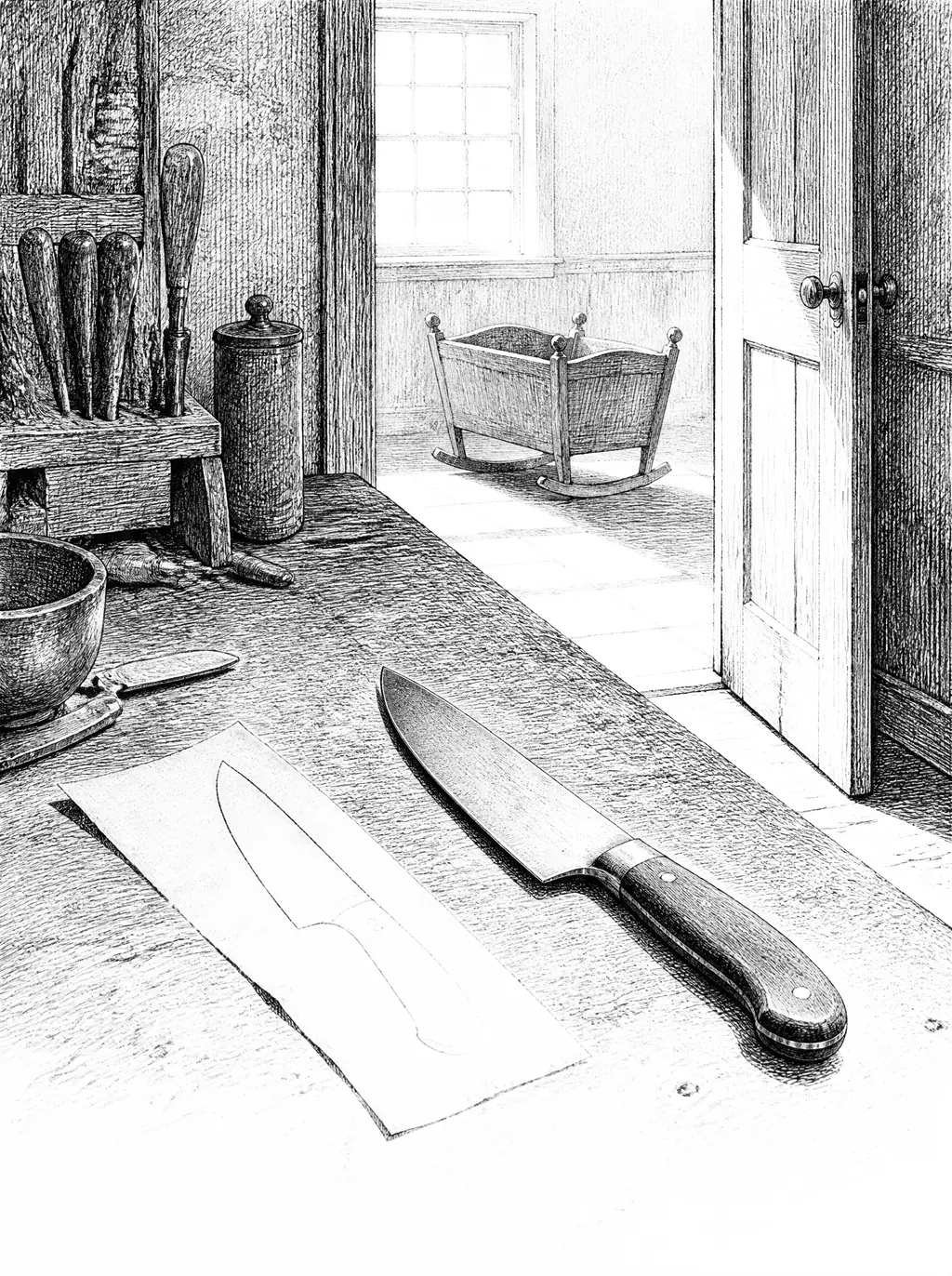
A knife's purpose exists before the knife does; a craftsman imagines the cutting first, then shapes the metal to fit. Sartre's claim is that a person is nothing like the knife. You show up first, with no design behind you, and no factory spec to meet. The lecture in which he said this was given in Paris in October 1945, to a hall so crowded, by contemporary accounts, that chairs were broken and people fainted. He had meant to explain existentialism to its critics. Instead he gave it a slogan, and the slogan outlived everything else he said that night.
The world it came from
Sartre gave the lecture Existentialism Is a Humanism on 29 October 1945 at the Club Maintenant in Paris, two months after the war ended. He was forty, a former prisoner of war, and suddenly famous: Being and Nothingness had appeared in 1943, and his plays had run under the occupation. Existentialism was under attack from both sides, by Catholics as despair and by Communists as bourgeois quietism, and the lecture was his defense. Sartre later regretted its simplifications, but it became the most read thing he ever wrote. The knife example comes from it: an artisan has the concept before the object, and Sartre's claim is that for human beings there was no artisan, because there is no God to have held the plan.
The idea
Existence precedes essence means you exist first, and only afterward, through what you actually choose and do, do you become anything in particular. There is no fixed human nature sitting inside you waiting to be uncovered, and no essence you are secretly failing to live up to. Sartre puts it as a sequence. First you exist, then you encounter yourself, then you surge up in the world, and only then do you define yourself. Nothing precedes the surge except the surge. Whatever you are, you became by doing, and you are still doing it, which means the definition is never finished while you are alive.
How the reasoning runs
Begin with the artisan. A paper-knife has an essence, the plan in the maker's mind, and the object follows it. Traditional theology treated God as the artisan of humanity, so human nature came first and each person was a copy. Remove God, as the eighteenth century did, and most philosophers kept the human nature while discarding the maker, which Sartre thinks is incoherent: an essence with no one to have conceived it. Take atheism seriously instead. Then there is at least one being whose existence comes before any concept of it. That being is the human being, who first is, and afterward makes himself by what he chooses. From this follows responsibility: if nothing made you, nothing else can be blamed for what you are.
Seen in life
Someone asks what you are like, and you answer with a list: introverted, bad with money, not a morning person, the kind who avoids conflict. Now ask where each item came from. Not from a factory. Each is a summary of things you have done, repeated until it felt like a fact about you rather than a record. Sartre's claim is that the record is still open. The next avoided conflict adds a line; a conflict faced instead adds a different one. You are not discovering what kind of person you are. You are writing it, and the pen does not leave your hand until you die. The list you gave was an obituary, drafted early, and treated as a birth certificate.
Why it matters
This removes your favorite excuses. You cannot blame your genes, your childhood, or 'the kind of person you are' for what you do next, because that kind of person is itself something you keep building. Every choice writes a little more of who you are, in real time, with no eraser. It also raises the stakes of every ordinary act. Sartre argues that in choosing for yourself you choose an image of what a person should be, so nothing you do is private. The anguish he describes is the weight of that, felt honestly, and he thought anyone who did not feel it was hiding from it.
“Existence precedes essence.”
From the source
In a 1946 lecture, Sartre put the whole claim in three famous words: “Existence precedes essence.” People, unlike letter-openers and knives, are not manufactured to a plan. We turn up in the world first, and only our own choices afterward decide what we finally are. The lecture continues with the consequence. Man is nothing else but what he makes of himself; that, Sartre says, is the first principle of existentialism, and what its critics call subjectivity. He then adds the line that gives the idea its edge: man is condemned to be free, condemned because he did not create himself, and yet free because, once thrown into the world, he is responsible for everything he does.
The pushback
Critics call this exhausting: total responsibility for a self with no fixed floor sounds like a recipe for constant anxiety, with nothing solid to lean on when a decision goes wrong. Sartre does not deny the feeling. He names it anguish, and argues it is accurate, not avoidable. A second objection is harder. Biology, class, sex, and upbringing plainly do shape what a person can become, and a philosophy that says every one of them is chosen has mistaken a wish for a fact. Beauvoir herself pressed this point about women, and Sartre's Marxist critics pressed it about the poor.
The reply
Sartre's answer to the first objection is the one the lecture gives: anguish is not a symptom to be cured but the correct perception of a real situation, and the cure on offer, a fixed nature, is a fiction. To the second he has a technical term, facticity: the given circumstances of a life are real and are not chosen. What is chosen is what one makes of them. The reply is honest as far as it goes, but Sartre's own later work conceded it did not go far enough. By the 1950s he was writing that a child of the slums has a freedom so narrowed that calling it freedom is an insult, and his turn toward Marxism was partly an attempt to repair the lecture's optimism.
Where it went next
Beauvoir applied the principle to women in The Second Sex in 1949: if existence precedes essence, then no woman was born to a role. Frantz Fanon applied it to colonized people. Heidegger, whom Sartre had claimed as an ancestor, disowned the reading in his Letter on Humanism of 1947, saying that Sartre had simply reversed a metaphysical formula and remained inside metaphysics. Viktor Frankl's logotherapy took the therapeutic version: a person is what he decides to be, even in a camp. The slogan outlived the movement, and by the 1960s it had become a general vocabulary for authenticity in psychology, theatre, and the counterculture, most of whose users had not read the lecture and would have been surprised by its anguish.
Where this leads
Bad faith is Sartre's name for the main way people flee this responsibility: by pretending they had no real choice at all, that their role, their upbringing, or their past already made the decision for them, long before they ever showed up. Amor fati approaches the same freedom from the opposite side. Nietzsche asks you to love the facts you did not choose; Sartre asks you to own the choices you made among them. Both refuse the excuse that things could only have gone this way, and both make the refusal a daily practice rather than a doctrine.