Symposium · Stoicism · Pl. 15Marcus Aurelius · 121–180 AD
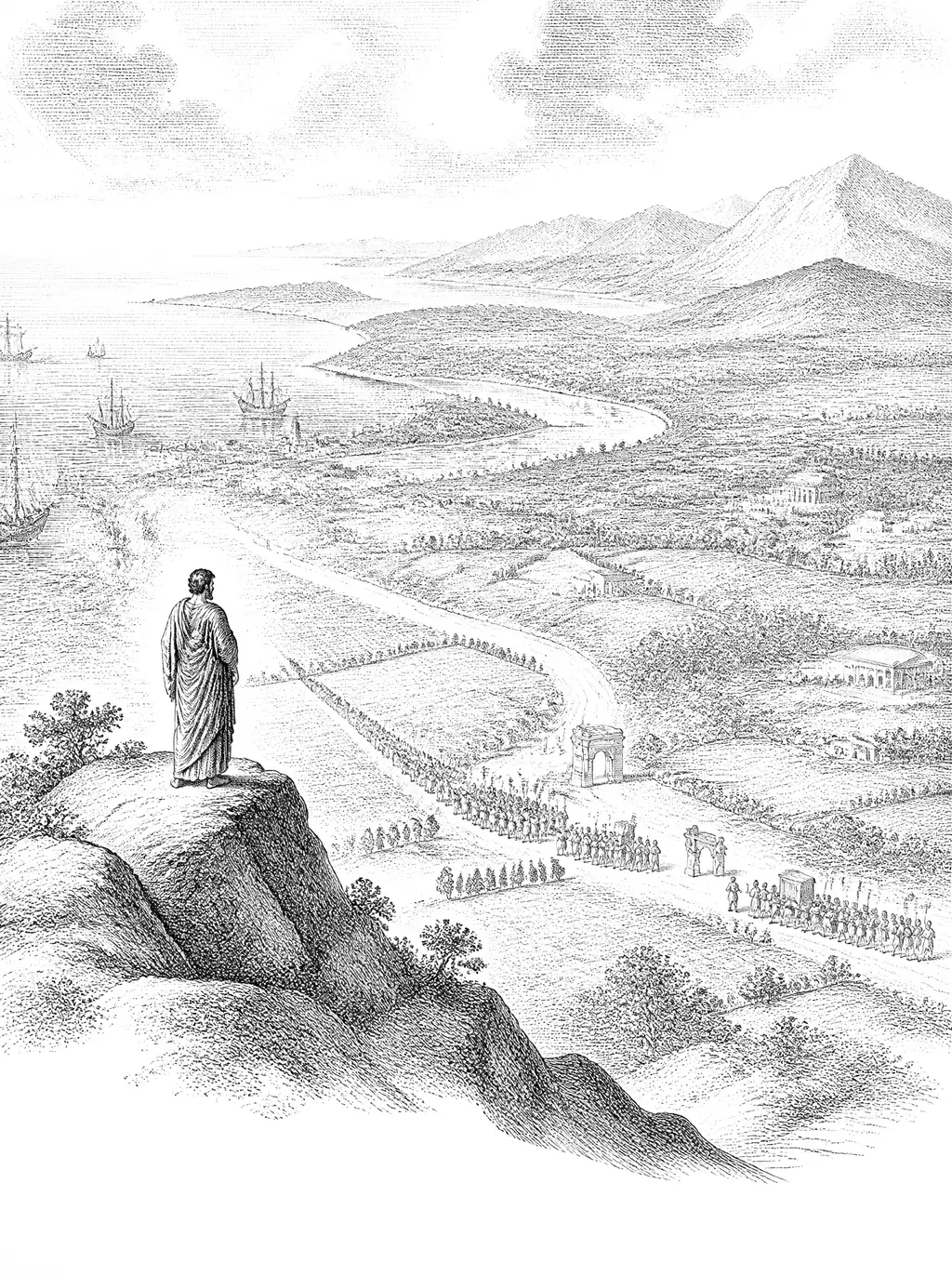
The View from Above
A speck called Rome
Picture your whole life lifted up and set down beside every other life happening on earth at the same moment: strangers marrying, burying parents, haggling in markets, sailing through storms, none of them aware of you at all. Marcus Aurelius used this picture on purpose, whenever his own troubles started to feel like the center of the world. He was not the first to try it. He was the first emperor to write down what it did to him, and the notebook shows him climbing again and again.
The world it came from
The exercise was old when Marcus took it up. Cicero had given it to Rome two centuries earlier in the Dream of Scipio, where a general is lifted into the heavens and sees the empire he serves as a dot too small to be worth a war. Lucian, writing satire in Marcus's own lifetime, sent a philosopher to the moon in Icaromenippus to look down at the squabbling ants of mankind. The Stoics used the image seriously, as a way of seeing the cosmos as a whole and one's own affairs at their true size. Marcus needed it. He was writing from a war camp, running an empire by letter, and the view from the camp was that everything depended on him.
The idea
The view from above is a deliberate mental exercise: imagine looking down at human affairs from a great height, seeing the whole tangled crowd of them at once, their scale shrinking as your vantage rises. What looked enormous from inside your own situation looks ordinary, temporary, and shared by nearly everyone who has ever lived, once you see it from far enough away. The exercise has two motions. Rise, and watch your situation shrink to its true proportion. Then look across, and see the same situations repeated in a thousand other lives, most of them long finished. The first corrects size; the second corrects loneliness.
How the reasoning runs
The reasoning is about scale and repetition. First, the felt size of a problem is set by how much of your attention it fills, not by its actual place in the world. Second, attention narrows under stress, so the more afraid you are, the larger the problem looks, in a loop. Third, a deliberate widening of attention breaks the loop, and the widest available frame is the whole earth seen at once. Fourth, from that frame two facts appear that the narrow frame hid: your situation is small among all the situations, and it is common, since the same weddings, wars, and deaths have happened to everyone who ever lived. Neither fact makes your problem less real. Both make it less total, and total was what was hurting.
Seen in life
It is two in the morning and the argument you had with your sister has become the whole world. Every sentence you said is being replayed and every reply she gave is being reread for evidence. Try the climb. Rise above the flat: there is the street, where somebody else is also awake. Higher: the city, where tonight a thousand siblings have said something they regret. Higher: the whole spinning surface, wedding and burial and shipwreck all at once, most of it with no idea you exist. Now come down. The argument is still there. But it has stopped being the world, and a thing that is not the world can be fixed with a phone call in the morning.
Why it matters
Most anxiety depends on a narrowed frame: this deadline, this argument, this fear, blown up to fill your entire field of view. The view from above is a deliberate zoom-out, not to make the problem fake, but to put it back at its actual size next to everything else happening in the world at the very same hour. It is also one of the few Stoic exercises that works in seconds and needs no doctrine. You do not have to believe anything about providence or virtue to climb. You only need the height, and the honesty to look at what your problem actually is from up there.
“From some high place as it were to look down, and to behold here flocks, and there sacrifices, without number; and all kind of navigation; some in a rough and stormy sea, and some in a calm.”
From the source
In Book IX of the Meditations, Marcus Aurelius practiced the exercise directly: “From some high place as it were to look down, and to behold here flocks, and there sacrifices, without number; and all kind of navigation; some in a rough and stormy sea, and some in a calm.” He returns to the height repeatedly. In Book VIII he tells himself to look at the courts of Augustus, Hadrian, and Antoninus and see where all those people are now: the same place as everyone else. In Book XII he imagines himself lifted up to survey the endless variety of human affairs, and asks how any of it can be worth vanity. The climb was a habit, not a moment.
The pushback
Doesn't shrinking your problems to specks risk shrinking your reasons to care about anything at all, including other people's suffering? Marcus Aurelius did not use the view from above to excuse indifference; he used it, then came back down and ruled, fought, and grieved anyway. The exercise resizes a problem's weight on you. It does not erase the problem. There is a colder objection too. Seen from far enough away, nothing is worth doing, including the war and the court cases Marcus went back to. The exercise may resize your worries, but it seems to resize your purposes along with them, and nobody governs from the moon.
The reply
Marcus's practice is the first reply: he climbed, and then came down and governed, so the exercise did not empty his purposes. The text supplies a second. He never used the height to say that human affairs were nothing; he used it to say they were small and shared, which is a different claim, and one that leaves justice and duty exactly where they were. The colder objection still has a point. A person who takes the view from above as a settled position, rather than a brief exercise, does risk a kind of cosmic shrug. The tradition's honest answer is that the view is medicine, taken in doses. Live at that altitude and you will stop caring; visit it and you will care at the right size.
Where it went next
The exercise got its modern name from the French scholar Pierre Hadot, who described it in the 1980s as one of the central spiritual exercises of ancient philosophy. The twentieth century then made it literal. Apollo 8's photograph of the earth rising over the moon in December 1968 did to a whole planet what Marcus had done to himself. Astronauts reported the same shift, and in 1987 Frank White named it the overview effect. Carl Sagan gave it its best modern text in 1994, looking at a photograph of the earth from six billion kilometres away and calling it a pale blue dot on which everyone who ever lived had lived. He was quoting nobody. He was writing Book IX again.
Where this leads
Plato's cave asks a related question about scale and perspective: what you take to be the whole world may only be the shadow cast by a much larger one, and the same climb that shrinks your worries can also show you causes you never examined directly. The inner citadel is the same move in the opposite direction. Instead of rising above the crowd to see it small, you retreat inside yourself to find the part of you the crowd does not reach. Marcus used both, often on the same night, and the notebook does not say which one worked better. Probably it depended on the night.